


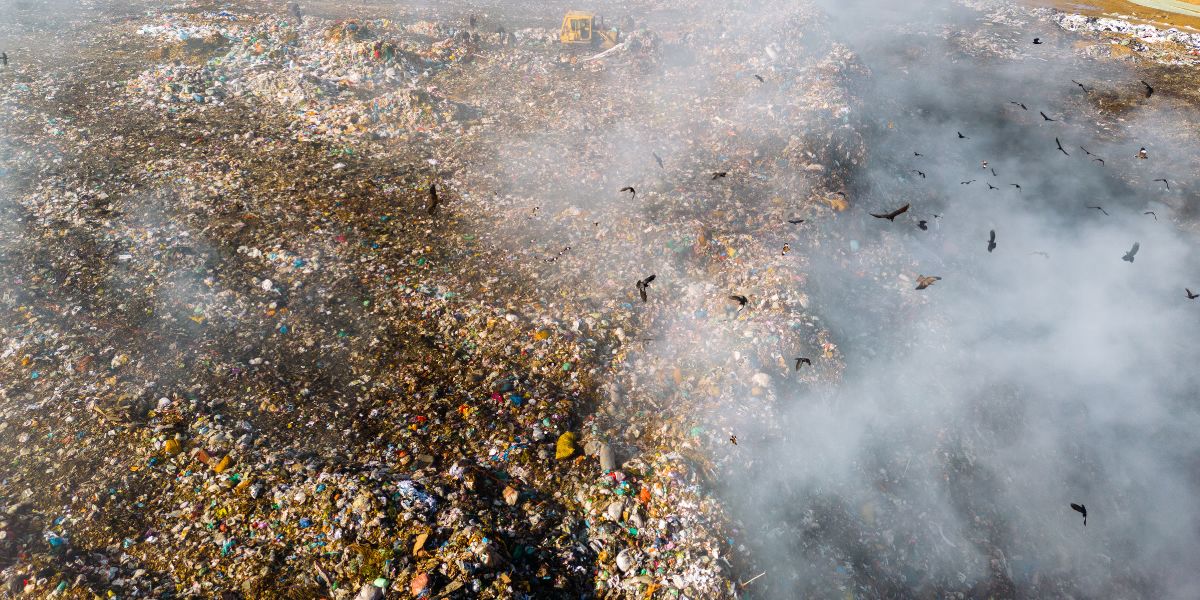
On November 16th, 2026, the Chiquita Canyon Landfill erupted with a massive geyser of rotting trash sending noxious odors affecting residents throughout the Southern California community. Initial investigations report that workers were drilling into the landfill when they hit a pressurized pocket of methane, causing thick black smoke to erupt into the sky. While this was not classified as a fire, the incident was serious enough for the Los Angeles County Department of Public Health to order the owners of the landfill to provide immediate temporary hotel stays, transportation assistance, and air filters to affected residents. Here’s what you need to know about protecting your family throughout this chemical geyser and the next one to come in your local community.
What Happened at the Chiquita Canyon Landfill? Why Has Chiquita Canyon Landfill Been a Problem Before? Are Toxic Fumes from a Chemical Landfill Leak Dangerous? How to Shelter in Place During a Chemical Spill Respiratory Protection for Your Whole Family Plan Ahead with the Industrial Simulator Frequently Asked QuestionsTable of Contents
Key Takeaways
-
The Department of Toxic Substances Control has reported several years of warnings, noncompliance findings, and violations of handling hazardous waste to the Chiquita Canyon Landfill.
-
While drilling through the landfill on November 16th, workers hit a pocket of pressurized methane sending toxic chemicals into the air.
-
The plume of smoke was visible for miles and rose approximately 500 ft into the air accompanied with noxious odors.
-
By 11 p.m. that evening crews had finally capped the geyser and remained behind to monitor the air quality.
What Happened at the Chiquita Canyon Landfill?

Image source: Envato
On November 16th, workers drilling into the Chiquita Canyon Landfill hit a pressurized pocket of underground gas, sending a plume of smoke and noxious odors over nearby neighborhoods. According to the EPA, the Chiquita Canyon Landfill had been experiencing what is known as a Subsurface Elevated Temperature event that has been growing since 2022. Without getting too far down into the weeds of the science, this resulted from garbage buried deep beneath the mountain of trash decomposing. As it does, it releases gases with nowhere to go. Chemical reactions cause temperatures to rise underground and the Chiquita Canyon Landfill reported temperatures in excess of the boiling point of water around 260 degrees Fahrenheit.
On November 16th, as workers drilled down into the Castaic landfill, they hit a pocket of these gases which caused an enormous chemical release into the skies above. Workers were treated by local hazmat teams and word began to spread in the media about the Los Angeles chemical spill. Nearby residents began reporting noxious odors and public health officials began to order residents to remain indoors and seal up their homes. While the event was short lived lasting only a single day, the threat of such future events remains present.
Why Has Chiquita Canyon Landfill Been a Problem Before?
Unfortunately, there is a well documented history of noncompliance and safety violations at the Chiquita Canyon Landfill dating back several years. While the landfill had been in operation for over 50 years, the past several years of citations should have given both government officials and residents a warning that a problem was brewing underground.
While government agencies issued their citations, it is not clear what information was made available to nearby residents or how likely it was that residents would remain up to date on safety issues within their local landfill. In October of 2026, the Department of Toxic Substances Control filed a lawsuit against the owner of the landfill for failing to comply with California Hazardous Waste Control Law. The Chiquita Canyon Landfill lawsuit came just weeks before the landfill gas would explode into the sky and local residents would then become acutely aware of the problem.
Are Toxic Fumes from a Chemical Landfill Leak Dangerous?
Anytime one is throwing around the words toxic fumes and chemical exposure, the danger is assumed to be inherent. When in doubt, these are two elements to avoid at all costs. There are approximately 2,600 municipal solid waste landfills in the United States, and while safety incidents do happen, they are not a daily occurrence. However, when toxic fumes are released in methane gas explosions similar to that at the Castaic landfill, danger from toxic fume inhalation does exist.

Image source: Envato
The CDC documents the following potential explosion hazards from common landfill gas components:
|
Landfill Gas Component |
Explosion Hazard |
|---|---|
|
Methane |
Methane is highly explosive when mixed with air at a volume between its LEL of 5% and its UEL of 15%. At concentrations below 5% and above 15%, methane is not explosive. At some landfills, methane can be produced at sufficient quantities to collect in the landfill or nearby structures at explosive levels. |
|
Carbon dioxide |
Carbon dioxide is not flammable or explosive. |
|
Nitrogen dioxide |
Nitrogen dioxide is not flammable or explosive. |
|
Oxygen |
Oxygen is not flammable, but is necessary to support explosions. |
|
Ammonia |
Ammonia is flammable. Its LEL is 15% and its UEL is 28%. However, ammonia is unlikely to collect at a concentration high enough to pose an explosion hazard. |
|
NMOCs |
Potential explosion hazards vary by chemical. For example, the LEL of benzene is 1.2% and its UEL is 7.8%. However, benzene and other NMOCs alone are unlikely to collect at concentrations high enough to pose explosion hazards. |
|
Hydrogen sulfide |
Hydrogen sulfide is flammable. Its LEL is 4% and its UEL is 44%. However, in most landfills, hydrogen sulfide is unlikely to collect at a concentration high enough to pose an explosion hazard. |
How to Shelter in Place During a Chemical Spill
To shelter in place during a chemical spill, get everyone indoors, seal the home off from outside air, and monitor emergency updates until officials give the all clear. With over 2,600 landfills throughout the United States, let’s now get to the practical part about how you protect your family. The call to shelter in place is most often the initial response in any chemical spill scenario. During the first few minutes of such an incident, it may not even be apparent what types of toxic gases are in the air. When in doubt, stay put and reference the following guidelines on how to shelter in place.
Shelter-in-Place Checklist
-
Bring all humans and pets inside the residence immediately.
-
Close all windows and doors.
-
Immediately turn off the HVAC system which brings outside air into the house.
-
Seal all gaps in windows, doors and vents with whatever materials available. Useful items are duct tape, plastic sheeting, wet towels, and improvised materials like aluminum foil, wax paper, or trash bags in a pinch.
-
Choose an inside room of the house and monitor emergency updates.
-
Prepare for the worst by having respiratory protection on hand and at the ready.
Respiratory Protection for Your Whole Family

Image source: MIRA Safety®
Every member of your family, including children, needs a properly fitted gas mask and enough filters to get through a prolonged chemical incident. In the Marine Corps, our platoon motto in Iraq was “expect no mercy from your enemies and no help from your friends.” While we knew that wasn’t altogether true as we could rely on other Marine units, it was a helpful mindset to carry into combat. As such, you are responsible for the safety of your family during hazardous events. While there are a great many agencies that may be able to respond, your best bet is to assume no one is coming. In a chemical incident, this means having respiratory protection on hand for the entire family. That’s gas masks for adults, gas masks for kids, and enough gas mask filters to survive a prolonged event. Here are a few recommendations.
Adult Protection: CM-6M Gas Mask

Image source: MIRA Safety®
The CM-6M Gas Mask is trusted worldwide by law enforcement and government agencies. It’s what the professionals use to face such threats and, when in doubt, do what the pros are doing. It’s our best selling gas mask for that very reason and it will show up for your family when you need it most.
Protecting the Children: MIRA Kids Gas Masks

Image source: MIRA Safety®
We didn’t originally offer gas masks for kids, but when we realized we were setting parents up to watch their children suffer from the safety of their own CBRN mask, we immediately shifted gears. Children’s gas masks will always be a part of our line because we believe in protection for the entire family. Don’t forget the little ones in your preparation for the worst events imaginable.
Choosing the Right Filter: VK-530 and DOTpro 330
Both are great gas mask filters, but each leans into one space of threats more than the other. The VK-530 is a dual filter designed to protect against toxic chemical threats and convert carbon monoxide into carbon dioxide giving you better protection during smoke and wildfire events. The DotPRO 330 is a combined filter designed to protect against toxic chemical threats, but also is designed to combat biological, viral and mold threats. For a breakdown on how long gas mask filters last, check out our most recent guide.
Plan Ahead with the Industrial Simulator

Preparation is the key to surviving any industrial accident and the toxic gas leak at the Chiquita Canyon Landfill may just be the shot across the bow that wakes people up to the threat. If you are curious about your neighborhood and what a toxic industrial accident would look like for your family, we’ve put together a unique industrial simulator that will help you identify the threats and address them accordingly.
Frequently Asked Questions
Sources
About the author

Leave a comment