


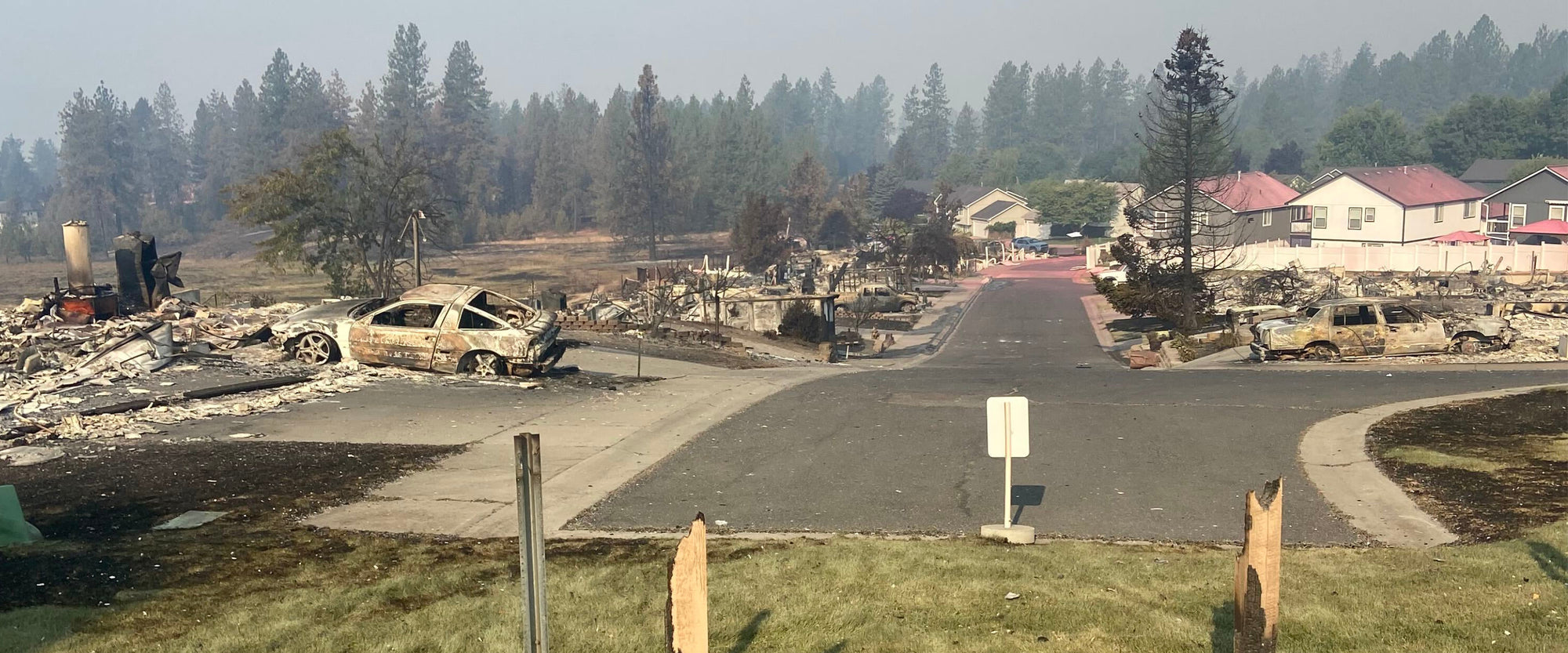
As the first signs of smoke began to rise from the West Plains area of Spokane, this fire seemed like those that had come before it. Given its close proximity to heavily populated areas, the fire crews were quick to respond and suppress the threat. However, today was different and as a writer here at MIRA Safety where preparedness is the core subject, I was about to witness whether I would practice what I preach.
How Fast Wildfires Can Spread: Lessons From the First Hour Why You Should Evacuate Before an Official Wildfire Order Wildfire Evacuation Planning: Know Your Routes Before You Need Them What We Found When We Returned Home After the Spokane Fire Key Takeaways for Your Own Family Wildfire PlanTable of Contents
In less than 24 hours, Spokane would witness the most devastating fire event in Washington State history with over 700 buildings destroyed, and over 60,000 people under Level 3 “Go Now” evacuations. As often as I write here at MIRA Safety, I must confess that many of the survival scenarios are drawn from research rather than firsthand experience. I’ve never been the subject of a nuclear explosion or EMP, but there is enough data present to develop a logical plan. In this case, it was my family in the direct line of fire and what I did in the first hour made all the difference.
My hope is that you take my experience and develop a plan to secure the safety of your own family when it matters most.
How Fast Wildfires Can Spread: Lessons From the First Hour
For my family, the day of the fire started like any average Saturday. The first order of the day was coffee, and then a few errands before my family of five planned to see a movie that afternoon. We were set to head off to the movies at 1p.m, but at about 12:30 p.m. we got the first warnings of a small brush fire in the West Plains area of Spokane. Given that the Indian Trails neighborhood of Spokane sits on a bluff, I had a pretty good view of the smoke billowing up from a couple of miles away.
Fires in this area of Spokane are not that uncommon, and plans to head to the movie theater proceeded. By 12:45, the fire had gone from 3 acres to 50 acres, and would quickly expand to 300 acres in short order. I knew this because I had downloaded the Watch Duty app, which is a 501(c)(3) nonprofit designed to warn the public about emerging wildfires. I cannot emphasize the utility of this app enough, and if you live in any area predisposed to wildfires, it is a must-have.
With wind advisories in excess of 50 mph, I began to discuss with my family whether the movie was the best option. The entire family was excited about the movie, but we had pets to consider as well. I made the decision that they should go see the movie and I would remain at home. This might sound like I was playing the martyr to miss the movie when, in reality, it was a strategic decision. Understanding the potential of the still ambiguous threat, I was removing what mattered most to me from the danger zone. 
It is not always clear when a wildfire will roll through your neighborhood with impunity. It is not always obvious that the initial blackout will last weeks and not hours. During the early hours of ambiguity, this is your opportunity to begin playing out the possibilities.
While most are assuming the best, your mind is rolling through the worst scenarios. By the time my family left for the movie, the cloud of smoke emerging from the West Plains became more ominous, and that’s when I put what I had been writing to others into personal practice.
Why You Should Evacuate Before an Official Wildfire Order
One thing you need to know about the Indian Trail area of Spokane is that there are only three routes out of the larger neighborhood. Considering that there are over 14,000 people living in this area, I quickly deduced that, if I waited until we got the official order to leave, it would be too late. The moment my family left, I started loading the car and securing the pets. It might have seemed early, but the worst outcome of overreacting was simply unpacking later. If I’d been even a little slower, though, the consequences could have been far worse as smoke began filling the sky.

Despite the fact that the fire still had to climb over a bluff and jump the Spokane River, I decided now was the time to leave. With my pets being the last addition to the car, I headed out of the neighborhood over the 5-mile Prairie neighborhood to the east. As I drove up the steep grade, I noticed people were parking their cars and taking pictures from the vantage point of the prairie. The pictures were no doubt fantastic, but my heart sank as I considered the possibility of what this fire could do. Within ten minutes, I was out of the neighborhood and danger zone. If you haven't already, take the time now to build a family evacuation plan so you're not making these decisions under pressure when smoke is already on the horizon.

It was approximately 20 to 30 minutes later that the fire had jumped the Spokane River and the entire Indian Trail neighborhood was under a Level 3 “Go Now” evacuation. There was no Level 2 “Get Ready” or Level 2 “Get Set” as it jumped straight to the worst case scenario. It was at that point that 14,000 residents decided to hit the road at the exact same time. It went as well as one might expect.
Gridlocked gripped the neighborhood, and what took me 10 minutes to traverse, took friends of mine anywhere between 2 to 4 hours to exit the neighborhood, all as the smoke and fire rolled in. Making matters worse, the 5-mile Prairie neighborhood was added to the evacuation, which added another 5,000 residents and eliminated one of the evacuation routes from Indian Trail.
It broke my heart to watch people I care about make frantic posts about the survival of their family as the threat encroached upon them. By the grace of God, no one was hurt or killed. Many had to drive down Indian Trail with fire on both sides of the road, but they made it. Within hours, some 60,000 people were given the notice to evacuate.

Wildfire Evacuation Planning: Know Your Routes Before You Need Them
The purpose of sharing this story is to serve as a first hand debriefing that you can use to assess your own unique situation. I had long known that the Indian Trail neighborhood had three vital chokepoints that would bring traffic to a halt in a mass evacuation scenario. I knew that leaving early was the only plausible scenario. Those stuck in the gridlock report drivers pulling up on curbs and making erratic decisions as the smoke and fire closed in. I can’t say that I blame those people when they feel like the survival of their family is on the line, but that is not the scenario in which you hope to find your family.
My decision to leave early could have seemed silly to many, and perhaps mocked if the fire turned out to be nothing. However, I’ve been a fool for lesser things than the survival of my family. I would encourage everyone to understand that you don’t have to make a big deal about the matter when you take early action. We learn in the Marine Corps that a good decision or bad decision doesn’t really matter, what matters is that you make one.
In such a scenario, take your family on a drive or out to eat in another part of town. If all is well, return to safety. If all is not well, you may very well have made the one decision that means the difference between life and death for your family. I also carried MIRA Safety respirators with me if needed, but the real win was exiting the danger zone before I needed them.
What We Found When We Returned Home After the Spokane Fire
My heart is broken for the friends and loved ones who lost their homes in the fires, as some 700 structures were destroyed. As for my home, I was blessed to discover that it was standing the next morning. Unfortunately, my two immediate neighbors across the street were not so fortunate. Though, my house is now pink from the air dropped flame retardant which is a reminder of how close this average Saturday afternoon came to altering the course of my family.

Despite leaving early, my family still did not have much with us, as we stayed with family around 20 miles to the east. With fires still breaking out, the Indian Trail neighborhood was blocked off by both the local police and the National Guard. While they were not admitting vehicles, they were allowing limited foot traffic if we were willing to accept the risk. After 6 years in the Marine Corps and a tour in Iraq, the risk was acceptable to me.
As I entered the evacuation zone a couple of days later to retrieve items for my family, I didn’t know how much that experience in Iraq would relate. The scenes I saw in my neighborhood as I walked throughout resembled bombed out scenes I witnessed in Iraq. The devastation was unimaginable and the smell reminiscent of a war zone. For these families, the Spokane Wildfire was indeed the day they dreaded most.
The pink hue of flame retardant littered throughout various streets indicating the valiant fight that first responders put up to protect what homes could be saved. There is not enough to say about those who went 24 and 36 hours without sleep to save the residences of strangers. Children will grow up in homes because they put it all on the line. Thank you to the first responders of the Spokane Wildfire who, at this moment, are still carrying on the fight.

Key Takeaways for Your Own Family Wildfire Plan
I’ll credit my time in the Marine Corps, as well as my writing here at MIRA, which put me in the mindset of preparedness long before the Spokane fire. I’m not the ultimate tactical guru or a prepper who deserves my own YouTube channel. I’m just a dad trying to look after his family. On Saturday, August 1st, 2026, that meant leaving the neighborhood early while most were taking pictures. I wish in my heart I could have found a way to reach all those who would later spend hours in gridlocked traffic amongst fire and smoke. My only penance is that I can try and reach you.
Preparedness is for every family and, while it may take on many forms and degrees of intensity, it is your responsibility to look after the well being of your family. I would have been happy to have lived my entire life without this particular experience, but, since that was not in the cards, I can at least put it to good use for you. The team here at MIRA truly cares about the safety of your family, and it is why Roman founder MIRA Safety many years back. This experience is raw and personal to me, but it is yours to use any which way you like to prepare your family for such a day.
Frequently Asked Questions
About the author

Leave a comment