


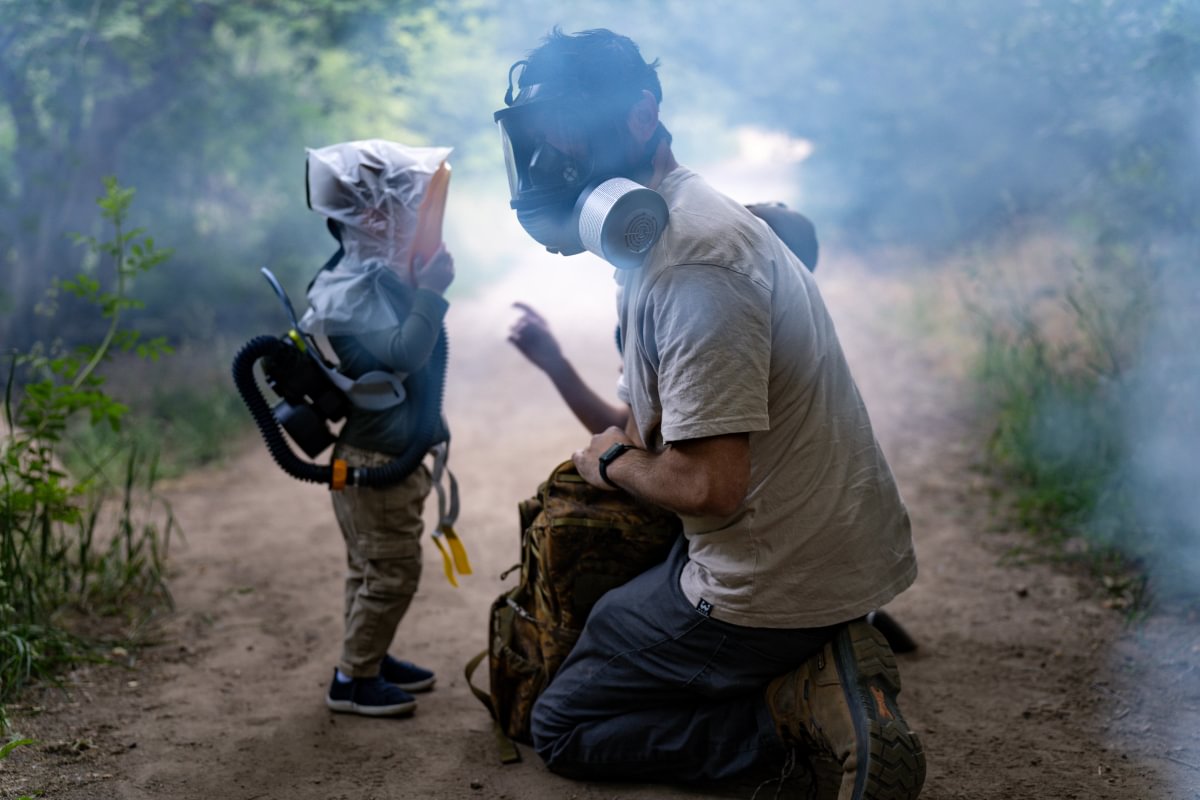
Right now, smoke from Canadian wildfires is drifting across the northern United States again. If you live in Minnesota, Michigan, Wisconsin, upstate New York, or New England, you've probably already seen it — that flat orange light in the afternoon, the smell that reaches you before the news alert does, the air quality app turning colors it usually doesn't turn.
This is the fourth consecutive summer this has happened. It is no longer a freak event. It's a season.
And every season, the same advice circulates: stay indoors, run an air purifier, wear an N95 if you have to go out. Two of those three are good advice. The third one is half-right in a way that matters, because an N95 solves part of the wildfire smoke problem — and quietly ignores the rest of it.
We're going to explain what's actually in wildfire smoke, why the standard advice falls short, and exactly which mask and filter combination handles it properly — including what we'd recommend from our own lineup and, just as honestly, when a $5 N95 is genuinely all you need. By the end you'll know precisely what to buy for your situation, whether that's a two-day smoke event or a family member with asthma who needs real protection every summer from now on.
Short version: for brief, light exposure an N95 handles the particulate. For anyone with respiratory conditions, extended outdoor exposure, or hazardous AQI days, you want a true respirator with a particulate + gas filter — our recommendation is the CM-i01 with the VK-530 filter, and we'll explain exactly why below.
What's Actually in Wildfire Smoke How Smoke Exposure Affects Your Health Why an N95 Is Only Half the Solution Best Masks & Respirators for Wildfire Smoke CM-i01 + VK-530: Best Overall for Smoke Season CM-6M + VK-530: One Mask for Every Emergency When to Choose the VK-700 Filter How to Use a Respirator During Wildfire Smoke Frequently Asked Questions Final ThoughtsTable of Contents
What's Actually in Wildfire Smoke
Wildfire smoke is usually discussed as if it were one substance. It's two distinct problems traveling together.

Image source: Envato
The first problem is PM2.5 — fine particulate matter smaller than 2.5 microns. These particles are small enough to pass through your airway's natural defenses, deposit deep in lung tissue, and cross into the bloodstream. PM2.5 is what the AQI number on your weather app is mostly measuring, it's what makes the sky orange, and it's the component an N95 is genuinely good at stopping.
The second problem is the one nobody's app measures: the gas phase. Burning forests — and increasingly, burning structures, vehicles, and everything else in a fire's path — release carbon monoxide, formaldehyde, acrolein, benzene, and a long list of other volatile organic compounds. These are gases, not particles. They pass through an N95's filter media as if it weren't there, because an N95 was never designed to stop them.
This is why people wearing N95s on heavy smoke days still report headaches, throat irritation, and that chemical taste at the back of the mouth. The particulate is being caught. The gases are not.
Explore Wildfire Spread and Risk Near You
Wildfire smoke can travel far beyond the fire itself, but local terrain, vegetation, weather, and wind all influence how a fire may spread. Use the interactive MIRA Safety Wildfire Spread & Risk Simulator below to explore an educational scenario for a supported location in the United States.
Search for a location or select a point on the map, adjust wind speed, wind direction, and fuel moisture, then select “Simulate Wildfire.” You can move through the available time horizons and turn on contextual layers for simulated smoke, fire history, wildfire risk, active fires, and air quality.
This simulator provides simplified educational scenarios, not a real-time fire, smoke, air-quality, evacuation, or emergency forecast. Never use it to decide whether a location is safe. Follow official alerts, evacuation orders, air-quality guidance, and instructions from local authorities. If the interactive map does not load, open the MIRA Safety Wildfire Simulator in a new tab.
How Smoke Exposure Actually Affects You

Image source: Envato
Short-term exposure to wildfire smoke produces symptoms most people now know from experience: stinging eyes, scratchy throat, coughing, headache, and fatigue. For most healthy adults, a day or two of light exposure resolves on its own.
The concern is sustained or repeated exposure — and vulnerable groups. PM2.5 exposure is linked to worsened asthma and COPD, elevated cardiovascular event risk, and reduced lung function, with children, older adults, pregnant women, and anyone with existing heart or lung conditions carrying substantially higher risk. If someone in your household is in one of those groups and your region now gets smoke every summer, respiratory protection stops being an emergency purchase and becomes a piece of seasonal equipment, like a snow shovel.
If you're experiencing chest pain, severe shortness of breath, confusion, or symptoms that worsen after exposure ends, that's beyond self-care — seek medical attention. This guide covers protection, not treatment.
Why an N95 Is Half a Solution

Image source: Envato
Let's be fair to the N95 first: it's cheap, it's available everywhere, and it filters at least 95% of particulate — including PM2.5 — when it fits properly. For a healthy adult running errands on a moderate smoke day, an N95 is a reasonable tool, and we'd rather you wear one than nothing.
Here's what it doesn't do:
- It does not filter gases or VOCs — carbon monoxide, formaldehyde, benzene, and acrolein pass straight through
- It does not protect your eyes — which is where a lot of the stinging and irritation happens
- It rarely seals properly — most people wear N95s with visible gaps, and any facial hair breaks the seal entirely
- It's disposable — in a multi-week smoke season, the per-day cost quietly adds up while performance degrades with each wear
A true respirator — half-face or full-face — with a combination particulate-and-gas filter addresses all four. That's the category the rest of this guide covers.
The test is simple: if you can smell smoke through your mask, gases are reaching your lungs. Smell is the gas phase announcing itself. A properly sealed respirator with an activated-carbon gas filter takes the smell — and what causes it — out of the air you're breathing.
Our Recommendations, by Situation
Best Overall for Wildfire Smoke: CM-i01 + VK-530 Filter

Image source: MIRA Safety®
The CM-i01 CBRN Industrial Gas Mask is the mask we recommend first for smoke season, and the reasoning is practical: it's a full-face design, so it protects your eyes as well as your lungs — which matters more with smoke than with almost any other threat, because eye irritation is usually the first symptom people notice. It's lighter and simpler than a tactical mask, it's comfortable for extended wear, and it uses standard 40mm threading so filters are easy to source and swap.

Image source: MIRA Safety®
Pair it with the VK-530 filter — a combined smoke and CBRN filter with both a P3-grade particulate stage (a higher filtration class than N95) and activated carbon media for the gas phase. That combination handles both halves of the wildfire smoke problem: PM2.5 and the VOC gases an N95 ignores. This exact pairing is what we'd put on a family member with asthma in Minneapolis right now.
Best If You Already Own a MIRA Mask — or Want One System for Every Threat: CM-6M + VK-530

Image source: MIRA Safety®
The CM-6M Tactical Gas Mask is our most popular full-face mask for general preparedness — if you already own one for CBRN readiness, you do not need to buy a second mask for smoke season. Thread a VK-530 onto it and you're fully covered. If you're starting from zero and want one mask that handles wildfire smoke this month and everything else a preparedness plan covers — chemical incidents, civil unrest, radiological events — the CM-6M is the buy-once answer. Panoramic visor, bromobutyl rubber construction, used by military and police units in over 50 countries.
For Extended Wear and Maximum Airflow: Add the VK-700

Image source: MIRA Safety®
The VK-700 is the higher-capacity version of the same combined smoke/CBRN filter concept — more filtration media, longer service life, and easier breathing resistance over long wear sessions. If your smoke exposure is occupational or extended — outdoor workers, long commutes on foot, multi-hour exposure days — the VK-700's larger capacity earns its price. For occasional bad-air days, the VK-530 is the better value.
| Setup | Protects Against | Best For | Notes |
|---|---|---|---|
| N95 (baseline) | PM2.5 particulate only | Healthy adults, brief moderate exposure | No gas/VOC protection, no eye protection, seal issues |
| CM-i01 + VK-530 | PM2.5 (P3-grade) + smoke gases/VOCs + eye protection | Best overall for smoke season; sensitive groups | Our top wildfire recommendation |
| CM-6M + VK-530 | Same as above + full CBRN capability | One-mask preparedness system | Buy once, covers every scenario |
| Either mask + VK-700 | Same, higher capacity | Extended / occupational exposure | Longer service life, easier breathing |
How to Use a Respirator Correctly During Smoke Season
- Check the seal every time — cover the filter with your palm, inhale, and confirm the mask pulls toward your face with no air leaking at the edges
- Facial hair breaks the seal — on any respirator, from any manufacturer; this is physics, not brand policy
- Store filters sealed until needed — an opened carbon filter starts adsorbing ambient VOCs immediately, spending its capacity on your garage instead of the smoke event
- Swap the filter when smell returns — breakthrough smell is the service-life indicator for the gas stage; for typical smoke-season use, a VK-530 handles multiple exposure days before replacement
- Don't rely on any mask indoors as your primary plan — keep windows closed, run HEPA filtration if you have it, and use the respirator for the time you must spend outside
The Bottom Line
Wildfire smoke reaching the northern US isn't an anomaly anymore — it's a recurring season, and the standard N95 advice covers exactly half of what's in that smoke. For brief exposure, fine. For anyone with lungs that already complain, for extended exposure, or for anyone tired of tasting a forest fire from 800 miles away, a full-face respirator with a combined particulate-and-carbon filter is the correct tool: the CM-i01 with a VK-530 if smoke is your primary concern, the CM-6M if you want one mask that covers everything, and the VK-700 when wear time is measured in hours instead of minutes.
Get it before the next smoke wave, not during — shipping is faster than wind, but not by much. Keep your family breathing easy. That's the whole job.
Frequently Asked Questions
About the author

Leave a comment