


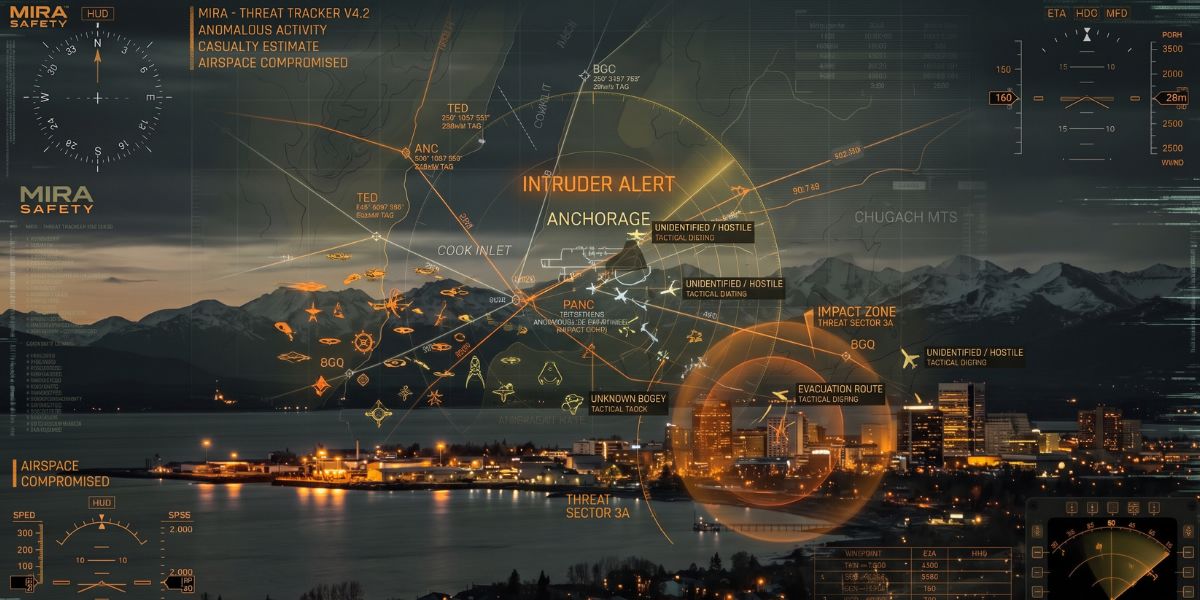
On June 15th, 2026, an Anchorage resident was photographing a rainbow when she observed an object that can only be described as a jellyfish UFO. While that report could easily fall into one of the many unverified UFO encounters, she brought the photographic and video evidence to the table. By November, the three-minute Alaska UFO clip had become one of the most-shared UFO sightings of 2026.
The video shows a dark, jellyfish-shaped object hovering in the direction of Joint Base Elmendorf-Richardson, which fits a pattern of Unidentified Anomalous Phenomenon (UAP) being spotted near military installations. Further lending credibility to the sighting is the fact that a downed U.S. pilot flying missions over Iran in June reported a similar scene of Iranian drones moving in one formation in a pattern that resembled a jellyfish.
While it is not evident that the jellyfish UFO is extraterrestrial in nature or the prelude to an alien invasion, it is remarkable that a private civilian and a trained U.S. fighter pilot reported similar observations in the same month some 5,000 miles apart. No agency has identified the jellyfish UFO and a more obvious answer of a kite, balloon, drone or camera artifact have not been ruled out at this time.
In the absence of a definitive answer, we’re left to ask what we would do if an unidentified object turned into a real threat. How would we respond if the skies suddenly became a hostile zone and, in a worst case scenario, the alien invasion actually begins on the ground? Running any survival scenario through your mind can always lead to better preparation for a variety of threats. We’re going to give you some resources and tools to run this scenario through to fruition and trust you to make the decisions that are best for your family.
What Happened During the Alaska Jellyfish UFO Sighting? Is the Jellyfish UFO an Alien Invasion? What the Evidence Says Why UFO Sightings Near Alaska's Military Bases Get Attention Could an Alien Attack Start as an Atmospheric Threat? Explore an Alien Invasion Scenario With MIRA's Alien Invasion Simulator How to Report a UFO Sighting Recommended Gear for Airborne Threats Frequently Asked QuestionsTable of Contents
Key takeaways
-
The Anchorage object was black and silver, had appendages that appeared to move on their own, and was visible for about three minutes.
-
No military, FAA or AARO response has been publicly reported, and no evidence ties it to aliens or classified technology.
-
Unidentified objects near Alaska's military bases aren't new. In February 2023, an F-22 shot down an unidentified object off Alaska's northern coast.
-
In almost any real aerial emergency, the first hazard to reach civilians is the air itself: smoke, dust, chemicals or radioactive particles.
-
MIRA Safety's free Alien Invasion Simulator lets you map airports, hospitals, nuclear and naval facilities near you and score your own household's preparedness.
What Happened During the Alaska Jellyfish UFO Sighting?

Image source: Envato
The details of that particular evening are as follows. Sara Jane Osborn was photographing a rainbow near Sixth Avenue in Anchorage at about 10:13 p.m. when she noticed a dark shape above the distant trees. She first assumed it was an insect near her phone's lens and was startled to find out that her lens was free and clear.
She described the object as black and silver, with appendages that moved independently while it hovered and rotated from side to side which she described as "jellyfish-like." The encounter lasted approximately three minutes before the object abruptly disappeared, which was enough time for her to take photographic and video evidence.
Still believing that terrestrial explanation existed, she and her husband searched a nearby park for a drone operator, kite, balloon, or other explanation. They then drove toward Arctic Valley for 30 minutes and found no evidence that would bring any light to the observation. No other witnesses have come forward and while Osborn continues to accept that a drone explanation is possible, she couldn’t explain why the appendages failed to move together in the wind.
|
Detail |
What's been reported |
|---|---|
|
Location |
Near Sixth Avenue, Anchorage, Alaska |
|
Date and time |
June 15, about 10:13 p.m. |
|
Duration |
About three minutes |
|
Appearance |
Black and silver, jellyfish-like, independently moving appendages |
|
Direction |
Toward Joint Base Elmendorf-Richardson (JBER) |
|
Evidence |
Still photos and video from one witness |
|
Official response |
None publicly reported from NORAD, the Pentagon, the FAA or JBER |
|
Ruled out |
Nothing yet: kite, balloon, drone, aircraft and optical artifact are all still possible |
Is the Jellyfish UFO an Alien Invasion? What the Evidence Says

Image source: Envato
Unfortunately for those seeking a definitive answer, the word “unidentified” continues to remain supreme in this conversation. Whether one uses the phrase UFO or UAP to describe the jellyfish object, it remains in all global observations unidentified. The U.S. government now uses the term UAP, short for unidentified anomalous phenomena, instead of UFO. The difference between a UFO and a UAP is mostly scope: UAP covers objects in the air, in space and underwater.
The Pentagon's All-domain Anomaly Resolution Office (AARO) collects these reports and publishes annual findings for Congress. To date, AARO has said it has found no verifiable evidence of extraterrestrial activity, and most cases it resolves turn out to be balloons, birds, drones, aircraft or sensor artifacts.
However, through the release of these reports, this makes the Alaska jellyfish UFO at least the third such sighting. A similar UAP was reported over a U.S. base in Iraq in 2018 and most recently in Iran in 2026. Whatever is causing this phenomenon is repeatable, if not explainable.
Without knowing how far away an object is, a photo also can't tell you whether you're looking at a small drone a few hundred feet up or something much larger and farther away. To date, this summary is as much as we know about the incident.
Why UFO Sightings Near Alaska's Military Bases Get Attention

Image source: Envato
Alaska sits on the front line of North American air defense, so any unidentified object in its skies draws scrutiny. JBER is home to F-22 Raptors of the Air Force's 3rd Wing, which regularly intercept foreign aircraft approaching U.S. airspace. This raises the question that if the object was so easily observable with the naked eye and camera, why wouldn’t U.S forces detect the presence of the jellyfish-like object?
The U.S. has demonstrated the ability to detect such objects as evidenced by the shooting down of a Chinese surveillance balloon in 2023. A few days later, an F-22 shot down an unidentified high-altitude object off Alaska's northern coast. Another object was downed over Canada's Yukon the next day. Those incidents showed that unknown objects near sensitive sites are treated as a security issue first. Why this particular jellyfish UFO was not treated as such remains unknown.
Could an Alien Attack Start as an Atmospheric Threat?

Image source: MIRA Safety®
In the Marine Corps, we were taught to embrace the mantra that “when in doubt, do something.” Whether that is a good decision or bad decision really doesn’t matter, because no decision and you are dead. While that thought system is great for combat, it can be applied to our experiences with UAPs. We are indeed in doubt of what they are, but that doesn't absolve us from the obligation to do something.
In any real attack from the sky, alien or human, the threat most likely to reach civilians first is in the air you breathe. Fires, explosions and damaged infrastructure release smoke, fine dust and chemicals, and a strike on a nuclear or industrial site can spread radioactive or toxic particles far beyond the impact zone. In the case of an alien species, that could also present as biological threats due to their unique biological makeup. They are likely to have encountered bacteria and viruses that we have not.
That’s why when facing preparedness scenarios, terrestrial or other, we can start with airborne hazards. When in doubt, a gas mask with a CBRN-rated filter covers airborne threats known and unknown. The table below shows you how the most likely hazards reach you and what protects against them.
|
Airborne hazard |
How it reaches you |
What protects you |
|---|---|---|
|
Smoke and combustion gases |
Fires from impacts, downed aircraft or damaged infrastructure |
Gas mask with a filter rated for smoke and carbon monoxide; shelter indoors |
|
Fine dust and debris |
Explosions and collapsed structures |
Particulate (P3) protection, sealed windows, HVAC turned off |
|
Toxic industrial chemicals |
Damaged plants, tankers or pipelines |
CBRN filter, sealed room, distance from the release |
|
Radioactive particles (fallout) |
Strikes on or near nuclear facilities |
Shelter in a building core, CBRN filter, a dosimeter to track exposure |
|
Biological agents |
Deliberate release or damaged labs |
CBRN filter, protective suit, isolation and decontamination |
Your exposure depends on what's near you. Living downwind of an airport, a nuclear plant or a naval installation changes your risk in a serious emergency, which is exactly what MIRA's new simulator is built to show.
Explore an Alien Invasion Scenario With MIRA's Alien Invasion Simulator
MIRA Safety's free alien invasion simulator turns the "what if" behind stories like the Alaska jellyfish UFO into a practical map of your own area. It joins MIRA's free nuclear bomb simulator, Wildfire Simulator, Biological Infection Simulator and Industrial Disaster Simulator. We run simulations for the threats we know about, but it is the threats that we yet can’t imagine which make such simulations valuable. Regardless of how absurd a scenario may sound to you, the simulation of how to survive it is well worth the time. It’s war-gaming for the survival of your family.
The map has selectable layers you can turn on and off:
|
Map layer |
What you can explore |
|---|---|
|
Airports |
Public airport locations, airport categories and aviation information |
|
Hospitals |
Hospital locations, emergency departments and general preparedness resources |
|
Nuclear facilities |
Publicly documented commercial nuclear power plants and general safety information |
|
Naval facilities |
Publicly documented naval installations and historical information |
|
Communications |
General coverage regions, network types and communication dependencies |
|
Personal location |
Your city and a household preparedness assessment |
The scenario is fictional, but the map data and the household assessment are real. Seeing which hospitals, airports and power plants sit near your home is a fast way to work out how to survive an alien invasion, or a far more likely regional emergency, with the time and supplies you actually have.
This will also allow you to make redundancy plans if any of these key resources are unavailable. You likely won’t be the only person running to hospital if injured in an alien invasion. The FAA would likely order a full ground stop of all civilian aircraft, as we recently saw in November of 2026, if jellyfish UFOs filled the skies.
It is also helpful to identify if the community resource is an asset or a liability. Living next to one of the key U.S. nuclear bases such as Naval Base Kitsap-Bangor in Washington means you live near a likely target in any alien invasion. Have a plan to leave and leave early before a strike takes place. All of this information is meant to help you think through the possibilities in order to create a plan that is right for your family.
How to Report a UFO Sighting

Image source: Envato
It is highly likely that Osborn had no intention of documenting a UFO that evening in Alaska. Most people don’t have any idea what to do, but thankfully modern technology means humans turn to their phones to record the unexplainable. If you see something you can't explain, record as much detail as you can, then report it. Most sightings are explained once investigators have the time, direction and footage. Here are a few key points to consider:
-
Note the exact time, your location and the direction you were facing.
-
Record video with a fixed reference point, such as a building or tree line, in the frame.
-
Keep the original files so the metadata stays intact.
-
Write down the weather, wind and any aircraft or lights nearby.
-
Look for an ordinary source: kites, balloons, drones, satellites and aircraft lights.
-
If the object is near an airport or a military base, contact local law enforcement or the FAA. Civilian sightings are also commonly logged with the National UFO Reporting Center (NUFORC).
Recommended Gear for Airborne Threats
Below are a few product recommendations that help you survive airborne threats whether they are from your fellow humans and unexpected visitors from above.

Image source: MIRA Safety®
-
CM-6M Tactical Gas Mask: Full-face CBRN protection with a wide field of view and a drinking system for long shelter-in-place periods. Remember, it is possible that you may have to move to safety during a highly ambiguous scenario like an alien invasion. Your ability to breathe clean air while you are on the move is essential.

Image source: MIRA Safety®
-
NBC-77 SOF® Gas Mask Filter: 40mm CBRN filter for chemical, biological, radiological and nuclear particles. Remember, a filter once opened and put to work doesn’t last forever. See our guide on how long gas mask filters last to plan replacements.

Image source: MIRA Safety®
-
HAZ-SUIT®: Protective suit for scenarios with chemical or biological contamination on skin and clothing. In the case of an alien invasion, when in doubt, suit up. We couldn’t possibly conceive of every threat they could pose and protecting every part of your body is the prudent choice when available.

Image source: MIRA Safety®
-
Geiger-2 Dosimeter: Tracks radiation exposure if a nuclear facility near you is affected. Aliens during an invasion could possibly target our greatest power source and response weapon. If you live near one of these installations, you’ll have to know if it is safe to move during an attack.
-
EvakPak kits: Ready-made evacuation kits if staying put isn't an option. This is a full comprehensive kit designed to cover most bases and are great options for those who may not know exactly what they will need for the wide range of scenarios possible.
Browse all gas masks to compare options for adults and children.
Frequently Asked Questions
Sources
About the author

Leave a comment