


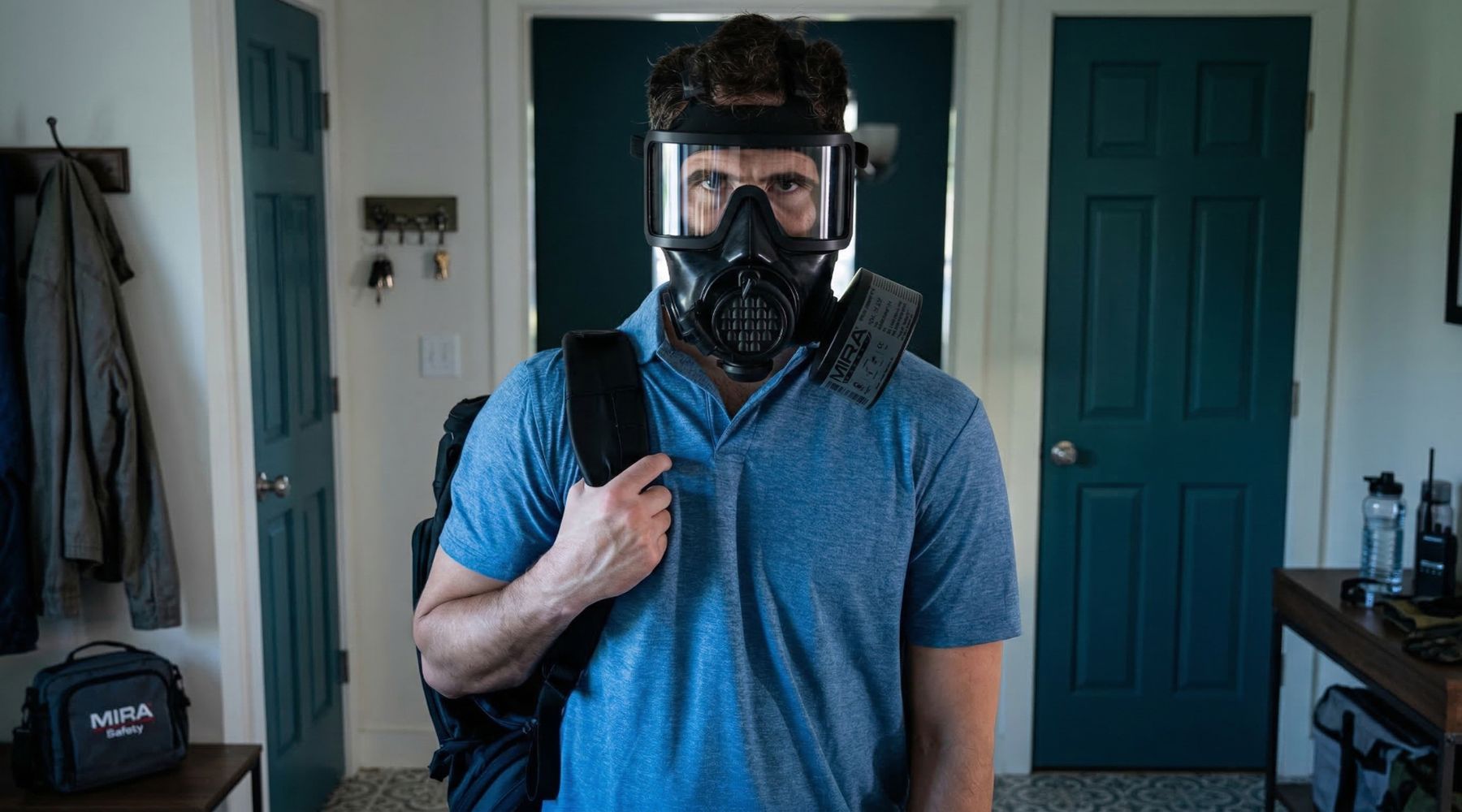
General (and later the 34th President of the United States) Dwight D. Eisenhower once said, “Plans are useless, yet planning is indispensable.” That quote encapsulates a paradoxical truth about not just wartime strategy, but also disaster preparedness. In all the chaos, unpredictability, and downright danger of an emergency situation, our preconceived ideas of what will happen or how we will respond seem quaint by comparison.

And yet, having an emergency kit combined with an evacuation plan dramatically improves our chances of survival when the unexpected occurs. A US Chamber of Commerce-led study found that, at the community level, every $1 spent on emergency preparedness saved $13 in overall damage and economic impact. Japan, a country that heavily invests in both national and individual preparedness strategies, routinely suffers fewer earthquake casualties per year than other regions that suffer earthquakes of similar strength.
Now that geopolitical events have once again put American citizens in the crosshairs of international terrorism, building an emergency kit is more important than ever. Europol is also sounding the alarm that the armed conflict with Iran and widespread instability across the Middle East, are elevating threat levels in Europe as well. Foreign near-peer competitors like Russia and China are also increasingly embracing the “hybrid warfare” model, using both covert and overt means to disrupt Western nations at all levels. For instance, Russian sabotage attacks against Europe quadrupled from 2022 to 2023, then tripled again into 2024. Kinetic vs Non-kinetic operations WMDs in 2026 Civilian readiness What gas mask to buy? How to choose a filter Accessories for complete protection You can prepare
Table of Contents
Kinetic vs Non-kinetic operations

This means that preparing for an attack against the US or American citizens is more complex than ever, and why staying informed is even more of an advantage. Terrorism, lone wolf attacks, foreign sabotage, all the way up to direct drone or missile strikes are all threats that we have to be aware of when making emergency plans for our households. These are what’s called “kinetic actions” in the strategy world since they physically damage property and injure people. However, bad actors have more access in 2026 to “non-kinetic” forms of attack. Cyberwarfare, GPS spoofing, doxxing, and targeted misinformation campaigns are all tools in the toolkit of foreign intelligence agencies or the more sophisticated non-state entities.
Compared to kinetic strikes, these types of attacks are often silent, and they may go unnoticed by the authorities even as their effects spread through the target list. Their effects can be far from benign, knocking out power stations, crashing cell networks, or inciting social unrest. During protests in the UK after a 2024 stabbing attack in Southport, targeted misinformation tactics (social media bots, fake news sites, paid influencers, etc) quickly spread false accusations against Syrian migrants, rapidly escalating the protests to violent riots across 27 British cities. UK authorities identified most of the incitement came from Russia or Russian-linked accounts.
WMDs in 2026

Weapons of Mass Destruction are still very much a factor, perhaps more so than during the early 2000s. At one point in 2025, four nuclear-armed nations were engaged in separate armed conflicts (Russia, India, Pakistan, and Israel), three of which are still at war at the time of writing. While a nuclear detonation on the US homeland still seems unlikely, international defense analysts warn that expiring nuclear treaties and a new nuclear arms race are steadily increasing the chance of runaway escalation each year.
There are also more tangible threats of radiological or chemical attacks against US soil thanks to the current conflict with Iran. While Iran doesn’t have a functional nuclear warhead, the International Atomic Energy Agency assessed in 2025 that the country had a stockpile of 440.9 kilograms of enriched uranium. Enriched uranium is dangerous by itself, and could form the basis of a “dirty bomb” attack through terrorist proxies. Similarly, Iran has used chemical weapons in the past, both during the 1980s Iran-Iraq War, and possibly just this past January against anti-regime protestors. Once again, Iranian missiles and drones may not be able to reach US shores from their own country, but we shouldn’t discount the possibility of an asymmetric attack from terrorists bringing a CBRN threat to the United States homeland.
Civilian readiness
With an understanding of the various threat vectors at play in 2026, we turn our attention to what we can do about them. Obviously the US armed forces and national security apparatus do a fine job everyday trying to intercept threats before they reach us, but we can also empower ourselves to reduce our risk and see to our own safety should the worst happen. Simple steps like building an emergency kit, taking first aid classes, knowing local emergency shelters, and having a communications plan with friends or neighbors contribute directly to our chances of survival. Exposure to an attack doesn’t have to translate into a death. We can transform ourselves and our family from a soft target to a hardened one.
Do I need a gas mask?

Image source: MIRA Safety®
The Center for Disease Control has an excellent guide for preparing for emergencies, including some of the basics for building your own disaster kit or “Go Bag.” A major benefit of keeping a bag at-the-ready is it dramatically improves our response time to an attack or emergency. If we had a crystal ball that told us the exact nature of the threat we might face in the coming days, we could tailor our response accordingly. Of course, we don’t have such perfect intel and many emergencies happen with no warning at all. Time isn’t just a luxury in emergency scenarios, it’s priceless. A prepared kit allows us to quickly grab-and-go, with the tools necessary to meet a wide variety of dangers and emergency needs.
That’s why a gas mask significantly improves our emergency response options. A good gas mask takes the guesswork out of respiratory protection. In other words, we don’t have to know the exact threat being released against us in order to survive: gas masks protect against multiple airborne threats at once. They also have a surprising amount of utility beyond just the apocalyptic, mushroom-cloud scenario. During the 2020 COVID-19 pandemic, I actually used my CM-7M® mask from MIRA Safety® to protect myself in public while medical masks were in short supply, and the mask came in just as handy living in LA when tear gas was deployed just up the street from my house during the George Floyd-BLM protests. That’s not something a normal N95 or other particle respirator can do: tear gas irritates the eyes themselves and will go right through the particle filter. Even if the US isn’t subject to a chemical attack, we may have to move through a zone of civil unrest where riot control agents are being deployed while on our way to safety.
What gas mask to buy?
With chemical, biological, and radiological threats, what you can’t see, can hurt you. That’s why we recommend full-face masks for maximum protection. This type of mask is designed to create a tight seal around the entire face, physically blocking contaminated air from getting into your eyes, nose, and mouth. The only way for air to reach you is by passing through the filter canister first. For a well-built system, this doesn’t restrict airflow, which is crucial for keeping a clear head when things are going wrong.
All of MIRA Safety®’s CBRN rated masks and filters are certified under the European Standards system for both airflow and purification efficiency. MIRA Safety® masks are also made from bromobutyl rubber, which is specially formulated to resist acidic gases and corrosive blister agents. That’s why our gear is trusted by militaries and emergency response agencies all over the globe. Below are some of the most important items to add that very same protection to your own Go Bag, as well as the key features and differences between them.
CM-6M® Gas Mask
The CM-6M® is a tactical mask that’s still user-friendly. It offers a panoramic view with an anti-fog, hypoallergenic nasal cup to maintain situational awareness. It’s lightweight at just 560 grams, yet tough enough for extended use or keeping stashed in a Go Bag for when it’s needed. It fits NATO spec 40mm 1/7” thread filter canisters for wide compatibility and meets the highest European protection standard EN 136:1998 standard, class III. It’s a simple, no-nonsense design that still provides excellent all-around protection.

Image source: MIRA Safety®
-
Key Points
-
EN 136:1998 standard, class III
-
Panoramic visor
-
Inner mask prevents fogging even under harsh conditions
-
Takes two standard filter cartridges, making breathing easier and increasing the time between filter changes
-
Compatible with a variety of filters for various levels of protection
-
Can be used by industry, agriculture, law enforcement, fire departments, military, or for civil defense
-
Ideal for use as a riot control or tear gas mask, considering the full face seal and level of impact resistance
-
Hydration system and canteen included
-
Compatible with CamelBak bladders
-
Speech diaphragm included
-
20-year shelf life
CM-7M® Gas Mask
The CM-7M® offers the same features as the CM-6M® but with more of a tactical focus. A military mask through-and-through, the CM-7M®’s dual viewport design is built to allow proper use of gun sights and optics without interference. The lower half of the mask also tapers to a narrower profile for a proper cheekweld when using rifles and shotguns. It’s also compatible with most helmets and night vision mounts. Altogether, the CM-7M® is built to provide extended CBRN protection without sacrificing advanced tactical capabilities.

Image source: MIRA Safety®
-
Key Points
-
EN 136:1998 standard, class III
-
Comfortable and wearable for long periods
-
Low breathing resistance
-
Compatible with a wide variety of military optical instruments
-
Eyepieces resistant to scratches and impact
-
High-quality speech diaphragm enables easy communication with or without communication devices
-
Easy decontamination
-
Recessed visor options for use with rifles
-
Effective within a temperature range from -30°C to 70°C
-
Compatible with NATO 40mm 1/7” thread canisters
-
Comes with a pre-installed hydration system and canteen
-
Compatible with CamelBak water bladders with a Type M adapter (not included)
CM-8M® Gas Mask
The CM-8M® combines the tactical features of the 7M with the wider vision cone of the 6M. The contoured panoramic visor gives users an unparalleled 92.5% field of view without compromising sight picture or night vision compatibility. It’s a truly professional grade mask that works equally well in civil defense settings.

Image source: MIRA Safety®
-
Key Points
-
EN 136:1998 CI. 3 certification
-
Special contoured, proprietary panoramic visor for maximum field of view (92.5%)
-
Complies with all standards under EN 168 for impact protection, making this the perfect gas mask for riot control situations
-
Inner gas mask prevents fogging even under harsh conditions
-
Can be configured for left- or right-handed filter mounting
-
Can be equipped with a wide variety of 40mm NATO standard filter cartridges
-
Compatible with all your existing MIRA Safety® gas mask accessories (gas mask microphone, PAPR, etc)
-
Comes with hydration system and canteen
-
Compatible with CamelBak bladders
-
Engineered to work with popular helmet systems
-
20 year shelf life
How to choose a filter
A gas mask is only as good as the filter attached to it. The canister is where the actual magic happens, physically trapping and chemically neutralizing toxic contaminants so you only breathe clean, pure air. MIRA Safety® masks are designed to use the common 40mm NATO (Rd 40 x 1/7”) thread, which means they’re compatible with a huge variety of filter canisters on the market. But not all filters are built to handle the same threats, especially when you’re looking beyond industrial accidents and are looking to protect yourself against much more aggressive chemical warfare agents. Fortunately, MIRA Safety® makes it easy to find filter canisters that provide broad spectrum protection against all kinds of CBRN threats.
NBC-77 SOF® Filter

Image source: MIRA Safety®
The NBC-77 SOF® is a combined filter that works against the full range of CBRN threats. It exceeds the 99.95% EN standards for particle efficiency at >99.999%. It also has a REACTOR rating, meaning the filter works against radiological threats like radioactive iodine. It’s our top recommendation for surviving a CBRN attack, with top marks against all known threats. It also has a 20 year shelf life in the packaging, ensuring the filter will be ready when you need it.
-
Key Points
-
Compatible with standard 40mm NATO threaded respirators (Rd 40 × 1/7"), which are widely available and used around the world.
-
20-year shelf life when factory sealed, helping you save money over time by reducing the need to replace filters every 5–7 years.
-
Used by military personnel, CBRN specialists, and special operations forces worldwide, providing proven performance in real-world conditions.
-
Filters all known CBRN agents, including radioactive iodine, and is rated A2B2E2K2HgSXP3 D R REACTOR under EN 14387.
-
Certified by European agencies and marked with the “CE” symbol. Compliant with EN 14387:2004 + A1:2008.
NBC-17 SOF Filter

Image source: MIRA Safety®
The NBC-17 SOF filter canister offers similar performance to the NBC-77, just in a lighter and more compact package. The NBC-17 filters a more focused array of gases and riot control agents that civilians might be exposed to during an attack and has a 10 year shelf life instead of 20. The -17 doesn’t have an Hg or REACTOR rating, meaning it isn’t tested against mercury vapors and radioactive iodine like the larger NBC-77, but still provides excellent protection against a wide range of threats. And don’t let the smaller size fool you, it still exceeds the EN standards for all of its rated threats.
-
Key Points
-
Compatible with standard 40mm NATO threaded respirators, which are widely available.
-
10-year shelf life - save money long-term by not having to replace your filters every year.
-
Used by military personnel, CBRN specialists, and special operations forces all over the world
-
Rated for A2B1E1K1P3 D R.
-
Certified by European agencies and has the “CE” symbol. Compliant under EN 14387+A1
For even more filter options, visit https://www.mirasafety.com/collections/gas-mask-filters
Accessories for complete protection
The proper gas mask and filter protects against the majority of CBRN threats, but there are some that pose dangers to the skin as well. Blister agents (i.e. mustard gas) and nerve agents (sarin, VX, Novichok, etc) burn or absorb through the skin, especially in their liquid form. It’s vital not only to protect the whole body from these dangers, but also to properly decontaminate yourself and your gear after exposure. Below are some of the best ways to extend your protection to the whole body and ensure these insidious chemicals don’t travel with you.
HAZ-SUIT®

Image source: MIRA Safety®
MIRA Safety®’s HAZ-SUIT® is a professional-grade full body protective suit that’s tested against 125 different CBRN agents. Unlike entry-level suits, the HAZ-SUIT® is made from a multi-layer laminate that’s durable, rugged, and flexible while retaining long-lasting protection. The HAZ-SUIT® prevents chemical burns or skin absorption of highly toxic agents, which are special hazards presented by mustard gas and certain nerve agents. When used in conjunction with an appropriate mask and filter, the HAZ-SUIT® provides full-body resistance against even the most aggressive chemical warfare and biological threats.
-
Key Points
-
Complete protection for all ages: Available in youth and adult sizes to provide personal protection for children as young as 4 years old through large adults.
-
Professional-grade CBRN defense: Designed for civil defense, emergency response, and hazardous environments requiring true CBRN resistance—not just light-duty splash protection.
-
Trusted by professionals worldwide: Used by military units, fire departments, hospitals, and industrial hazmat teams globally.
-
Extended practical shelf life: Long-term aging tests show its multi-layer barrier fabric maintains performance for decades when properly stored.
-
NFPA-certified options: Certain configurations are available for bulk orders requiring specialized certification.
-
Made in the USA: Manufactured in partnership with Kappler, a U.S. leader in chemical protective apparel.
-
Proven chemical protection: Tested and proven against a wide range of CWAs and TICs.
-
Enhanced durability: High tensile and puncture resistance help protect against hazards in debris-filled or unpredictable environments.
-
Advanced seam sealing: Heat-sealed and taped seams create a consistent, reliable barrier.
-
Universal compatibility: Integrates with MIRA Safety® gas masks, full-face respirators, gloves, boots, and chemtape for a complete protective ensemble.
DeconDust™ and Decon Wipes

Image source: MIRA Safety®
Protecting yourself and others after escaping a CBRN environment can be just as important as the evacuation itself. Many CBRN agents are lethal in very small doses, or persist long after initial release. If these aren’t properly neutralized, they can expose users when taking off their protective gear, or lead to secondary exposure of others in the vicinity. Unfortunately, emergency and healthcare services might be overwhelmed during a large-scale attack, limiting access to decontamination showers or other essential cleansers. That’s why DeconDust™ offers a fast, effective, and safe means of neutralizing acids, Toxic Industrial Chemicals (TICs), CWAs, and riot control agents by physically binding to them. The metal oxide components of the powder then go to work breaking down these compounds on contact.
The Decon Wipes go a step further to neutralize and remove chemical warfare agents and radioactive particles. The prepackaged wipes store easily and provide rapid decontamination in the field, even when water is in short supply.
-
Key Points
-
Immediate Neutralization: It rapidly neutralizes liquid hazards, reducing injury severity and limiting the spread of chemicals.
-
Easy to Use: Minimal training is needed for effective operation.
-
Versatile: Formulated for decontaminating skin, personal gear, equipment, vehicles, and for neutralizing liquid threats.
-
No water, setup, or specialized infrastructure is required for use, making it perfect for mobile and urban environments.
-
DeconDust™ works on:
-
Riot Control Agents: This includes common irritants like OC (oleoresin capsicum), as well as tear gases like CS, CN, and CR. It neutralizes these agents on surfaces, allowing for safer cleanup and reoccupation of affected areas.
-
Toxic Industrial Chemicals (TICs): The product is highly effective against contaminants such as chlorine, hydrogen chloride, ammonia, and sulfur dioxide.
-
Acids and Caustics: It provides immediate neutralization of corrosive substances like sulfuric, hydrochloric, and nitric acids, which are often used in attacks to cause severe burns and disfigurement.
-
Chemical Warfare Agents, including sulfur mustard (HD)
-
Decon Wipes additionally work on:
-
Radioactive particle contamination
Potassium Iodide Tablets

Image source: MIRA Safety®
One of the biggest dangers following a nuclear accident or attack is iodine-131. This isotope is chemically identical to the regular iodine our bodies need, which is why it’s so insidious. When iodine-131 is released into the environment, the human body can’t tell the difference between it and the regular stuff, so it accumulates in the thyroid glands where it constantly irradiates the rest of the body. Following an accidental or intentional radiological release, potassium iodide tablets provide the body a safe source of stable iodine so it doesn’t absorb the dangerous iodine-131.
-
Key Points
-
Each tablet contains 65mg of potassium iodide.
-
Tablets can easily be split to manage dosing for both children and adults.
-
Each container comes with 60 tablets, or 30 adult doses (60 for children).
-
Metered dose with minimal risk of side effects or discomfort.
-
10-year shelf life for long-lasting reliability.
To access our full range of protective accessories, visit our page.
You can prepare
There’s no shortage of threats facing civilians already, and the list seems to keep growing year after year. Attacks using CBRN agents in particular are designed to exploit the unprepared, bypassing security personnel who are equipped to respond to threats and affecting the more vulnerable civilians behind them.
With the right equipment you can resist these attacks, becoming a survivor who can help others instead of a casualty. The right equipment combined with first aid training and emergency planning are what we in the military call “force multipliers.” With these tools at our disposal, we can maintain the confidence and situational awareness necessary to act decisively even when chaos threatens to overwhelm us. We may not be seizing objectives or shooting down missiles, but prepared civilians can reinforce our own defenses all the same.
Frequently Asked Questions
About the author

Leave a comment