


Global events in early 2026 have average Americans contemplating the impact of terrorism at levels not seen since the wake of 9-11. We see it based on the questions customers are asking and the safety products they are choosing to acquire. The world sees it as news from the Middle East dominate the headlines and social media feeds. While it is indeed unfortunate that we live in a world where such events take place, it is not entirely a bad thing that awareness of terrorism is on the rise.
Awareness leads to preparation and, preparedness leads to the average American family being ready for a host of threats that extend far beyond terror. This preparation shouldn’t come from a sense of panic, but rather a steadfast resolve to protect one’s family. Generations of prepared people have survived seasons of terror before and it will be so for citizens of the United States.
In this guide, we are specifically talking to parents. If a new season of increased terrorism is upon us, then it is incumbent upon us, as parents, to prepare our children in an age appropriate and responsible manner. We’re not here to cause fear, but to produce a ready, prepared new generation of American citizens.
Defining the Terrorist Threats Facing the United States in 2026 Lessons from the History of Terrorism Around the World What Parents Need to Know to Keep Children Safe in an Environment of Terror A Summary on Preparing Children for a Less Safe World Table of Contents
Defining the Terrorist Threats Facing the United States in 2026

Image source: MIRA Safety®
The Cambridge Dictionary defines terrorism as “violent actions or threats designed to cause fear among ordinary people, in order to achieve political aims.” Terrorist threats can be both domestic and international. A key phrase to emphasize from that definition is “ordinary people.” It is not just law enforcement or the military who needs to prepare for these threats. By definition, everyday American families could also be affected. Cause fear in ordinary people and, as such, ordinary people should prepare. Here are the primary threats facing the average person in 2026:
Iranian State Sponsored Terror
The conflict in Iran has elevated concerns of Iranian sleeper cells and drone attacks off the west coast. Unlike traditional terrorists who are merely seeking a target of opportunity that will cause the most panic, Iranian sleeper cells are state sponsored agents. It is believed that they have been residing in the United States for sometime and merely waiting for orders from the Iranian state.
One would assume that they are well-trained and well-funded. With open military conflict taking place between Iran and the United States, 2026 would be the moment one would assume these orders would come, if they are ever to come at all. Moreover, it is likely that Iran would feel justified in striking both civilian and military targets in the United States in retaliation for what is happening in their own country.
ISIS or Al Qaeda Inspired Attacks
While Al Qaeda still exists and is indeed a threat, ISIS has supplanted the organization as the leading threat within the United States. Unlike Iranian state sponsored terror, ISIS threats in the United States are often decentralized. As opposed to ISIS sneaking agents across the border, a radicalized individual within the United States pledges loyalty to the organization and engages in some act of terror.
Just this past week, two ISIS inspired individuals attempted to detonate two explosive devices outside the Mayor’s mansion in New York City. Thankfully, law enforcement was able to apprehend the individuals and disarm the explosive devices. Due to the decentralized nature of these threats, there is much less training and support than from state sponsored agents.
The success of the attack is largely due to the skills and capabilities of the individual undertaking them. That is why, in many cases, we see ISIS inspired individuals attempting to fire a gun into large crowds like we recently saw in Austin, Texas. Bombs are difficult to make, whereas firearms are much more easily accessible in the United States. In Virginia, a former National Guard soldier who recently pledged his allegiance to ISIS opened fire on the campus of Old Dominion University. What makes ISIS inspired terror difficult to stop is that any individual with a mere change in loyalty can become an agent of ISIS.
Political Violence and Domestic Terrorism in the United States
Any act which is designed to cause fear among ordinary people to achieve political aims can be considered an act of terrorism. This includes acts of political violence, which we have seen at an increasing pace over the past two years and that may increase as we near the midterm elections in 2026.
In February, members of ANTIFA were convicted for their role in a July 2025 shooting of a police officer outside the Prairieland ICE Detention facility. In 2025, activist and speaker Charlie Kirk was assassinated on the campus of Utah Valley University. Last year, a politically motivated individual set fire to Democratic Governor Josh Shapiro’s house in Pennsylvania. Threats against lawmakers on both sides of the aisle have become more commonplace over the past few years and there doesn’t seem to be a sign of them slowing down in 2026.
Lessons from the History of Terrorism Around the World
What makes terrorism so difficult to defend against is the fact the attackers feel that they have a moral or religious justification to take life. These individuals are highly motivated. Around the world, we’ve seen various nations endure seasons of increased terror based on current events. Below, we cover several major periods of increased terrorist activity and the lessons learned.
Acts of Terrorism in Russia
Russia has witnessed some of the more brutal terrorist attacks over the past 25 years. The war in Chechnya was the primary driver of this terror in the late 90s and early 2000s, while their recent military action in Syria made them a target of the Islamic State over the past 6 years. Some of the more notable attacks are as follows:
2002 - Moscow Theatre Hostage Crisis: Chechen militants took over 700 hostages at a Moscow theatre where 129 were killed during the attempted rescue.
2004 - Beslan School Siege: Militants seized a school and took over 1,000 hostages. Over 300 hostages were killed to include 186 children.
2010 - Moscow Subway Bombings: Blasts hit Moscow subway stations during rush hour resulting in 40 deaths.
2015 - Aircraft Bombing in Egypt: A Russian airliner was targeted by the Islamic State and blown up over Egypt resulting in all 224 lives on board lost.
2024 - Crocus City Hall Concert Attack: Terrorists with loyalty to the Islamic state stormed the concert hall near Moscow and opened fire into the crowds. The gunfire and subsequent fires resulted in the deaths of 150 people and over 600 injured.
Acts of Terrorism in Europe

Europe has experienced its own frightful history with terrorism over the past 25 years with jihadist inspired attacks serving as the primary driver. Irish Republican Army attacks were the primary driver in the 80’s and 90’s. Below we’ll focus on the last 25 years:
2004 - Madrid Train Bombings: Coordinated attacks on commuter trains during rush hour resulted in 191 dead and over 2,000 injured.
2005 - London Transit Bombings: Suicide bombers targeted trains and a bus which resulted in the deaths of 52 victims.
2011 - Norway Attacks: A far-right extremist carried out a bombing and mass shooting killing 77 most of whom were teenagers at a youth camp.
2015 - Paris Attacks: Gunmen and bombers loyal to ISIS targeted various venues throughout Paris resulting in 130 deaths.
2016 - Nice Truck Attack: A truck driven by an individual loyal to the Islamic State drove a truck into crowds celebrating Bastille Day resulting in 86 deaths.
2017 - Manchester Arena Bombing: A suicide bomber targeted an Ariana Grande concert in Manchester resulting 22 deaths, many of which were teens and children.
2018 - Strasbourg Christmas Market Attack: An Islamist extremist began shooting and stabbing at a local Christmas market resulting in 5 deaths and 11 wounded.
2020 - Vienna City Center Attack: An ISIS inspired terrorist began shooting in the city center resulting in 4 deaths and 23 wounded.
2023 - Arras School Stabbing: A French literature teacher was killed in a stabbing by an ISIS inspired terrorist. Three additional persons were wounded in the attack.
2024 - Solingen Festival Stabbing: An ISIS inspired terrorist conducted a knife attack at a local festival which resulted in the deaths of 3 people and the wounding of 10 others.
2025 - Mulhouse Market Square Stabbing: An Islamic extremist conducted a knife attack at a local market in France which resulted in 1 fatality and 5 others wounded, to include police officers.
You’ll notice in this guide, we are focusing on terrorism in parts of the world that have cultures and institutions resembling more of our own. Terrorism in Asia takes on a different look as Asia has primarily sat out the past 25 years of the Global War on Terror. There are indeed terror attacks in Asia, but they are unrelated to the threats facing the United States.
We’ve also not focused on terror attacks in the Middle East as for one as there would be far too many to list in one article. While the source of terror is often the same source we face in the United States, those that have taken place in the Middle East often had simultaneous military objectives. This would include terror attacks throughout Iraq during the civil war and surge of ISIS as well as the horrific attacks by HAMAS on October 7th, 2023.
What Parents Need to Know to Keep Children Safe in an Environment of Terror

Image source: Envato
As we review the history of terrorism in the west and come to the realization that an attack can take place anywhere from a subway train to a pop music concert, we realize that we can’t wall off our children from the potential of a terrorist attack. Just know that high-profile public gatherings and mass transit have been targets around the world. What we can do, however, is to prepare them with age appropriate knowledge and emotional resilience. We’ll give you a few age range suggestions, but know that they are just that, suggestions. You know your kids better than anyone and what they can handle.
Preparing Children Ages 4 to 7 Years Old

Image source: MIRA Safety ®
If you’ve ever been a parent, you know that children in this age range can be walking disasters when it comes to their own personal safety. They can be oblivious to the threats around them and that’s why nature and divine providence gave them parents. In this age range, you really can stick to the basics of personal safety that we recommend on any given day.
They should know to stick with mom and dad in a crowd. They should know how to identify good guys like police officers and firemen. As soon as they are capable, they should know their address and the name of their parents. Any terror event is likely to overwhelm their senses as they will be overloaded with fear. Teach them who to look for as they are not much help defending themselves.
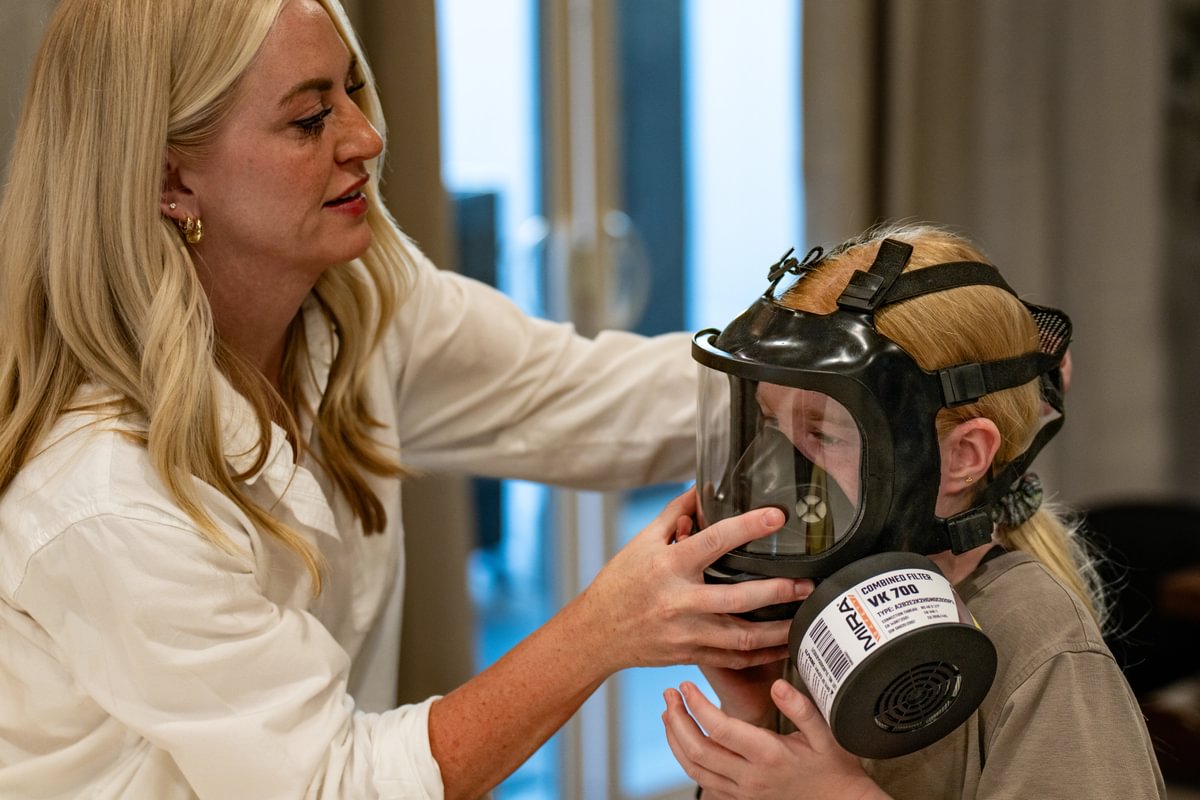
As it pertains to safety gear, now is the time to start making them feel comfortable with it all. We have a respirator that will work for children as young as 2 years old. The first time they put it on shouldn’t be the first time they really need it. You can make a game of it, but get them comfortable with what will help them breathe if you may be incapacitated. It shouldn’t be scary and should be a positive experience.
Preparing Children Ages 8 to 12 Years Old

Image source: MIRA Safety ®
Children are more resilient than you may believe. You can find plenty of reports of children in this age range showing great skepticism to would-be kidnappers, as well as violent resistance. If they have seen enough “safety” in their life, they can recognize “danger” in their gut. If something doesn’t feel right, teach them to trust it and/or, verify it with a trusted adult.
Kids should learn to recognize where the exits are when they enter crowded venues like movie theaters. You don’t have to scare them into understanding why with every plausible scenario. Just start pointing out the exits as you live daily life with your kids and they will catch on. Ask them the hypothetical, what would you do if you were separated from us and you couldn’t find us?
This is also a great age range to get children extremely comfortable with survival gear. Can they effectively put on a gas mask and full MOPP gear in enough time to counter a threat? This is another opportunity to gamify the experience to make it fun for the kids. Make it a competition between siblings? There is no need to terrify them by yelling “gas, gas, gas” as was the case when I served in the Marine Corps. Keep survival fun while they are learning the skills.
Parents tend to start considering cell phones for kids around the age of 12 or 13. As such, you have to assume kids in this range won’t have one. What is the communication plan that you have discussed with your child? Is it to stay put and wait for help, or get back to the car or home? That’s your call as a parent and your assessment of their capability.
Preparing Children 13 to 17 Years Old

Image source: MIRA Safety ®
Teenagers tend to think they know everything anyways, and so there is no harm in being more candid in this age range with the threats around them. You can begin discussing current events, still from an optimistic perspective, but you can start asking them a broader range of “what ifs”. They are aware that we are in open military conflict with Iran. They can likely handle the conversation of what happens if something explodes at a public event.
Asking them how they would handle looking out for a little brother or sister is a reasonable idea. As you deem appropriate, what does your teen understand about firearm safety and proper use? It’s great that they want to attend a concert with their friends. Do they know what to do if danger unfolds and can they find proper cover? There are parents who allowed their teens to attend an Ariana Grande concert in Manchester who wished they would have had that conversation.
A Summary on Preparing Children for a Less Safe World

Image source: Envato
Many parents would tell you that preparing to survive in a world without their children is a pointless endeavor. If we are not preparing our children in an age appropriate way, we are threatening our own ability to survive. The 9-11 Memorial and Museum has some great information on talking to your kids about terrorism. We just take it a step further and ask the question, now what?
We believe that the average American family can be ready for this moment. History suggests many societies have emerged from such difficult seasons stronger as a result. We believe that this can be the case for American society in the current turbulent season in which we live. Humans are natural survivors and, with the right plan and enough practice, you will surprise yourself about just how much you are capable of enduring. With the right plan and enough practice, your children just might surprise you as well. Keep training and reach out to us anytime if you have any questions or we can be of any help. We don’t choose the times in which we live. We can choose how we respond to those times.
Frequently Asked Questions
About the author

Leave a comment
1 comment
I love Mira products & just got my kids & myself masks. I am considering other products, but the article is throwing me off a bit by using the word ‘Antifa’. Why not just call it an attack against ICE? Antifa isnt is a real organization, just a proproganda word used by this current adminstration, commonly used to describe protestors. Of all the terrorist situations that could be described, that felt like a real reach.