


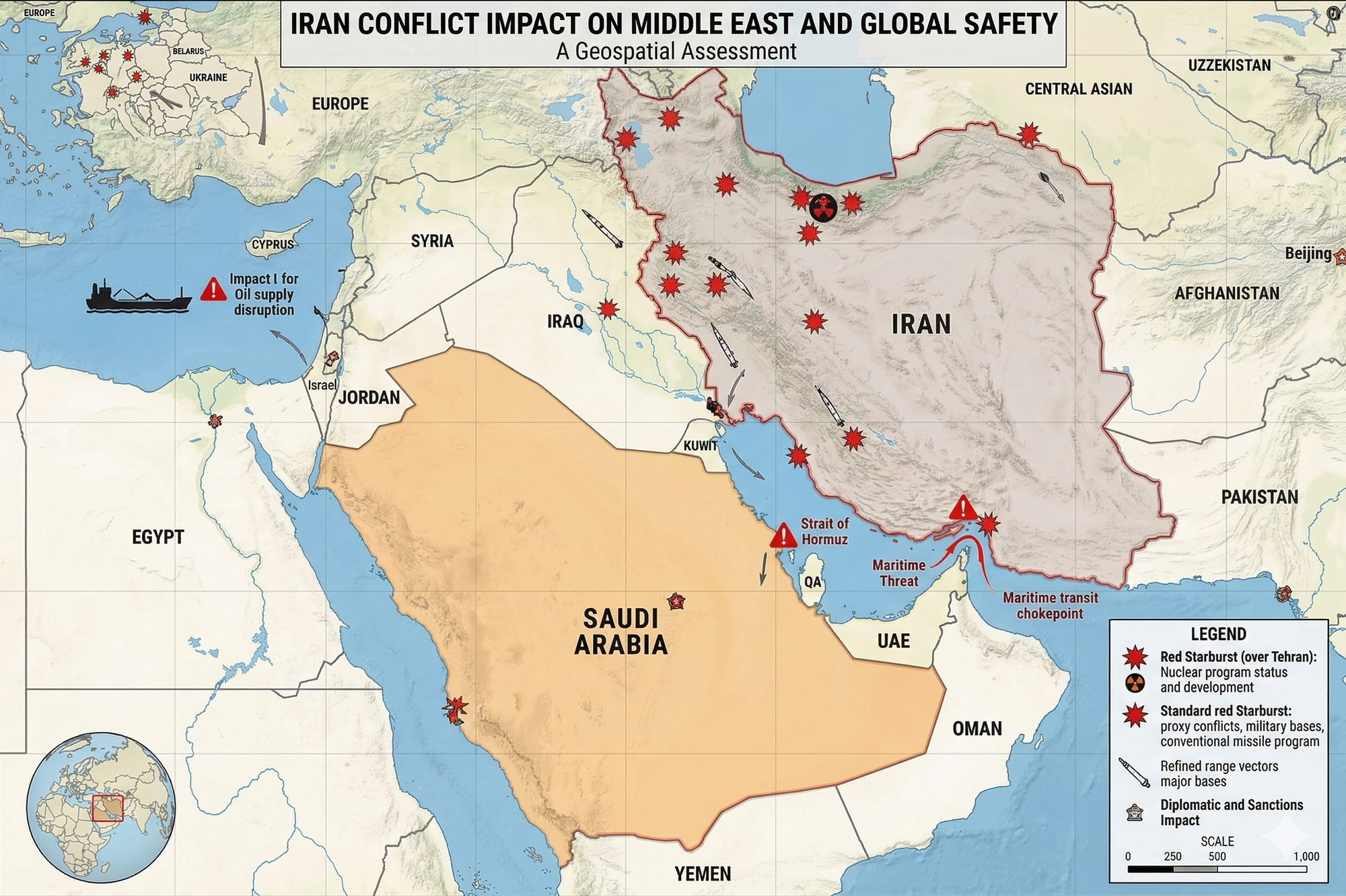
At the time of writing, the conflict with Iran is expanding to include more and more Middle Eastern and European nations. Iranian explosive drones reached as far west as the island of Cyprus on Sunday, prompting the United Kingdom to enter the conflict in a defensive capacity. In spite of the largest concentration of military forces in the Middle East since just before the 2003 invasion of Iraq, Iran is still capable of launching enough ordnance into the skies and surrounding cities that some warheads are getting through air defense networks. These missiles and bombs are damaging both military and civilian targets, killing 3 US service members so far along with hundreds of injured civilians across the Gulf States and Israel.
Major risk factors Practical civilian readiness ConclusionTable of Contents
No one knows how long this conflict will last, or what the geopolitics of the region will look like when it ends, but we know enough about Iran’s capabilities to infer some likely scenarios about how the ongoing operations may impact civilians outside the direct line of fire. This article seeks to keep the public informed about some of the dangers and economic shock that might arise in the coming weeks to months as Iran seeks to retaliate against whoever they deem responsible for the current conflict.
Major risk factors
Missile and drone threats

Iran has two main means of projecting force beyond their own territory: long range weapons and proxy militias. During last year’s brief, but intense, Twelve-Day War with Israel, Iran retaliated against Israeli airstrikes by launching over 550 ballistic missiles and 1,000 explosive drones against Israel. While the bulk of these were intercepted by Israel’s Iron Dome air defense network, the sheer number of munitions Iran deployed meant some attacks penetrated Israel’s barrier and destroyed military, government, and civilian targets.
In response to a January 2020 US drone strike that eliminated Iranian Major General Qasem Soleimani, Iran retaliated in a similar fashion by firing 12 ballistic missiles against two US air bases in Iraq, wounding 110 US service members. Looking beyond the direct impacts of missile and drone strikes, Iran’s long range arsenal has the potential to disrupt civilian travel. For instance, 31,000 international travelers were stranded in Israel alone as result of June 2025’s Twelve-Day War. When missiles are in the air, airlines and airports shut down or cancel flights, both to avoid exposure to danger and to prevent interference with local air defense networks.
We’ve already seen Iranian missiles target civilian airports directly in this conflict. Within hours of Operation Epic Fury kicking off, Iran launched missiles and drones against major travel hubs throughout the region. Several people were injured at Dubai International Airport when a suspected ballistic missile hit one of the concourses. Airports across the Middle East remain shut down as of March 2nd, stranding hundreds of thousands of travelers across 2,400 canceled flights.
Proxy forces and terrorism

Iran has also cultivated a broad network of non-state militias and paramilitary organizations over the decades. By 2022, there were over 100 different proxy militias in the Middle East that were trained, funded, and loosely controlled by Iran. Iran’s policy of supporting paramilitary forces is what led the US State Department to declare Iran a state sponsor of terrorism on January 19th, 1984, which is what current President Donald Trump was referring to in his State of the Union speech.
Hamas and Hezbollah are two of the most well-known, along with Houthi rebel fighters in Yemen. Israel’s aggressive response to the October 7th terrorist attacks has severely depleted many of Iran’s proxy forces in the region, and the remaining paramilitaries still pose an asymmetric threat to civilian and economic targets. As just one example, the Houthi rebels created a major crisis for two years in the Red Sea by attacking or hijacking tanker and container ships passing through the high traffic Bab al-Mandab Strait. This cut traffic through the major shipping route by over 75% and affected more than 30% of global maritime trade.
Returning to the present day, one of the main vectors for escalation of a US-Iranian military conflict is this large network of proxy forces activating, either independently or as part of a coordinated operation managed from Tehran. On March 1st, Austin, TX may have been the target of a lone wolf attack when a gunman wearing a religious slogan attacked a local bar, killing two and seriously injuring fourteen. The investigation found the slain gunman had pictures of Iranian leaders in his home, supporting the possibility the attack was a response to the military operation against Iran.
Oil blockade

During past crises, Iran has threatened to leverage its strategic position along the northern coast of the Strait of Hormuz and blockade the Persian Gulf. Roughly 20% of global seaborne fossil fuels transit through the Strait each year, meaning any closure could have dramatic impacts on world oil and natural gas prices. Blockading the Strait is one of Iran’s most dramatic conventional military capabilities, and Iran’s Navy is designed around overwhelming US-led efforts to protect commercial shipping through swarms of speedboats, drones, mines, and anti-ship missiles. Oil industry experts believe that even a temporary closure would disrupt global trade, driving the prices of oil up by $10 to $20 dollars per barrel.
In fact, a similar situation has played out before in the Persian Gulf during the Tanker Wars of the 1980s. Both Iran and Iraq targeted commercial shipping as a means to cripple each others’ economy. Because of the region’s strategic importance, the US Navy deployed to escort commercial traffic through the Persian Gulf, and it was on one such escort mission in 1987 that the USS Stark was severely damaged and nearly sunk by Iraqi anti-ship missiles.
As of the early morning on March 2nd, Iran has yet to position any ships or mines in the Strait, but two tanker vessels have reportedly been struck by missiles and vessel traffic through the waterway dropped by 70% as ships avoided the passage out of their own sense of caution.
Chemical and radiological threats

The initial basis for Operation Epic Fury is Iran’s alleged nuclear weapons program. While Western analysts and intelligence agencies assess that Iran does not currently have a functional nuclear weapon, Iran does still have large amounts of Uranium in both raw and enriched forms, possibly as much as 6,604 kilograms of enriched Uranium according to an NTI estimate. Speaking in late February, International Atomic Energy Agency Director General Rafael Grossi stated, “Most of the material that Iran had accumulated up until June of last year, despite the [U.S.] bombings and the attacks, is still there, in large quantities, where it was at the time of the strikes.”
Iran’s chemical weapons program hasn’t received anywhere near as much international concern as the country’s nuclear infrastructure, but Iran has used chemical weapons in the past and may have deployed chemical agents just this past January. Historically, Iran fired 130mm mortar shells filled with Mustard Gas on at least two documented occasions during the Iran-Iraq War of the 1980s. A UN Security Council report from 1988 indicates the possible employment of nerve agents and phosgene gas as well. While Iran later signed the Chemical Weapons Convention in 1993 and claims to have destroyed their chemical weapons stockpiles, the US has accused Iran of continued non-compliance with the convention.
Most recently, the Foundation for Defense of Democracies published a report that alleges Iran has continued secretly developing new chemical weapons, particularly pharmaceutical-based agents like fentanyl and its derivatives, and deployed them against its own people. Derived from medical anesthetics and similar central nervous system depressants, these weaponized dual-use compounds are designed to incapacitate victims through unconsciousness, but they can be lethal in high doses. According to the FDD’s report, Iran may have already deployed these compounds as crowd control agents to quell protests and civil unrest from 2022 to earlier this year.
It stands as a remote, yet plausible scenario that Iranian leadership may use the threat of Weapons of Mass Destruction as a last ditch effort to save themselves. Now that the scope of the conflict has expanded to include regime change, the Iranian leadership are in a fight for their own survival. Even without a functioning nuclear warhead, the Iranian military could still disperse radiological material through a “dirty bomb.” Iran has its own delivery systems for chemical or radiological weapons through missiles and drones, but they could also distribute these materials to their network of foreign paramilitaries, raising the spectre of terrorist attacks against international targets using these chemical or radiological agents.
Practical civilian readiness

Image source: Envato
What all of the above boils down to is a great deal of uncertainty. Even a limited military campaign can spiral outward and lead to unintended consequences, especially in a region as volatile as the Middle East.
Uncertainty can be scary, but there are measures the average civilian can take to be prepared without dipping into panic. Preparedness is about reducing exposure to uncertainty, not predicting worst-case scenarios. We recently published a detailed preparedness guide for American citizens and here are some additional measures travelers and prepared civilians can take to mitigate their own risk factors.
Travel safety

During times where tension is high, travel to or through the region could be disrupted. Be alert but don’t assume the worst while going about your business or vacation in crisis zones. Here are some ways to maintain your situational awareness and give yourself some backup plans while abroad:
-
Monitor State Department travel advisories at https://travel.state.gov/en/international-travel/travel-advisories.html
-
Enroll in the Smart Traveler Enrollment Program (STEP). Registration is free, quick, and easy, but make sure to register your trip before you leave to minimize interruptions. https://travel.state.gov/en/international-travel/travel-advisories/smart-traveler-enrollment-program.html
-
Maintain digital and paper copies of passports.
-
Carry emergency funds and multiple payment methods.
-
Have contingency plans for extended stays abroad. For example, carrying a physical map of a city you’re visiting with reputable hotels and relevant embassies marked can work wonders if travel plans get delayed and power or cell service goes haywire.
-
Pack extra medications and other essentials.
Domestic readiness
Crises abroad can impact life at home in many ways. Fuel prices can rise while supply chain disruptions can affect the availability of things we take for granted (toilet paper shortages ring a bell?). In extreme cases, protests or political rallies can lead to civil unrest. It’s important to plan ahead without panic buying. If we react in a knee-jerk way to every news headline or price change at the grocery store, we’ll just end up spending more money than we have to on resources that might not even be needed. Be resilient while staying reasonable.
-
Keep track of how much fuel you need on a weekly basis, both at home and on-the-road. Keeping your car’s gas tank topped up can help avoid long lines if a gas shortage hits. Similarly, have a reserve stock of propane or firewood if you live in a remote area, both for cooking and staying warm.
-
Have a buffer of food, water, and essential medications. Freeze-dried emergency meals keep exceptionally well, but even just having several days worth of groceries will make you less susceptible to price fluctuations at the local market.
-
Build an emergency Go Bag if your household doesn’t have one already. Even a basic kit will allow you and your family to evacuate quickly if needed, or stay safe while sheltering-in-place. Keep it light enough to travel, but a better equipped bag will add more capabilities to handle a broader range of emergencies.
-
Factoring in the additional threat of chemical or radiological threats that Iran is capable of, consider adding a gas mask and other CBRN protection items to your emergency kit. https://www.mirasafety.com/collections/ppe-kits
-
Have a communication plan. Sometimes local power, internet, or cellular connections can get swamped during an emergency, or when people think there’s an emergency. Have several alternate ways to communicate with family and friends that you’ve discussed ahead of time (satellite communicators are great and getting cheaper each year).
-
Stay positive. Recognize that most emergencies are temporary in nature and focus on the factors you can control in the here-and-now. In fact, the better prepared you are ahead of time, the more confidence and comfort you’ll have in the face of uncertainty.
Conclusion
International tensions can change quickly and the 24-hour news cycle doesn’t help our stress levels when it feels like the world is on the brink. But remember that while we can’t control foreign policy decisions, there are many things we can control that directly increase our personal safety. Staying aware while traveling, registering with consular services, maintaining a resilient household, and being prepared at home. These are just some of the real, tangible measures we can use to improve our situation in the present and future.
Politics, both at home and abroad, are their own force of nature. Preparedness is a strategy for stability that benefits everyone.
Frequently Asked Questions
About the author

Leave a comment