
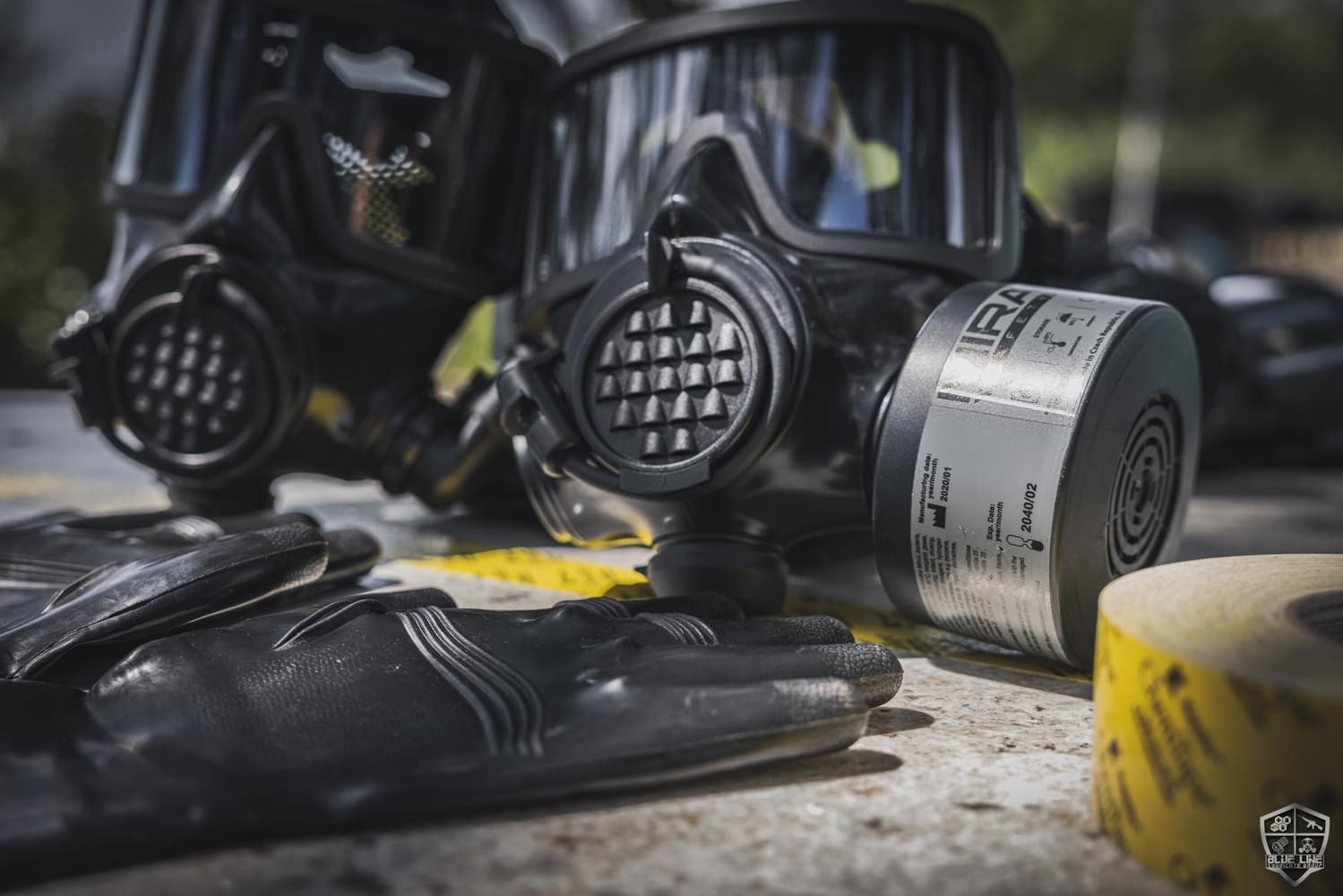
A riot mask is a full-face respirator paired with a filter built for chemical crowd control agents like CS gas, OC (pepper spray), and combustion byproducts from burning materials. The mask seals your face. The filter neutralizes the agents. Together they buy you the time and clarity to leave a chemical exposure event without injury.
Civil unrest looks different in 2026 than it did in 2020. Tear gas deployments are more aggressive, the chemical agents in the canisters have evolved, and the line between a peaceful march and a chemical exposure event has gotten thin. Whether you're a journalist covering a protest, a security professional working a crowd, or a civilian in a neighborhood that turns into a flashpoint, a riot mask is no longer fringe gear.
This guide breaks down what a riot mask has to do, which MIRA Safety models do it best, and what else belongs in a riot kit beyond the mask itself.
Key Takeaways What is the best gas mask for tear gas and riot control? What are the main threats during riots and civil unrest? Gas Mask Filters for Riots What body armor and protective clothing should you wear during a riot? Can civilians legally own riot gear for self-defense? How do you escape safely if you are caught in a riot? The bottom lineTable of Contents

Key Takeaways
-
Best overall riot mask: the MIRA Safety CM-6M paired with the P-Can Police Gas Mask Filter.
-
Threats a riot mask protects against: CS gas, OC pepper spray, smoke, and combustion particulates from burning materials.
-
Who needs one: journalists covering protests, security professionals, medics, and civilians in areas prone to civil unrest.
-
Filter selection is just as important as the mask. The P-Can is built for crowd control agents. Step up to the NBC-77 SOF if you're worried about broader chemical threats.
-
A riot mask alone isn't a complete kit. Add body armor, flame-resistant clothing, and an escape plan.
What is the best gas mask for tear gas and riot control?
The CM-6M, CM-7M, and CM-8M are MIRA Safety's three riot-capable masks - pick the mask based on the form factor and use case. We recommend our 40mm NATO filter be used with all three of these masks for riots.
CM-6M Tactical Gas Mask (Best for Most People)

Image source: MIRA Safety®
The CM-6M is the default civil-unrest pick. If you only buy one riot mask setup, this is it. What sets it apart:
-
Butyl rubber facepiece. Seals against CS, OC, smoke, and industrial chemicals where standard EPDM rubber gives up. Most respirators don't use butyl because it's more expensive.
-
Panoramic single-lens visor. Wide field of view with no frame down the middle. You can move through a crowd without losing peripheral awareness.
-
Dual 40mm NATO filter mounts. Swap the filter side based on shooting position, recording angle, or which side is taking the most exposure.
-
Drinking system port. Stay hydrated through three-hour-plus events without breaking the seal.
-
P-Can compatibility. Calibrated for street-level CS and OC concentrations and lighter than a full CBRN filter, which matters when you're wearing it for hours.
In short: the CM-6M is the proven workhorse of the lineup. It's the mask MIRA Safety built its civil-unrest reputation on, the one most owners run as a daily-driver, and the one with the deepest catalog of accessories (filters, lens protectors, head harness upgrades, hydration bottles). If you're new to gas masks and you want one setup that handles riots, fires, and CBRN threats without overthinking it, start here.
CM-7M Military Gas Mask (Best for Rifle Users)

Image source: MIRA Safety®
The CM-7M is the rifle-and-optics build, developed with Czech Army specialists. Pick it if you train or work with a long gun or run helmet-mounted night vision. What sets it apart from the CM-6M:
-
Tapered facepiece for cheek weld. The profile is cut so you can mount a rifle stock without the mask interfering with the cheek-to-stock seal.
-
Dual silicate glass binocular lenses. Sharper optical clarity than polycarbonate, with recessed lenses that reduce eye offset for better alignment with NVGs, red dots, and scopes.
-
Trade-off: 71.5% effective field of view. Narrower peripheral vision than the CM-6M (77.6%) or CM-8M (92.5%) - the binocular layout costs you situational awareness.
-
Dual 40mm NATO filter ports. Mount the filter on either side based on the shooting hand. Same drinking system and bromobutyl rubber facepiece as the CM-6M.
-
500g (lightest of the three). Easier on the neck during long deployments.
In short: the CM-7M is the specialist pick. If you're an armed civilian, a competitive shooter, or you carry a rifle as part of your kit, the cheek-weld geometry and optics compatibility justify the narrower field of view. If you're not running a long gun, the CM-6M or CM-8M will serve you better.
CM-8M Full-Face Respirator (Best Premium Choice)

Image source: MIRA Safety®
The CM-8M is MIRA Safety's newest mask, positioned as a hybrid between the CM-6M's situational awareness and the CM-7M's tactical fit. Pick it if you want the most current platform with the best field of view in the lineup. What sets it apart:
-
Contoured panoramic visor with 92.5% effective field of view. Widest of the three masks, with the same optics compatibility (red dots, thermal, NVGs).
-
Polycarbonate single-lens construction. Impact-resistant, with a wider sight picture than the CM-7M's binocular glass.
-
Six-point mesh head harness. More even seal pressure distribution than the older five-point harnesses.
-
Bromobutyl rubber facepiece. Same CBRN-rated material as the CM-6M and CM-7M, with a ~30-hour mustard gas resistance and 20-year shelf life.
-
540g, NATO 40mm filter compatible, with built-in hydration. Splits the weight difference between the CM-7M (500g) and CM-6M (560g).
In short: the CM-8M is the upgrade pick. If you already own a CM-6M and want the next-generation platform, or if you're buying your first mask and want the widest field of view available, the CM-8M is the strongest all-rounder. Same accessory ecosystem as the CM-6M (filters, lens protectors, hydration bottles), with better optics and a more comfortable harness.
What are the main threats during riots and civil unrest?
The primary threats during civil unrest fall into three categories: chemical agents deployed by law enforcement or military, physical violence between participants, and improvised devices ranging from incendiaries to small explosives.

The chemical agents are the most predictable and the most preventable. Almost every modern riot involves one or more of three substances, and each one has a known signature that a properly chosen riot mask and filter can handle.
Tear Gas (CS Gas)
CS gas (2-chlorobenzalmalononitrile) is the most commonly deployed tear gas agent worldwide. Developed by Ben Corson and Roger Stoughton at Middlebury College in 1928 and later adopted for riot control by the U.S. military, it remains the standard chemical crowd control agent for most law enforcement agencies in 2026.

CS is a lachrymatory agent: it makes your eyes water shut, your nose run, and your skin burn. Exposure is incapacitating but rarely fatal. The real danger isn't the gas itself, it's what happens when you panic and trample someone, breathe deeply enough to trigger asthma, or lose visual contact with your exit route.
A proper riot mask with a CS-rated filter stops the exposure cold. Without one, you have less than a minute of useful function before your eyes shut and you can't see where you're going. For a deeper look at how tear gas canisters work and how to handle a direct deployment, see our tear gas grenade guide.
Pepper Spray (OC)
OC stands for oleoresin capsicum. The active ingredient is capsaicin, the same compound that makes chili peppers hot, derived as an oily resin. Where CS gas is lachrymatory (it causes tearing), OC is inflammatory (it causes pain). Exposure burns the eyes, mouth, throat, and any exposed skin.

OC gets deployed two ways at riots. Personal-use spray is short range and targeted at individuals. Wide-area dispersal comes from launched canisters or vehicle-mounted systems and can affect entire blocks. The wide-area deployment is what a riot mask is built for.
OC exposure on children is more dangerous than on adults because of smaller airways and lower body mass. We covered the specific risks to infants and toddlers at protest events in our piece on babies, ICE protests, and CS gas risks.
Smoke, Particulates, and Combustion Byproducts
Riots almost always involve fire. Trash cans, dumpsters, vehicles, occasionally structures. Burning synthetic materials release toxic combustion products: hydrogen cyanide, carbon monoxide, vinyl chloride, and a soup of organic compounds depending on what's actually on fire.
A filter with P3 particulate protection handles the airborne debris and ash. The gas component of a combined filter handles the chemical vapors. This is the part most people forget when they buy a tear gas filter and assume it covers the full threat picture.
Physical Violence and Improvised Weapons
A gas mask doesn't stop a thrown bottle, a baton strike, or a rubber bullet. Body armor and impact protection are separate categories. We cover them in the body armor section below and in our civil unrest safety guide.
Gas Mask Filters for Riots
Three filters cover the riot use case. Which one you pick depends on what else you're worried about and the needs you want to prioritize.
P-Can Police Gas Mask Filter (Riot-Specific)
 Image source: MIRA Safety®
The P-Can is the dedicated riot filter. Built for CS gas, OC pepper spray, and the combustion products of burning materials at street-level concentrations. If your threat model is strictly civil unrest and you want the lightest, most focused filter for the job, the P-Can is the right call for your riot mask.
NBC-77 SOF (Broader Threat Coverage)
 Image source: MIRA Safety®
If you're worried about chemical or biological threats beyond crowd control agents (a chemical plant fire near a protest, an unknown agent deployment, or fallout from an industrial accident in a contested area), step up to the NBC-77 SOF. It handles CS and OC, adds full CBRN coverage, and has a 20-year shelf life in vacuum-sealed packaging. The trade-off is weight and price.
For the full breakdown on filter classifications, shelf life, and how to build a filter stockpile, see our gas mask filter buyer's guide.
NBC-17 SOF Gas Mask Filter (Best lightweight filter)
 Image source: MIRA Safety®
The NBC-17 SOF Gas Mask Filter is the compact version of the NBC-77 SOF. Broad-spectrum protection at a fraction of the carry weight. The NBC-17 is the right choice for journalists, security professionals, and anyone working a riot for hours rather than minutes. Less fatigue, same coverage on the threats that matter.
If you're building a riot mask kit and you can carry two filters, run the P-Can on the mask and keep the NBC-17 SOF in your bag for fallback. The P-Can gives you the dedicated riot performance; the NBC-17 covers you if the scene changes and you need broader protection.
What body armor and protective clothing should you wear during a riot?
Layered riot protection comes down to three categories beyond the mask itself.
Body Armor
For most civilians the realistic option is a Level III or Level IIIA soft armor plate carrier. That covers pistol-caliber rounds, rubber bullets, and most blunt-force impact. Level IV plates protect against rifle rounds but at a weight and visibility cost that doesn't match most civil unrest scenarios. Our Level 4 body armor guide has the full breakdown on plate ratings and when each one makes sense.
Flame-Resistant Clothing
Fire is a constant presence at large protests. Avoid synthetics, which melt on contact with heat. Cotton, wool, or purpose-made flame-resistant gear is the right call. A polyester windbreaker is a liability the moment a flare or molotov lands within ten feet.
Eye, Ear, and Comms Integration
A full-face riot mask handles the eyes. For ears, consider electronic shooter's earpro that dampens impulse noise from flashbangs and amplified sound systems while letting ambient sound through. If you need to coordinate with a team, see our guide on gas mask comms and communications earpieces.
Can civilians legally own riot gear for self-defense?
In most U.S. states, civilians can legally own gas masks, respirators, soft body armor, and most personal protective equipment without restriction. The federal regulatory framework treats them as commercial products available to any adult buyer.
A handful of states restrict body armor purchases for people with felony convictions or limit certain armor categories to law enforcement and military. Ballistic shields and full ballistic helmets are restricted in more jurisdictions than basic plate carriers and gas masks. Check your state laws before you build out a full kit.
Owning the gear is one thing. Wearing it in a public protest is another. Many jurisdictions have anti-mask laws on the books, some written specifically around face coverings at demonstrations.
For example, New York's Penal Law §240.35 makes it a violation to congregate in public wearing a mask or facial disguise, with a narrow exception for masquerade events; the statute has been used to charge protesters at recent demonstrations. Florida prohibits wearing a mask in public under Statute §876.12, with exceptions for occupational safety, weather, and Halloween.
Know your local statutes. The gas mask is legal to own everywhere; whether it's legal to wear at a specific event in a specific city is a separate question.
How do you escape safely if you are caught in a riot?
If caught in a riot without warning, the priority is leaving the crowd, not winning the moment. Pride is what gets you trampled.
-
Move with the crowd, not against it. Trying to push upstream against a panicking group gets you knocked down. Move at the pace of the flow until you can angle toward an exit.
-
Identify cover early. Solid cover means concrete walls, parked vehicles, building interiors. Soft cover (dumpsters, planters, signage) stops projectiles but won't protect you from a crowd surge.
-
Avoid engagement. Don't argue, don't push, don't film aggressively in anyone's face. Recording is fine. Confrontation is what gets you targeted by either protesters or law enforcement.
-
Keep your riot mask on. Residual CS and OC settle on clothing, skin, and street surfaces and continue to irritate even after you've left the immediate area. Keep the mask on until you're at least two blocks clear of the chemical exposure zone.
Decontaminate before going indoors. Don't carry chemical residue home. Strip outer layers, rinse with cold water (avoid hot, which speeds skin absorption of the agent), and bag clothing for later washing. Our donning and doffing PPE guide covers the decon sequence in detail.
The bottom line
A working riot kit is a full-face riot mask, a riot-specific filter, body armor, and an escape plan. The mask alone isn't enough. The most expensive gear in the world doesn't help if you panic and walk into a crowd surge.
If you're starting from scratch, build the kit around the CM-6M Tactical Gas Mask and the P-Can Police Gas Mask Filter. Add a backup NBC-17 SOF filter for broader threat coverage. Layer in plate armor, flame-resistant clothing, and pre-event planning. Match the gear to the threat, then practice using it before you need it.
Browse the full MIRA Safety gas mask lineup and filter inventory when you're ready to build your riot mask kit. If you're new to gas masks generally, start with our types of gas masks guide for the full picture.
Frequently Asked Questions