
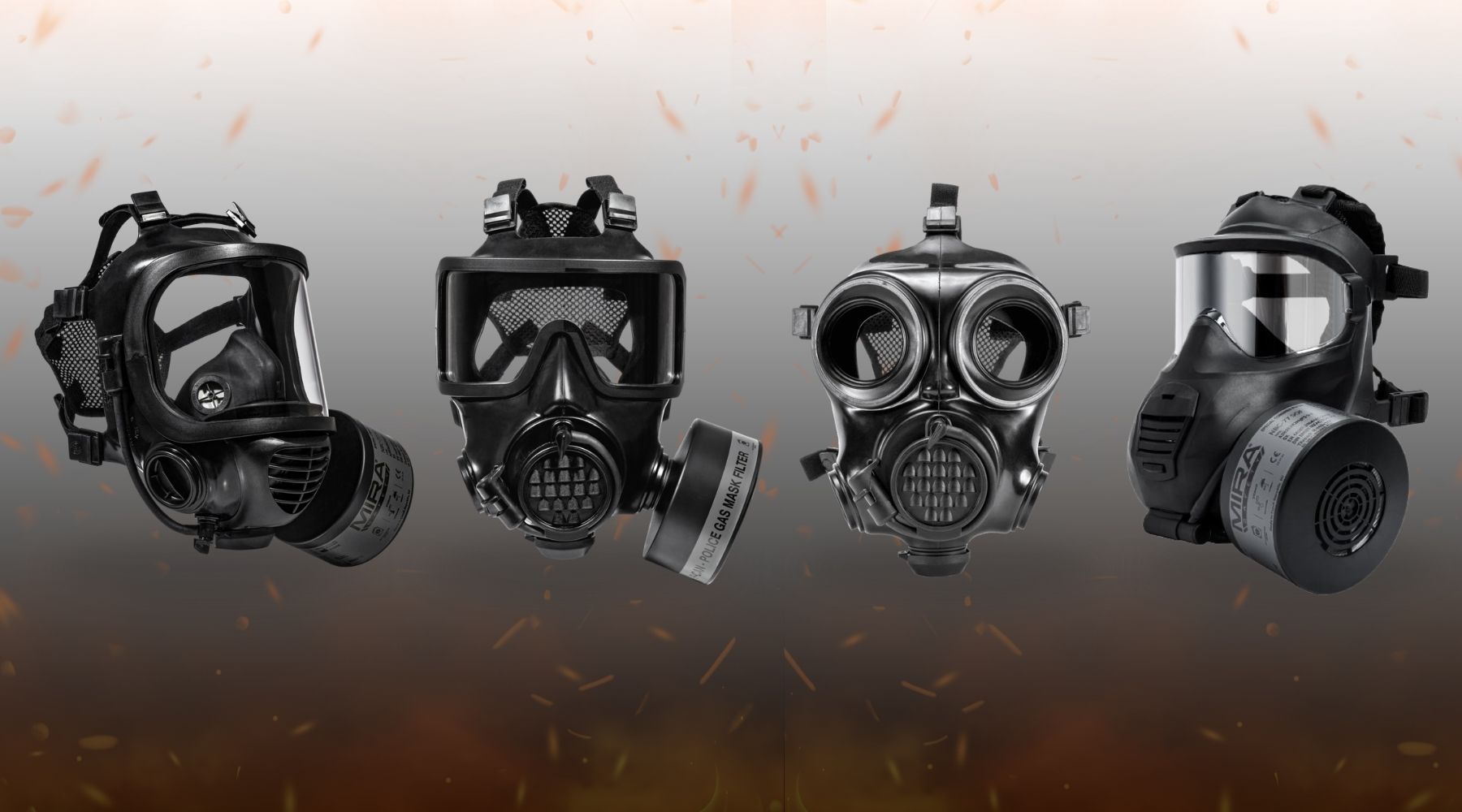
There are six types of gas masks on the market today: half-face respirators, full-face gas masks, escape hoods, powered air-purifying respirators (PAPRs), self-contained breathing apparatus (SCBAs), and dedicated children's and infant masks. Each one solves a specific problem, and matching the right type to your threat scenario is what separates working preparedness from a false sense of security.
The wrong gas mask gets you killed twice. Once when it fails to seal against a threat it wasn't built for. And again when you find out the surplus deal you scored at a gun show was a Cold War leftover with degraded filters.
This guide covers every type of gas mask, what each one does, who it's built for, and how to figure out which one belongs in your kit. We'll get into the difference between gas masks and respirators, the gap between CBRN and HAZMAT gear, why surplus is a bad investment, and which MIRA Safety masks match each use case.
Key Takeaways What are the main types of gas masks? Which gas mask should you buy first? Gas mask vs respirator: what is the difference? CBRN vs HAZMAT: what is the difference? Should you buy a surplus gas mask or a new one? How to choose the right type of gas mask The bottom lineTable of Contents
Key Takeaways
-
There are six types of gas masks: half-face respirators, full-face masks, escape hoods, PAPRs, SCBAs, and dedicated children's masks.
-
Gas masks are a category of air-purifying respirator (APR). They filter air through chemical cartridges rather than supplying their own oxygen.
-
CBRN-grade masks use butyl or bromobutyl rubber. These are the only seal materials that survive the mustard droplet test for chemical warfare agent exposure.
-
Full-face coverage is critical for chemical threats. Many CBRN agents are absorbed through the thin membranes around your eyes.
-
Filter selection is just as important as the mask. A CBRN-grade mask paired with the wrong filter leaves real protection gaps.
-
Skip surplus. Surplus gas masks have no reliable verification path, and the savings disappear the first time the seal fails.
What are the main types of gas masks?
Gas masks fall into six categories, defined by coverage area, threat type, and power source. Each one was designed to solve a different problem. The mistake most buyers make is treating the types as interchangeable, then ending up with the wrong tool when it actually counts.
Half-Face Respirators
A half-face respirator covers the nose and mouth and leaves the eyes exposed. That open eye area is the limit. Many CBRN agents are absorbed through the thin membranes around your eyes, which makes a half-face mask a non-starter for serious chemical threats.
Half-face respirators are the right tool for three jobs: filtering particulates like wildfire smoke, sawdust, and mold; handling organic solvents in spray painting or refinishing work; and protecting against pandemic-grade biological hazards when paired with a P3 particulate filter element.
MIRA's half-face option is the TAPR Tactical Air-Purifying Respirator. It uses the same 40mm NATO threaded filters as our full-face masks, which means you can pair it with the same NBC-77 SOF or ParticleMax P3 filter inventory you've already built. Lighter than a full-face mask, easier to wear for long stretches, and built for situations where you need protection but not full eye coverage.
Full-Face Gas Masks
Full-face gas masks cover everything from the hairline to under the chin. The full-face seal protects the eyes, prevents skin absorption around the face, and is the only practical option for chemical warfare scenarios. This is the type of gas mask most people picture when they hear the term.
MIRA makes four full-face models, each built for a different use case:
-
CM-6M Tactical Gas Mask. Our flagship. Butyl rubber construction, panoramic single-lens visor, integrated drinking system port, and dual filter mounts so you can run the filter on the left or right side. Built for tactical operators, civilian users, and anything in between. View the CM-6M.
-
CM-7M Military Gas Mask. The heavier-duty cousin to the CM-6M. Same butyl rubber, with features built for military and government end users. View the CM-7M.
-
CM-8M Full-Face Respirator. The entry point into our full-face masks. Single filter port, straightforward design, same 40mm NATO threading as the rest of our masks. A good first mask. We covered it in depth in the CM-8M guide.
-
C21 Full-Face Respirator. Our premium tier. Bromobutyl rubber construction (the same material grade used in chemical weapons response gear), a refined facepiece, and the longest expected service life of any MIRA mask. View the C21.
All four use 40mm NATO threaded filters, which means they're cross-compatible across our entire filter inventory. Build a filter stockpile once and it works with every full-face MIRA mask. For the head-to-head on picking between them, our gas mask buyer's guide covers it in detail.
Escape Hoods
An escape hood is a one-time-use full-head hood that gives you fifteen to thirty minutes of breathable air to escape an immediate threat. Sealed in vacuum packaging. Deploys in under 30 seconds. Built for office buildings, hotel rooms, travel kits, and anywhere else you need protection on the way out the door.
Escape hoods don't replace a real gas mask. They're a one-shot tool for getting from point A to point B during an evacuation. After that, they're done. Use them for what they're built for: getting out of a building, not standing your ground in a chemical environment.
Powered Air-Purifying Respirators (PAPR)
A PAPR uses a battery-powered fan to push filtered air across your face. The positive pressure does two things. It makes breathing effortless because you're no longer pulling air through a filter with your own lungs. And it adds a layer of seal protection by keeping outside air from leaking in around the edges of the mask.
PAPRs are heavier and bulkier than passive gas masks. They're the right call for medical workers, hazmat response teams, and anyone who needs to wear a respirator for hours at a stretch. Our MB-90 PAPR is the adult option, built on the same 40mm NATO filter standard as the rest of our gear. For child-specific PAPR use cases, see the MD-2 in the children's section below.
For the full breakdown on PAPRs, who needs one, and how to pick a system, our PAPR CBRN gas mask guide covers everything from battery life to cartridge selection.
Self-Contained Breathing Apparatus (SCBA)
An SCBA carries its own air supply in a pressurized tank. Same principle as a firefighter's gear or a scuba setup. SCBAs are the only practical option in environments below roughly 17% ambient oxygen: structure fires, confined spaces, post-blast environments, oxygen-deficient industrial atmospheres.
SCBAs are heavy, expensive, and need professional training to use safely. They're not preparedness gear for most civilians. If your threat model includes operating in oxygen-deficient environments, that's a separate conversation and you should be working with a qualified safety officer, not a blog post.
Children's and Infant Gas Masks
Standard adult gas masks don't seal correctly on smaller faces. Breathing resistance is too high for small lungs. Kids and infants need gear built specifically for them, full stop.
MIRA Safety makes dedicated systems for younger users, sized to seal correctly on smaller heads and made with lower breathing resistance. The children's gas masks collection covers options for kids. The baby gas masks collection handles infants and toddlers.
The MD-2 CBRN Child Escape Respirator is our powered child-specific option. It's a PAPR built for emergency escape from chemical, biological, radiological, and nuclear threats, sized for children and made with the lower breathing resistance younger lungs need. If your kit needs powered protection for a child, the MD-2 is what you want.
Which gas mask should you buy first?
If you want one answer to cover most realistic threats, here it is: the CM-6M Tactical Gas Mask paired with an NBC-77 SOF filter. That combination handles wildfire smoke, civil unrest, industrial accidents, and chemical or radiological events. It's the type of gas mask most households should build a kit around.
From there, the CM-7M, CM-8M, and C21 are upgrades. The TAPR half-face covers situations where full-face is overkill. Kids need the children's collection or the MD-2 if you want powered protection.
Buy the mask masks and filters together. Then stock spares. That's the sequence.
Gas mask vs respirator: what is the difference?
A gas mask is a type of respirator. The terms get used interchangeably, but the distinction matters when you're picking gear. Respirator is the broad category. Any device that filters or supplies air to protect your lungs qualifies as a respirator, including paper dust masks, half-face cartridge respirators, and full-face industrial models. A gas mask is a specific type of respirator: a full-face or hood-style air-purifying respirator that uses chemical filter cartridges to neutralize toxic gases and vapors.
The term comes from World War I, when soldiers needed protection from chlorine and phosgene gas. Today the gas mask label generally implies full-face coverage, a serviceable rubber seal, and a 40mm threaded port for filters. Every gas mask is a respirator, but not every respirator is a gas mask. For more on the history and how to pick a mask for general preparedness, our gas mask buyer's guide covers it.
CBRN vs HAZMAT: what is the difference?
CBRN stands for Chemical, Biological, Radiological, and Nuclear. It's a defense-oriented classification that assumes deliberate release: nerve agents, weaponized pathogens, dirty bombs, fallout. HAZMAT is short for hazardous materials and typically refers to industrial accidents. A tanker rollover. A chlorine plant leak. A meth lab fire. The threats overlap heavily, but the framing is different. HAZMAT assumes accident. CBRN assumes attack.
That framing changes gear selection. Industrial-grade respirators built for HAZMAT work handle the chemicals you'd encounter on a job site: organic solvents, acid gases, ammonia, particulates. They typically use thermoplastic or silicone seals, which can break down under chemical warfare exposure. CBRN-grade gas masks are built from butyl or bromobutyl rubber, the only seal materials that pass the mustard droplet test. Sulfur mustard (HD) is the World War I blister agent that eats through most synthetic materials, and it's the standard chemical used to confirm that a facepiece can survive a real chemical weapons environment.
Our CM-6M Tactical Gas Mask uses butyl rubber. The C21 Full-Face Respirator steps up to bromobutyl rubber, which adds another layer of chemical resistance and a longer service life. Both are built for the CBRN end of the spectrum, not just industrial HAZMAT. If you want the side-by-side on materials and use cases, our military gas masks vs industrial respirators guide breaks it down.
Should you buy a surplus gas mask or a new one?
Surplus gas masks from military stockpiles have no reliable way to verify their protection level. There's no current testing process for a thirty-year-old Russian GP-5 sitting in someone's basement, and the distributor who flipped it on eBay has no obligation to tell you whether the filter is asbestos-laden, the seal is dried out, or the entire mask is past its useful life.
Some surplus masks contain real hazards. Older filters from the Soviet GP-5 lineage were manufactured with chromium and asbestos in the filter media. The Czech M10 had similar issues. World War II era masks contained even worse materials, which is why we covered the health risks of WW2 gas masks in a separate post. Israeli civilian surplus is wildly inconsistent. Some are functional. Most are expired. None come with documentation you can actually trust.
You don't save money on a surplus mask. You burn money on something that doesn't work when you need it. Our full breakdown on why surplus is a trap is at affordable & dangerous: why you should avoid surplus gas masks. Worth a read before you click "buy" on any used listing.
How to choose the right type of gas mask
Match the type of gas mask to the threat you're actually planning for:
-
Wildfire smoke, pandemic biological hazards, and industrial particulates. Half-face respirator with a P3 particulate filter element. The TAPR is built for this category.
-
Civil unrest, protests, and crowd control exposure. Full-face mask with a riot-specific filter. The CM-6M paired with the P-Can Police Gas Mask Filter is the go-to combo. For the deep dive, see our best riot gas mask guide.
-
Industrial accidents and general home preparedness. Full-face mask with a combined CBRN filter. The CM-6M, CM-7M, or CM-8M paired with an NBC-77 SOF filter covers this scenario well.
-
Extended response work (medical, hazmat, decontamination). A PAPR. The MB-90 is built for hours-long shifts where passive breathing through a filter would wear you down.
-
Maximum chemical warfare and nuclear fallout survivability. The C21 paired with the NBC-77 SOF filter. Bromobutyl rubber, longest service life, broadest threat coverage.
-
Kids and infants. The dedicated children's gas masks and baby gas masks collections, plus the MD-2 Child Escape Respirator for powered child-specific protection.
Filter selection is just as important as the type of gas mask you pick. A great mask paired with the wrong filter leaves real protection gaps. Our gas mask filter buyer's guide covers classifications, shelf life, and which filter handles which threat. The how long do gas mask filters last guide covers expected service life under different conditions.
Once you have the mask, fit is everything. Our gas mask fit test guide walks through how to confirm the seal before you need it. And our respirator cleaning guide covers how to keep the mask in working condition between uses.
The bottom line
Pick the type of gas mask that matches your threat. Pair it with a filter that actually covers what you're worried about. Skip the surplus. Stock spare filters, because the mask is useless without them. That's the whole game.
If you're building from scratch, the CM-6M with an NBC-77 SOF filter is the right starting point. Add the half-face TAPR for situations where full coverage is overkill. Upgrade to the C21 when budget allows. Browse the full MIRA Safety gas mask lineup when you're ready to put a kit together.
Frequently Asked Questions
About the author
