
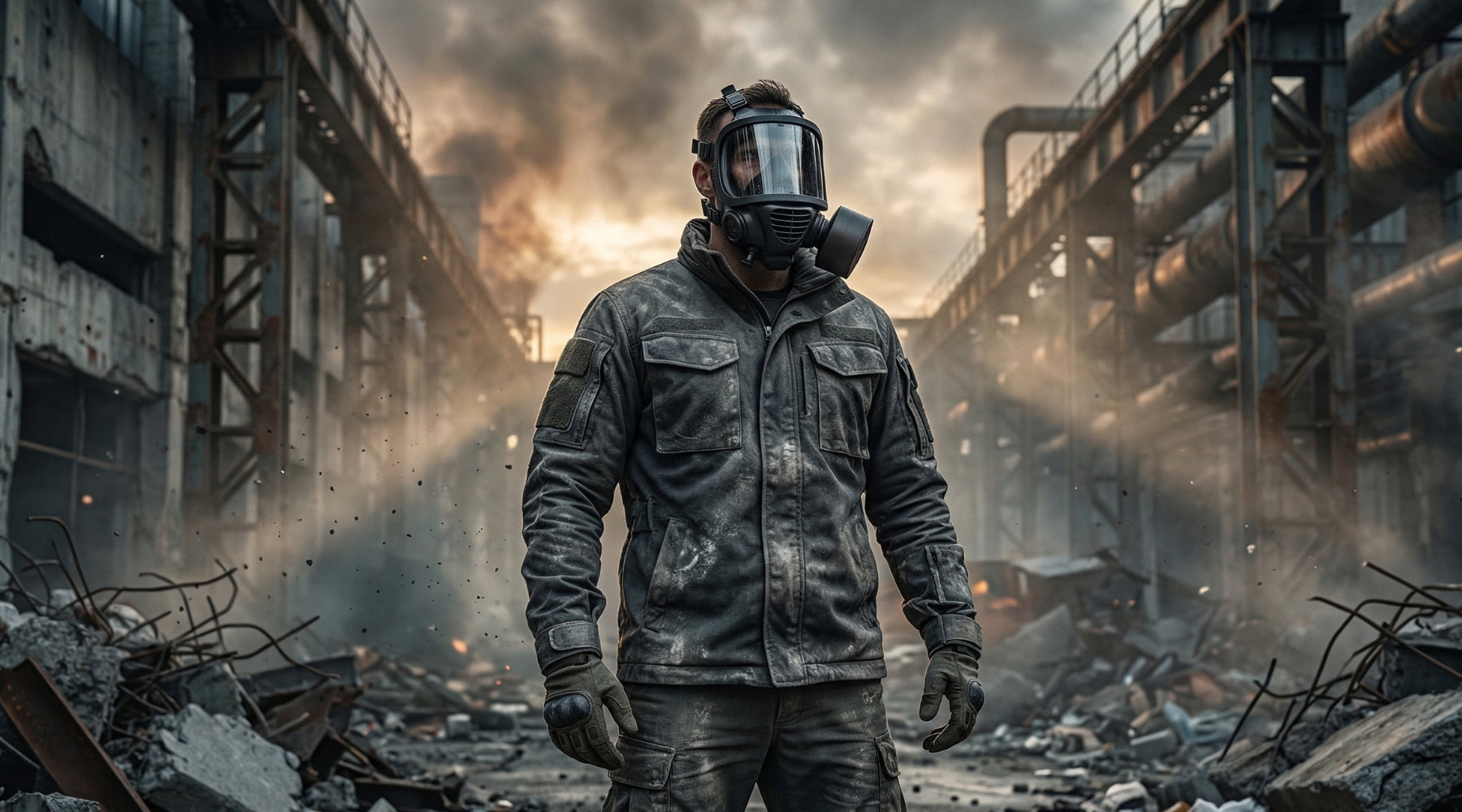
There’s no shortage of toxic chemicals, viruses, radioactive substances, and other hazardous materials out there that can do serious harm to living things. All of them work via different mechanisms and attack different parts of the body. Fortunately, gas masks defend against a huge variety of them, and you don’t need a chemistry degree to understand how they work.
Key Takeaways How does a gas mask work? What Does a Gas Mask Filter Do? How Is Activated Carbon Treated to Stop Chemical Threats? What Material Is a CBRN Gas Mask Made Of? Do You Need Both a Gas Mask and a Filter?Table of Contents
Here is a quick rundown of how gas masks and filters protect people from all walks of life when the unexpected comes their way.
Key Takeaways
-
A gas mask only works if the face seal is airtight: any gap bypasses the filter entirely.
-
Activated carbon adsorbs chemical vapors through London dispersion forces; the particulate layer (P3 standard) traps bacteria, viruses, and dust.
-
Chemical impregnation (phosphoric acid, copper salts, etc.) tunes a filter against specific CBRN threats.
-
The facepiece material determines CBRN rating: butyl or bromobutyl rubber passes the mustard droplet test; thermoplastic and silicone do not.
-
Filter type must match the threat: the NBC-77 SOF covers the full Chemical, Biological, Radiological, Nuclear spectrum; the ParticleMax P3 handles particles only and has no chemical protection.
-
Replace a filter when you detect any odor inside the mask or notice increased breathing resistance.
How does a gas mask work?

A gas mask works by forming an airtight seal against the face so that every breath passes through a filter canister, which strips chemical vapors, gases, and particles from the air before it reaches the airway. The most fundamental principle of a gas mask’s function is to prevent any unfiltered air from reaching our airway. The facepiece physically blocks unfiltered air in such a way that the only way for new air to enter the mask is to go through the filter canister. It’s the job of the filter canister to scrub the air as it flows through, removing or neutralizing hazardous materials from the air so that, by the time the air reaches our mouths and nostrils, the air is as pure and clean as can be.
This depends on two main things: a good seal between the mask material and our faces, and a filter material that’s rated for the type of hazardous material that’s present in the environment. The mask material also needs to be tough enough to stand up to aggressive chemicals so that the seal stays airtight no matter what.
What Does a Gas Mask Filter Do?
The filter canister is the active protection component of a gas mask; the facepiece is only a physical barrier, and it is the filter that removes or neutralizes hazardous materials from each breath.

The first way that canisters accomplish this is by trapping the bad stuff while letting the good air slide through. In more technical terms, the vast majority of chemical filters use a layer of activated carbon to adsorb hazardous molecules, sort of like how dust sticks to the surface of sticky tape if you leave it out too long. Activated carbon has a very porous texture with tons of microscopic holes that provide a lot of surface area. It’s these millions of tiny pores in the surface that makes it “activated” rather than just a lump of coal.
When highly reactive chemicals collide with the tightly-packed grains of activated carbon in a filter, molecular forces (called London dispersion forces) cause the atoms to electrostatically “stick” to the carbon structure. Most water filters you’ll find at home goods or camping stores work via the same principle, just with a different distribution of activated carbon. However, don’t try to use a water filter in place of an actual gas mask filter, as the size and distribution of the carbon grains are totally different to allow air to flow evenly through the canister.
Filter canisters also usually have a particulate filter layer as well to trap larger dust and aerosols before they reach the carbon layer. These work in the same way as HEPA air filters or medical N95 masks, just at even higher efficiency. Tiny fibers knit close together act as a microscopic strainer, catching anything larger than the mesh weave. Our filters at MIRA Safety® are built to the P3 standard, meaning they filter out more than 99.9995% of particles above 0.2 microns in size. This makes them ideal for capturing harmful dust and aerosolized pathogens, either on their own, like in our ParticleMax P3 filter canisters, or as part of our multi spectrum CBRN filters like the NBC-77 SOF® filter. Having a particulate filter in front of the activated carbon layer also helps the carbon last longer before it gets saturated and needs replacing.

How effective are gas masks?
When properly fitted and paired with the right filter, a gas mask is remarkably effective: but the keyword is properly fitted. The entire system depends on an airtight seal between the mask and your face. Any gap, no matter how small, allows unfiltered air to bypass the canister entirely, which can be just as dangerous as wearing no mask at all.
That's why gas mask fit test matters, and why facial hair is a genuine concern in a CBRN environment. Even a day's worth of stubble can compromise the seal enough to let contaminants through. When the seal is solid and the filter is correctly matched to the threat, gas masks filter out an extraordinary range of hazards.
How long does a gas mask last?
The lifespan of a gas mask depends on two separate things: the facepiece itself and the filter canister, and they age very differently. A high-quality facepiece made from butyl or bromobutyl rubber (stored properly away from UV light, heat, and ozone) can last well over two decades. The filter canister is a different story entirely.
An unused, sealed filter canister typically has a shelf life of 15-20 years, depending on the manufacturer. Once opened and exposed to air, the activated carbon inside begins adsorbing whatever is in the ambient environment, slowly reducing its capacity to protect you when it counts. In an active chemical environment, a filter can reach saturation much faster depending on the concentration of the threat. For CBRN preparedness, MIRA Safety® recommends stocking a minimum of two filters per person per day in a sustained-threat scenario. For a full breakdown of filter replacement timelines, storage best practices, and exactly when to swap out your canister, read our in-depth guide on how long do gas mask filters last.
How Is Activated Carbon Treated to Stop Chemical Threats?
Most professional-grade gas mask filters enhance plain activated carbon by impregnating it with chemical additives, including phosphoric acid, sodium hydroxide, and copper salts, that react with and neutralize specific toxic agents.

This process is called impregnation, and these ingredients enhance the efficiency of the filter canister against specific threats, and changing the makeup of these additives helps “tune” the filter against particular agents. These additives help the canister purify the air before it goes into the mask better than activated carbon alone.
Can you still smell through a gas mask?
If your gas mask is working correctly, you should not be able to smell any chemical agent at all. The activated carbon layer in the filter canister adsorbs chemical vapors before they ever reach your nose. If you begin to detect an odor while wearing your mask, that is not a minor inconvenience, it is a warning sign that your filter is saturated and needs to be replaced immediately.
What Material Is a CBRN Gas Mask Made Of?
CBRN-rated gas masks use butyl rubber or bromobutyl rubber for the facepiece, materials that resist blistering agents like mustard gas, which can rapidly degrade natural rubber and even attack steel.

While the mask and facepiece might look like just a bunch of rubber, there’s a surprising amount of science at work here too. As mentioned above, the mask needs to be chemically resistant to some of the harshest compounds in the world. For just one example, the sulfur compounds in mustard gas (HD) can rapidly eat through natural rubber and even steel or brass. This means that the mask needs to be constructed from special materials like bromobutyl rubber, which is remarkably stable and can stand up to blister agents, acids, and strong bases. It’s also dense enough to prevent very lightweight chemical agents like hydrogen cyanide from seeping through.
MIRA Safety's CBRN-rated gas masks use butyl rubber or bromobutyl rubber - both of which are certified to resist blistering agents like mustard gas (MIRA Safety's CBRN masks meet EN 136:1998 Class 3, the highest classification under European respirator standards). In the US, gas mask performance is evaluated under NIOSH (National Institute for Occupational Safety and Health) approved testing frameworks, which is why EN and NIOSH standards are commonly referenced together.
To keep the good air flowing in while keeping the bad air out, gas masks use one-way valves that use the air pressure of the user’s own inhalation and exhalation rhythm to control the flow of air into and out of the mask. Most mask designs have an inlet valve behind where the filter canister attaches, plus an outlet valve near the user’s mouth so that exhaled air clears out of the mask quickly even during strenuous activity. The gas mask design itself also needs to be comfortable enough for extended wear.
This means gas masks have to strike a delicate balance between being flexible enough to move with the user, while staying rigid enough to maintain their shape and seal. The interior of the mask also needs to move air across the visor to prevent fogging. During an emergency, it’s almost as important to see where you’re going and avoid danger as it is to keep breathing.
Do You Need Both a Gas Mask and a Filter?
Yes - a gas mask is only as effective as the filter it is paired with. The mask provides the seal and the filter provides the chemical protection, and neither works without the other. The combination of these two components working in tandem is what keeps us safe in a CBRN environment. Choosing the right gas mask filter is as important as choosing the correct gas mask.
The exact design and materials of filters and masks available on the market varies wildly, but they all work according to the same basic principles mentioned above. Filters rated to EN 14387 are tested against defined chemical classes - A for organic vapors, B for inorganic gases, E for sulfur dioxide, K for ammonia - and the number suffix (1, 2, 3) indicates protection level at 1,000, 5,000, or 10,000 ppm respectively. The most comprehensive CBRN filters also carry a DIN reactor rating, which means they are tested against radioactive methyl iodide released in nuclear plant accidents - this distinguishes full-spectrum CBRN filters from general-purpose respiratory protection.
To get your own gas mask and filter combination that’s ready to go right out of the box, have a look at our EvakPak™ Survival Kit. Complete with a carry bag, two types of filters, and radio protective Iodine tablets, this kit was built to offer the most versatility and protection available in a single, easy-to-use package. For more guidance on how to pick the right gas mask for you, check out our full gas mask buyer’s guide.
Frequently Asked Questions
About the author
