


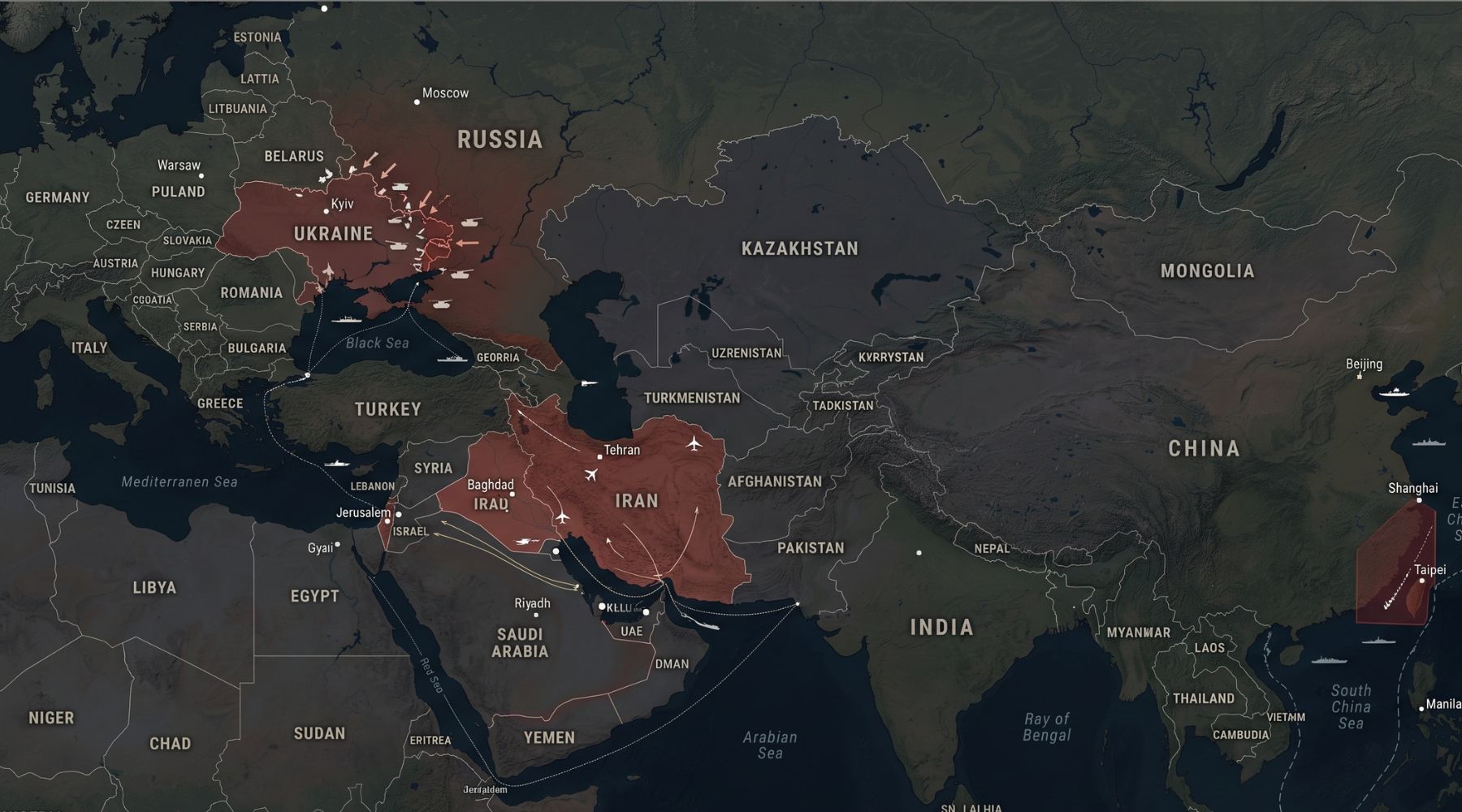
It is not clear who gets to make the final call that any global conflict is indeed a "world war," but so far in 2026 we certainly have the ingredients of a world war in the oven. Nuclear-armed Russia is fighting in Ukraine with the rest of Europe supporting Ukraine in what could only be called a proxy war. Nuclear-armed Israel and the United States are in open conflict with Iran, and one of the world's most strategic waterways is under a blockade as a result. Fuel and supply shortages are beginning to ripple throughout the world. How Many Wars Are Going on Right Now in 2026? How Likely Is World War 3 in 2026? Which Countries Would Be in World War 3? WW3 Sides Map: Alliance Blocs Visualized Where Would World War 3 Be Fought? When Could World War 3 Start? Will WW3 Be Fought on American Soil? Economic Impacts of World War 3: What to Expect How to Prepare for World War 3: Civilian Readiness Final Thoughts: What You Can Actually Do
Table of Contents
If China sees an opportunity to make a move against Taiwan, that might cement the call that the world is most certainly at war.
In this guide, we will give you our best analysis on what this might look like and, most importantly, how to prepare.
This article is not about doom and gloom. It is about answering some of the most basic questions on what to expect next as current geopolitical tensions boil over.
How Many Wars Are Going on Right Now in 2026?

Before we can assess whether World War 3 is likely, it helps to take stock of the active conflicts already underway. The world in 2026 has no shortage of them. Several significant conflicts rage globally, each driven by deep-seated historical, political, and social tensions. Here is a summary of the most critical ongoing wars and how each one connects to the WW3 question.
1. Ukraine-Russia War
In the heart of Eastern Europe, Russia's invasion of Ukraine, now in its fifth year, shows no sign of resolution. What began with the annexation of Crimea in 2014 has turned into a brutal war of attrition, with both sides absorbing enormous casualties and neither achieving a decisive breakthrough.

Russia has deployed hypersonic missiles, Iranian drones, and North Korean troops. Ukraine has responded with domestically produced strike drones that have reached deep into Russian territory.
As it pertains to WW3, the problem comes when Putin feels he is backed into a corner and on the verge of a strategic defeat. Will he escalate with strikes on Baltic nations? Will he consider the use of tactical nuclear weapons to change the landscape on the battlefield? An escalation stands the chance of drawing the rest of Europe out of the proxy war and into active combat.
It is most certainly the most active WW3 trigger on the board.
2. Israel and U.S. vs Iran Conflict
Israel's Operation Rising Lion struck Iran's nuclear and military infrastructure directly. The United States has been drawn into the conflict through existing defense commitments.

The Strait of Hormuz carries roughly 20% of global oil supply, and the stranglehold there has sent fuel prices climbing and triggered supply shortages across the developing world. See our complete analysis: What the Attack on Iran Means for the Prepared American Civilian.
A boots-on-the-ground scenario has not been completely ruled out. The European Union has announced it has weeks before jet fuel shortages threaten to cancel flights. The ramifications of the conflict with Iran are still unknown and developing in real time. It is, in many ways, the wildcard that could pull the largest number of nations into open conflict simultaneously.
3. China-Taiwan Standoff

China continues to demonstrate increasing aggressiveness with military drills around Taiwan, and the December 2025 Justice Mission drill rehearsed a full Taiwan encirclement. Many analysts believe China would first attempt a blockade around Taiwan and dare the United States to try to break it.
The U.S. blockade of Iran's coastline removes the moral high ground America would typically claim regarding freedom of navigation. The massive amounts of ordnance dropped on Iran has reduced U.S. munitions stockpiles needed in a fight with China.
The question is whether China senses an opportunity to act in 2026. See also: Will China Invade Taiwan?
4. 2025 India-Pakistan Conflict

In April 2025, a terrorist attack in Pahalgam, Kashmir, killed 26 civilians, escalating India-Pakistan tensions dramatically. India launched Operation Sindoor, striking militant camps in Pakistan-administered Kashmir with Rafale jets, SCALP missiles, and precision drones.
Pakistan claimed to have downed Indian aircraft using Chinese-supplied J-10 fighters. Both nations are nuclear-armed. A miscalculation here does not stay regional.
5. Palestine-Israel Conflict
The ongoing conflict between Israel and Hamas in Gaza, which escalated dramatically on October 7, 2023, continues to draw in regional powers. Iran's support for Hamas, Hezbollah's involvement in Lebanon, and Turkey's increasingly hostile posture toward Israel all raise the possibility of further regional escalation. Arab and Muslim nations continue to demand a ceasefire while Israel presses operations in Lebanon and Gaza simultaneously.
6. Congo War 2026: High-Stakes Mineral Conflict
The Congo War, reignited by the M23 rebel group's capture of Goma, has displaced over 6.7 million people. UN-confirmed Rwandan troops have directly enabled M23's offensive, exploiting the region's coltan and cobalt reserves, the minerals essential to the global battery supply chain. China's deep mining interests in the DRC give this conflict strategic significance beyond its immediate theater.
7. Myanmar Civil War
Myanmar's civil war, triggered by the 2021 military coup, continues to grind on with no resolution in sight. The conflict is notable primarily as a demonstration of the global pattern: democratic backsliding, military assertiveness, and the inability of international institutions to impose order on sovereign states determined to go their own way.
How Likely Is World War 3 in 2026?
Nostradamus himself could not tell you the exact percentages of how likely WW3 is to break out in 2026. We are going to look at a few of the risk factors that increase the risk and some mitigating factors that lower it.
Factors Increasing WW3 Risk
Russia backed into a corner in Ukraine: Strategic defeat is not a politically survivable outcome for Putin. The options available to him as losses mount become increasingly dangerous.
Iran conflict straining U.S. munitions and naval focus: The U.S. cannot be fully committed in two separate great-power theaters simultaneously. Any adversary that understands this is incentivized to act now.
China sensing an opportunity window: With U.S. attention and ordnance focused on Iran, 2026 represents a window China may not see again. A Taiwan blockade, not an invasion, is the most likely opening move.
U.S.-NATO fracture signals: President Trump has publicly questioned U.S. commitment to NATO. Removing the American nuclear umbrella from European security calculus is destabilizing.
Turkey-Israel escalation risk: A direct military confrontation between a NATO member and a U.S. ally would create an impossible treaty geometry for the alliance.
Doomsday Clock at 89 seconds to midnight: The Bulletin of Atomic Scientists' indicator has never been closer. It is not a prediction. It is a probability framework.
Factors Reducing WW3 Risk
Mutually Assured Destruction still works: For the past 80 years, MAD has kept the peace. Russia, the United States, and China all have enough nuclear weapons to ensure the others are wiped out.
China-U.S. economic integration: For all the talk of tariffs and trade wars, the United States and China are still deeply economically integrated. Any conflict would have severe repercussions in both economies.
NATO has remained out of direct combat in Ukraine: Europe is sending weapons in massive numbers but has kept boots off the ground. Ukraine has demonstrated an ability to hold Russia at bay. European NATO members have committed to 5% defense spending and to forming a peacekeeping force, raising the cost of any Russian gamble.
No great power wants the first nuclear use: Even in Russia's most desperate scenarios, crossing the nuclear threshold would trigger a response that ends the Russian state.
What the Probability Models Say
Metaculus, a leading forecasting platform, puts the probability of a war between NATO and Russia in any given year at approximately 3 to 5 percent. The Bulletin of Atomic Scientists' Doomsday Clock sits at 89 seconds to midnight as of 2026, the closest it has ever been. These are not predictions. They are probability frameworks.
The most realistic scenario analysts focus on is not a deliberate choice for world war but a miscalculation cascade: a regional incident that triggers mutual defense obligations faster than diplomatic de-escalation can operate. The Iran conflict is precisely this kind of scenario. So is a Chinese blockade of Taiwan while the U.S. is committed in the Middle East.
Which Countries Would Be in World War 3?
If a global conflict were to erupt, the alliance structure would largely follow existing defense treaties, with some important nuances. Here is how the blocs would likely form based on current alliance commitments and geopolitical alignments.
NATO Alliance Bloc
The United States, United Kingdom, France, Germany, and Poland provide the bulk of NATO firepower. The U.S., U.K., and France all possess nuclear weapons.
An attack on any NATO member triggers Article 5 mutual defense obligations, the structural reason a Russia-NATO confrontation cannot stay contained. Smaller European states would contribute troops, with the Baltic states finding themselves on the frontlines of any NATO-Russia conflict. The Suwalki Gap, a 65-mile land corridor between Poland and Lithuania bordered by Belarus and Kaliningrad, is the most strategically critical and vulnerable land point in NATO's defensive posture.
States not in NATO but aligned with the alliance include Australia, Japan, and South Korea in the Pacific. Australia is also part of the AUKUS pact with the United States and the UK, which adds nuclear-powered submarine cooperation to Indo-Pacific deterrence. In a true global conflict, these states would remain engaged in Asia while NATO focused on European security.
Russia-China Alignment Bloc
Russia and China represent the strongest threat to the NATO military bloc. One can liken it to Germany focusing on Europe and Japan focusing on Asia during World War II. If both engaged the West in military conflict simultaneously, it would be hard to call it anything other than World War 3.
The Russia-China bloc also has supporting actors. Nuclear-armed North Korea could strike South Korea, diverting U.S. attention from Taiwan.
Belarus is a Russian ally bound by the CSTO mutual defense treaty. The question of Iran's military capacity after the current round of strikes is the key unknown.
Swing States and Neutral Countries
Nuclear-armed India has strong ties with both the West and Russia, purchasing sanctioned Russian oil and resisting Western pressure to cut military ties with Moscow. A conflict between India and Pakistan, both nuclear powers, represents a separate but intertwining thread.
Turkey, a NATO member, is not considered a lock to join the alliance. It has openly criticized European support for Israel. Direct military conflict between Turkey and Israel is no longer unthinkable.
One notable difference from World War II is that the Global South is far less likely to automatically align with Western powers.
The expanded BRICS+ bloc, which added Iran, the UAE, Egypt, and Ethiopia in 2024, gives many of these states a credible economic alignment to fall back on.
Most states will attempt neutrality and benefit economically from both sides. They will stay on the sidelines until it becomes clear who will emerge victorious.
WW3 Sides Map: Alliance Blocs Visualized
 At the broadest level, a WW3 scenario is organized into two primary military blocs with a large neutral middle. This is not a clean split. China's primary interest is Taiwan, not European conflict. Russia's primary interest is Ukraine and its near-abroad.
These theaters could remain separate or could link if the United States is drawn into both simultaneously.
A simultaneous Taiwan crisis and Russia-NATO escalation would stretch U.S. military logistics beyond any currently planned scenario.
This dual-front vulnerability is precisely why North Korea's increased cooperation with Russia is treated as strategically significant. In an ideal scenario, Europe handles the defense against Russian aggression while protected by the U.S. nuclear umbrella, freeing U.S. forces to focus on China.
Where Would World War 3 Be Fought?

Western Alliance v. Eastern Powers (Image: MIRA Safety®)
Unlike WW1 and WW2, a modern great-power conflict would not be concentrated in a single theater. The U.S. possesses global strike capability. The likely battle spaces would be as follows.
Eastern Europe: The Primary Land Theater
The Russia-Ukraine war has already established the template. If NATO-Russia conflict expands, fighting would extend through Poland, the Baltic states, and potentially Belarus. If seized, the Suwalki Gap would cut NATO's Baltic members off from land resupply. It is most certainly on Russia's strategic planning list.
The Pacific: The Primary Naval Theater
A Taiwan conflict would be primarily naval and air. China would attempt an amphibious invasion while the U.S. Navy and Air Force attempted to interdict it.
Japan's Ryukyu island chain, extending to within 100 miles of Taiwan, would become an immediate forward base and target. Guam hosts major U.S. military installations within range of Chinese and North Korean ballistic missiles.
The Middle East: Regional Escalation Risk
The Iran-Israel conflict has the potential to draw in U.S. forces under existing defense commitments while disrupting global energy supply through the Strait of Hormuz.
A Hormuz closure would be an immediate global economic shock. The region is too rich of a target for any adversary looking to cripple the global economy to pass up.
Cyberspace and Space: The Invisible Theaters
Major powers have pre-positioned cyber capabilities in adversary infrastructure. Power grids, financial systems, and military communications would all face coordinated attacks. Space-based assets like GPS, intelligence satellites, and communications would be targeted, degrading civilian navigation and military coordination simultaneously. An EMP attack from a high-altitude nuclear detonation remains the most catastrophic single non-kinetic threat to the continental United States.
Modern warfare is also being reshaped by AI-coordinated drone swarms, autonomous loitering munitions, and machine-speed targeting. Ukraine's domestically produced strike drones and Iran's Shahed-class loitering munitions have already proven that low-cost, high-volume air power can tilt a conventional battlefield, and the next conflict will be the first in which AI systems make targeting decisions faster than human operators can review them.
When Could World War 3 Start?
"When will WW3 start" is one of the most searched questions on this topic and, if we are being honest, the most difficult to answer honestly. Wars are not scheduled. They start when political leaders miscalculate, when deterrence fails, or when a cascading crisis exceeds the capacity of diplomatic channels to contain. A few 2026 flashpoints that could escalate are as follows.
U.S. political uncertainty in 2026: The United States is heading for a contentious midterm election. Civil strife at home could force the U.S. to look inward. Anywhere the U.S. pulls back is seen as an opportunity by the Russia-China bloc.
Chinese blockade of Taiwan in 2026: With U.S. munitions depleting in Iran and the Navy committed to the Persian Gulf, China could see this as the window. It is most certainly the question Beijing is asking.
Turkey and Israel in open military conflict: Turkish President Erdogan has hinted at direct intervention. Any direct military conflict between a NATO member and a U.S. ally would create an impossible treaty geometry. It is the quintessential cascading event that could spiral out of control.
Russia begins to lose significant Ukrainian territory: Russian losses in Ukraine only increase WW3 likelihood. Admitting defeat is not a politically viable option for Putin. Escalation to preserve his domestic position is more likely than a graceful withdrawal.
Will WW3 Be Fought on American Soil?

One of the biggest questions people have regarding World War 3 is whether it would be fought on American soil. In the case of a global nuclear exchange, one can be certain that both China and Russia field intercontinental ballistic missiles (ICBMs) capable of reaching every corner of the United States.
In this scenario, few corners of the country would be left untouched. See our complete guide: US Nuclear Attack Map: Which Cities Are Most at Risk in 2026.
Both China and Russia currently lack the force projection capabilities of the United States.
The U.S. can bring the war to Asia and Europe. It is not apparent how Russia or China would move significant conventional military assets across the oceans, certainly not while the U.S. Navy still dominates the high seas.
More likely scenarios for the U.S. homeland to come under attack include coordinated cyber attacks on power grids and financial systems, sabotage of critical infrastructure, drone strikes on unprotected targets, and in the worst case, nuclear strikes against military installations and population centers.
Hawaii, Alaska, and U.S. Pacific territories face the highest direct risk. The likelihood of conventional WW3 on U.S. soil is low. That does not mean the American homeland is safe. It means the threat is different from what it was in 1941.
Economic Impacts of World War 3: What to Expect
A global conflict on the scale of WW3 would not just be a military event. It would be an economic catastrophe that reshapes the global order. Based on a World War II analysis applied to the modern global economy, here are six significant economic impacts to prepare for.

Unprecedented Destruction and Economic Toll: WWII cost approximately 3% of global GDP annually for six years. A modern conflict involving nuclear weapons, cyberattacks on financial systems, and disruption of global shipping lanes would dwarf that figure in the first weeks alone.
Supply Chain Vulnerabilities: Modern supply chains are just-in-time by design, with no redundancy. A conflict closing the Strait of Hormuz, the Taiwan Strait, or the North Sea simultaneously would trigger cascading shortages in electronics, pharmaceuticals, food, and fuel within weeks.
Hyperinflation and Currency Devaluation: Governments would print money to finance war expenditures. Combined with supply shortages, the inflationary pressures would be severe. Nations that hold dollar-denominated reserves would see those reserves eroded rapidly.
The Dollar's Future and a New Global Order: WWII ended with the Bretton Woods system and the U.S. dollar as the world reserve currency. A conflict that damages U.S. economic credibility and military reach could accelerate the multipolar currency shift that Russia and China have been engineering for years.
Long-Term Economic and Social Upheaval: Post-WWII reconstruction took a generation. A conflict involving nuclear strikes on major cities would require reconstruction on a scale that no current multilateral institution is designed to manage.
Climate Change as a Compounding Factor: Nuclear winter scenarios would reduce agricultural output globally for years. Even a limited nuclear exchange between India and Pakistan would put a billion people at risk of starvation according to peer-reviewed analysis in Nature Food.
How to Prepare for World War 3: Civilian Readiness

Preparedness is not panic. Having supplies and equipment for a major disruption is rational given the threats we face. Download the MIRA Safety® WW3 Preparedness Checklist (PDF) for a printable version of everything below.
Tier 1: Basic Disruption Preparedness (Anyone Should Have This)
This is your 72-hour emergency kit.
It may come as no surprise that we put owning a gas mask in this basic Tier 1 preparedness category. Gas masks are no longer niche items. They are as useful in a wildfire or industrial chemical accident as they will be in a conflict scenario. The CM-6M is the right entry point for most households, since it is sized to accept a 40mm CBRN filter and works for both adults and older children.
- 72-hour food and water supply per family member
- First aid kit with trauma-capable supplies
- Battery-powered or hand-crank emergency radio
- Cash in small bills (ATMs go down first)
- Printed documents and maps, sealed in a waterproof container
See also: Is Body Armor Legal in Your State?
Tier 2: Extended Emergency Preparedness
Now we are getting into the world of serious preparedness and digging in for the long haul.
A minimum of 30 days of food and water for every member of your family. This may mean you opt for a gas mask like the CM-7M that is designed for use with rifles and optics.
In an extended emergency, the world will become a very dangerous place and those who have not prepared will become desperate. See our complete survival food guide and wilderness safety guide.
Consider a satellite phone, since cellular infrastructure goes down early in any serious conflict.
See also: PPE Kits: Complete Protection Packages
Tier 3: Nuclear-Specific Preparedness
As it pertains to World War 3, nuclear preparedness is what most people actually want to know about. This means you have everything in Tier 1 and Tier 2 plus the CBRN-specific items below. See our complete guide: US Nuclear Attack Map: Which Cities Are Most at Risk in 2026.
MIRA Safety® Geiger Counter / Dosimeter

Radiation is invisible. You have to have the ability to detect it before the signs of radiation sickness show up. By the time symptoms appear, it is too late. A Geiger counter is non-negotiable in any nuclear preparedness kit.
Thyrosafe Potassium Iodide (KI) Tablets

Nuclear fission produces radioactive iodine (I-131) that concentrates in the thyroid gland. KI tablets flood the thyroid with stable iodine, blocking radioactive uptake. They must be taken before or within hours of exposure to be effective.
CBRN MOPP Suit
The same quality of protection afforded to U.S. military members in CBRN environments, built for the civilian market. The MOPP suit protects you from radioactive particles, chemical agents, and biological threats when paired with a quality gas mask.
NBC-77 SOF CBRN Filter

The NBC-77 SOF carries the reactor certification that specifically protects against radioactive iodine (I-131). It has a 20-year sealed shelf life. Buy it once, store it sealed.
HAZ-SUIT CBRN Protective Suit

Full-body skin protection against chemical splash and radiological particulate contamination. Pair the HAZ-SUIT with your gas mask for complete respiratory and dermal protection.
Setting Up CBRN Decontamination Zones at Home
If you have to operate in a contaminated environment, you need to enforce a hot, warm, cold zone discipline before contaminated equipment ever crosses your threshold.
The hot zone is everything outside, where the contamination lives. The warm zone is a transition airlock, ideally a garage or a tarp-lined entryway, where you remove and bag contaminated outer layers, decon your CM-6M or CM-7M with soap and water, and wipe down your NBC-77 SOF filter housing. The cold zone is the clean interior of your shelter where no contaminated item is allowed past the threshold.
A second HAZ-SUIT staged in the warm zone lets one family member assist with doffing without becoming a contamination vector.
Final Thoughts: What You Can Actually Do
We started this guide by noting that nobody gets to make the official call on when a world war begins. Historians will likely debate when WW3 started for decades after the fact. What we can tell you is that the risk factors are as elevated as they have been at any point in the post-Cold War era.
The Doomsday Clock is at 89 seconds to midnight for a reason.
Far too many assume that if things get truly bad, survival is hopeless. That sentiment makes planning seem pointless. It is wrong. The vast majority of casualties in any conflict scenario, nuclear or conventional, are preventable through preparation.
The families that survive extended disruptions are the ones who prepared before the sirens went off, not after.
Whatever plan you develop, it has to be unique to your family. Look up your location relative to military installations, critical infrastructure, and population centers. Identify your evacuation routes before they are gridlocked. Make sure every member of your family knows the plan and you practice it often.
We will continue to update this page as the geopolitical situation evolves. Until then, keep assessing your own risk and practice the plan to keep your family safe.
Frequently Asked Questions
Leave a comment