
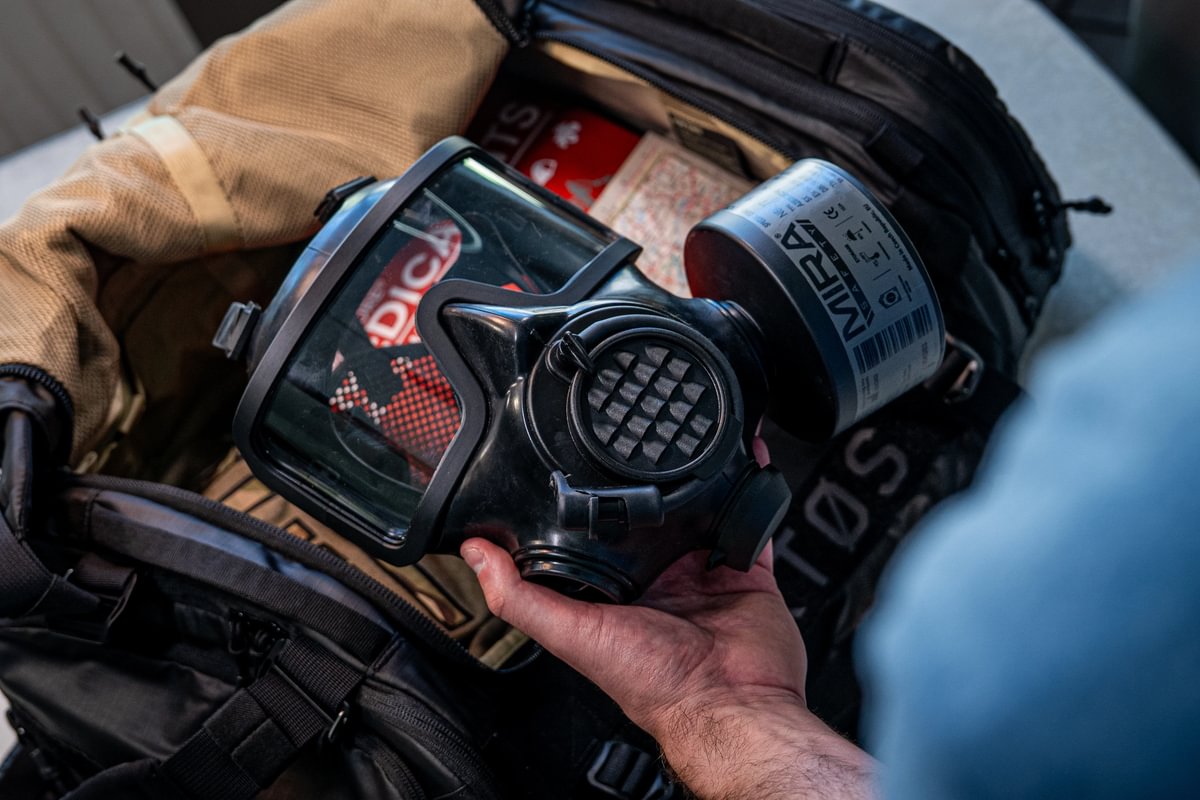
When it comes to gas masks, proper fit is about a lot more than just comfort; a proper fit is essential to their function and, by extension, your survival. Gas masks are a physical barrier between your face and the outside world so the more airtight the seal, the better. But it’s not just about getting the tightest fitting mask and cinching all the straps until you feel your eyes bulging out. A properly fitted gas mask works with your face and maintains a good seal through aggressive movements like running, jumping, or going hands-on with an attacker. And as an added bonus, a good fit will be more comfortable too, keeping you focused and aware for as long as it takes to escape danger. Fortunately, ensuring a gas mask stays where it should is a pretty straightforward process once you know the tricks.
Do I have the right size? Establishing a proper seal How snug is too snug? How to fix an improper seal What about facial hair?Table of Contents
Do I have the right size?

Image source: MIRA Safety®
The first step of course is choosing the right size mask. Thankfully, it’s not rocket science. Mira Safety’s entire gas mask lineup is designed to fit the vast majority of users right out of the box. The majority of CBRN masks are made of bromobutyl rubber, a material flexible enough to mold to different face shapes and sizes, yet tough enough to last for years with minimal maintenance. Both the CM-7M and C21 in Size 2 (Medium) fit 95% of the population but we offer these in three sizes to keep everyone well-protected. Each model has their own sizing chart but, in general, Size 1 (Small) is for users under 130 pounds with narrow face shapes while Size 3 (Large) works best for those over 250 pounds with especially wide face structures.
The CM-8M is available in a single, universal size that’s very similar to the Size 2 of the other tactical models. While this means it fits the broadest segment of the population, the panoramic visor that gives great vision also makes it more rigid, making it more challenging to flex and properly seal against very narrow or super bulky face shapes. For those users, the CM-7M and C21 sizing options are great alternatives.
Child sizing
For preparing the whole family, Mira Safety also has two separate child-specific models. It’s an unfortunate side effect of an uncertain world that the most vulnerable among us are also at-risk during a CBRN event. Smaller bodies also means smaller lung capacity that’s even more sensitive to exposure, which makes a good fit even more important. There’s some good news though: sizing for these is even easier. Less emphasis on tactical features means the MD-1 has more adjustability than adult masks, so it comes in two sizes measured by general age range. The MD-2 uses a hood and positive pressure design to seal around the neck instead of the face, simplifying things even further. It’s a safer, less fatiguing option for children and small teens who don’t usually do well with anything attached to their face for extended periods.
Establishing a proper seal

Image source: MIRA Safety®
Modern gas masks are designed to be easy-to-use even in the most stressful of situations. Even so, the following steps will ensure a rock solid and comfortable seal every time.
-
Keep the mask stored with all straps and buckles fully loosened. For faster deployment, position the mesh head harness stretched forward over the face of the mask, as if the mask were already being worn by an invisible head. This leaves the inside of the mask completely open and clear of any obstruction.
-
Hold your breath and put on the mask chin-first. Fully seat the chin before pressing the upper portion against the top half of the face.
-
Pull the harness over the top of the head. Secure the bottom straps near the jawline first, then work upwards in sequence. The topmost straps should be secured last and need the least amount of tension.
-
Purge and clear the mask. Cover the exhaust valve where air comes out of the mask with a hand and exhale sharply to purge any contaminants out of the mask. Then, cover the intake valve where air comes into the filter and inhale sharply. This creates a vacuum and seals the mask against your face.
And that’s it. Breathe normally and let the mask/filter combo do its job. With only a little practice, the whole process can be done in 2-3 seconds, minimizing exposure to any CBRN agents.
Checking the seal
The best way to make sure a seal is airtight is to perform a Negative Pressure Test. Simply cover the intake valve (where air enters the filter and flows into the mask) like in Step 4 and inhale deeply. There shouldn’t be any leaks around the edges and the front of the mask should pull inward from the vacuum. The only way for air to enter the mask is through the filter, so the internal pressure shouldn’t normalize until after you uncover the intake valve.
It’s crucial to test the mask during activity too. People rarely survive emergencies by standing still and you should be confident that your kit will protect you no matter how chaotic things get. While wearing the mask, try talking, yelling, shaking your head, or jumping, then conduct another Negative Pressure Test. If the mask dislodged or there’s any new leaks, simply tighten the straps closest to the problem area and try again. Also, filters add some weight and bulk so be sure to test the mask at least once with one attached.
How snug is too snug?
While it’s tempting to tug the straps as tight as they’ll go and call it a day, the majority of the mask’s adherence to your face should come from the seal itself. The harness and straps are mostly there to keep it aligned properly and support its weight.
In general, the more snug the fit the better, but you shouldn’t crush your sinuses or get a headache after just a few minutes. That’s why cinching the straps from the bottom-up is your best bet for success. Unless things have gone very wrong, the jaw is the only structural part of the face that moves and it has a pretty wide range of motion across several axes. That translates to the lower straps needing the most tension, but also the most margin for error if you overdo it. Unlike the upper straps, overtightening the jaw area doesn’t cause much discomfort besides limiting mouth movement. Cheek or temple straps need the next highest level of tension as they mostly just stabilize side to side motion of the mask. The topmost straps need the least amount of tightening since their job is just to hold the mask up against gravity.
Nine times out of ten, if someone has a headache from wearing a mask it’s because the topmost straps are too tight. These straps need the least tension and put pressure directly on the skull and upper sinuses if they’re overdone. Starting with all straps fully loose and tightening them in a bottom-up order is the best way to avoid this problem. You should get a pretty good feel for the appropriate level of tension for each strap after only a few tries. Minor adjustments are easy, but be sure to hold the mask in place with one hand if you’re in a CBRN environment while making them.
How to fix an improper seal

Image source: MIRA Safety®
There are several reasons a mask might fail a Negative Pressure Test, most with easy fixes.
-
Long hair isn’t as much of a problem as people think since modern masks have a generous amount of sealing space around their edges. A few strands shouldn’t cause a leak, but enough bulk can still prevent a proper seal. Making sure any hair is out of the way is a good first step to troubleshooting a leak. Problem strands can be tugged out of the way with the mask already on and sealing against bare skin is always best.
-
The same goes for makeup. While I haven’t seen makeup cause an issue for anyone during CBRN training, there’s still a chance that really heavy powder could prevent a seal. If this is a potential issue for you or your family, then keeping a travel pack of makeup remover wipes in your gas mask bag could save a life.
-
Uneven strap tension can cause one side of the mask to lift away from the face. Conversely, some people’s facial structure might require more tension on one strap than the rest. Simply adjust as needed. If you or a family/team member encounter this issue during training, it can save time and lives by marking the proper strap position with a white marker in case someone is incapacitated and needs their mask put on for them.
-
Folded edges can prevent a proper seal. While you’ll be able to feel them pretty easily during training, emergencies wreak havoc on the senses and sheer adrenaline might mask the discomfort. Stowing the mask with the harness pulled onto the front face naturally opens up the inside to help prevent this. Donning the mask chin-first also helps roll the mask onto the contours of the face instead of mashing things together all at once.
-
Loose or cross-threaded filters can allow air past them and into the mask. It’s very uncommon with the 40mm NATO thread, but if you carry a gas mask with you, often day-to-day life can cause things to come loose. Periodically checking your gear is the best way to prevent this. Even better to check your mask and filter connection before putting on the mask if time allows.
What about wearing gas masks with facial hair?
When it comes to CBRN protection, gas masks and beards just don’t mix very well. As mentioned above, masks work best sealed against bare skin and the laws of physics just don’t allow for much facial hair in the CBRN world. There’s a reason military regulations still demand a close shave for all CBRN-rated personnel.
The National Fire Protection Association, NIOSH occupational safety institute, and OSHA have all done extensive studies in the civilian world for firefighters and industrial hazmat workers regarding facial hair. NFPA 1500, NFPA 1981, and NFPA 1404 are the main NFPA standards that cover firefighter safety and Self Contained Breathing Apparatus use. They require that facial hair must not interfere with the sealing surface of a tight-fitting respirator mask. The OSHA Respiratory Protection Standard (29 CFR 1910.134) explicitly states that tight-fitting respirators may not be worn by individuals who have facial hair that comes between the sealing surface of the facepiece and the face or interferes with valve function.
These standards have been rigorously tested both in the lab and in the field, year after year. Based on the evidence, we can’t recommend anything except a bare skin-to-mask seal.
Conclusion
Taking a few minutes to test fit your mask and familiarize yourself with its features can make all the difference in an emergency. Consider that it takes just 0.1 parts per million of CS tear gas to cause severe respiratory symptoms, while more serious agents like Sarin nerve gas can be lethal within 10 minutes at just 0.064 parts per million. Even small leaks can let that nastiness into your lungs and directly into your bloodstream.
Fortunately, gas masks are designed to stay put even during strenuous activity. They’re built for first responders and military service members after all, but preparedness is essential to making the most of this lifesaving equipment. Practicing the above techniques for donning, clearing, and testing your mask’s fit eliminates leaks and cultivates confidence. It’s our ongoing commitment at Mira Safety to keep you informed, equipped, and prepared to handle the unexpected.
Frequently Asked Questions
About the author
