
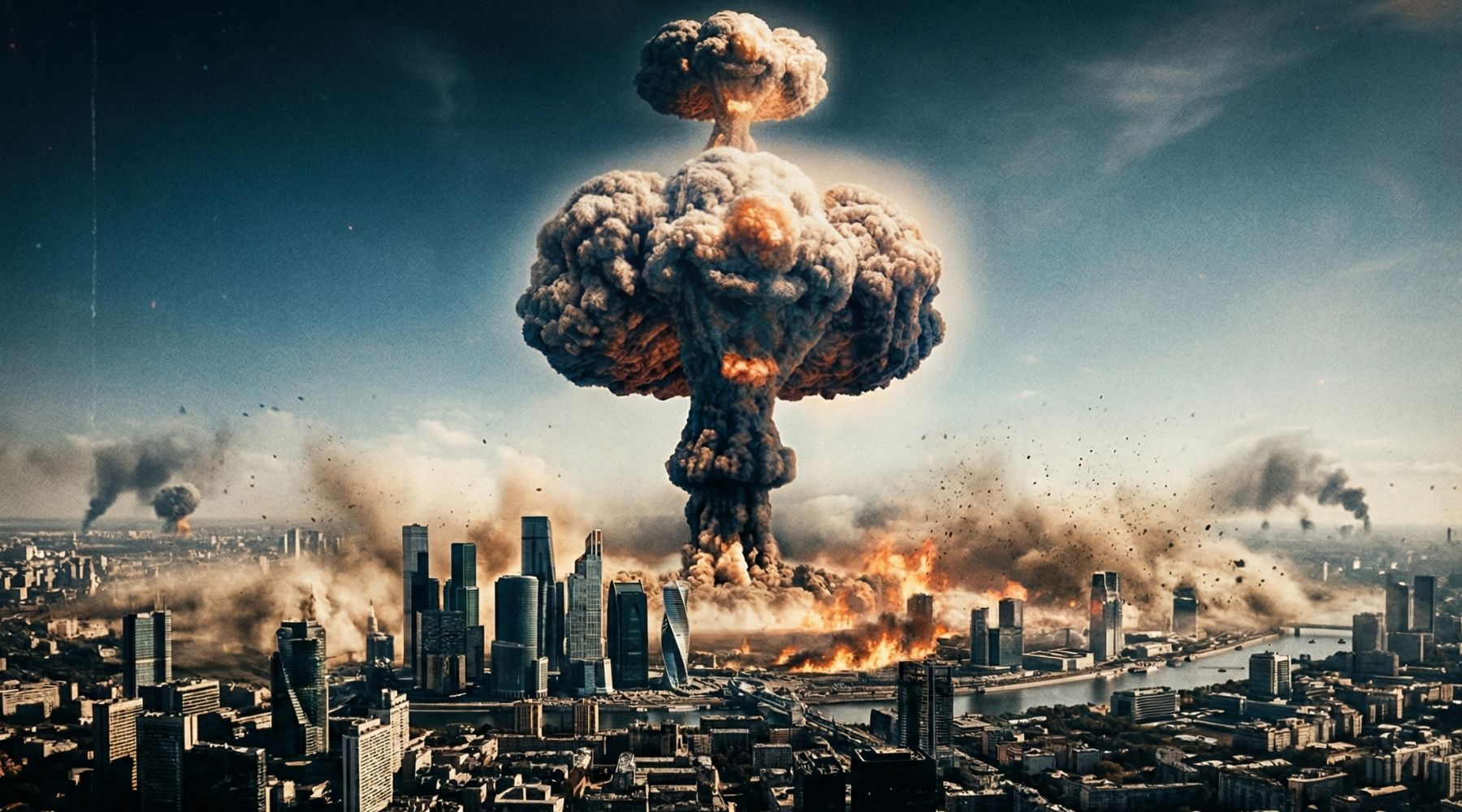
Believe it or not, people have survived standing directly underneath a nuclear bomb blast with no special protection. Back in 1957, five Air Force personnel had a front row seat to the Plumbbob John nuclear test, even having some fun during the whole affair by making a sign that read “Ground Zero. Population: 5.” Directly overhead was the first and only live fire test of the AIR-2 Genie nuclear air-to-air rocket, detonating an actual 1.7 kiloton warhead above the volunteers.
The dawn of the nuclear age was full of radical ideas as both the US and the Soviet Union explored any possible way to outpace each other in the Cold War. The concept behind the AIR-2 Genie was to arm American fighters with a weapon that could theoretically stop massed formations of Soviet bombers before they dropped their own atomic weapons on US cities. As for the volunteers standing beneath the blast, they were totally fine, and if you want to understand your own risk today, our interactive nuclear attack map shows the most likely US targets and blast radius estimates for modern warheads.
Source: atomcentral
[Table-of-Contents]
The five Air Force personnel and the cameraman filming them received a negligible dose of gamma and neutron radiation. The airmen who flew sampling aircraft through the afterglow of the detonation received a much higher dose than the volunteers on the ground, receiving between 13 and 22 rems. In fact, 53 years later, the participants of the entire Plumbbob series of nuclear tests as a whole had a lower rate than the general population. The key to the airmen's survival while out in the open was distance. The W25 warhead in the AIR-2 Genie was detonated at 18,500 feet, well outside the theorized 1,000 foot lethal radius of the 1.7 kiloton yield.

While I’d still advise against standing in the open while any nuclear weapon goes off nearby, the Plumbbob John test proves that you don’t have to be in an underground bunker to survive a blast.
What Are The Types Of Nuclear Damage?
The actual damage created by nuclear blasts is influenced by many variables, but atomic weapons behave in predictable patterns. Thanks to the Operation Plumbbob tests and many other studies, we know quite a lot about what to expect if nuclear weapons are ever fired in anger.

There are three main types of damaging effects from nuclear blasts:
-
Thermal Radiation: Nuclear weapons release intense amounts of heat, up to 100 million degrees Celsius in the very center of the fireball at the instant of the chain reaction. This heat energy dissipates rapidly as distance increases, but the thermal pulse of a nuclear weapon is still a substantial threat much further away than from any conventional explosive. Post-blast data from Japan estimates that the temperature was still over 3,000℉ over a half mile away, enough to ignite fires and burn exposed skin from just the radiated heat alone.
-
Shockwave: The supersonic (Mach 3 or above) air displacement of a nuclear weapon causes a high pressure wave of overpressure called a “shock front.” The kinetic force of this overpressure wave expands outward in a roughly circular pattern from ground zero, physically knocking buildings down and causing widespread casualties. Air, as a compressible gas, propagates kinetic energy under the laws of fluid dynamics, so the majority of a nuclear blast’s damage comes from the expanding shock front. As much as 50% of a blast’s total energy is transferred through the shockwave. Even as the strength of the overpressure wave itself drops below the fatal threshold, thrown debris can cause severe injuries or death outside the lethal range. Because light travels faster than sound, broken glass is a major risk factor for people who see the brilliant flash and move towards windows to investigate. For a deeper look at how each of these forces plays out in the real world, our guide on the effects of a nuclear bomb explosion walks through the physics in detail.
-
Ionizing Radiation: Ionizing radiation is the danger most associated with nuclear blasts, but it only accounts for roughly 15% of the total energy released by a blast. That’s not to say it isn’t dangerous though and it creates persistent risks over wide areas that aren’t a factor following conventional attacks. The nuclear chain reaction that sets off a nuclear weapon releases large amounts of gamma, neutron, x-ray, and ultraviolet radiation that can be lethal or cause severe burns to exposed persons, but these are very short-lived (milliseconds to minutes after detonation). This initial “prompt radiation” is generally only lethal over a comparatively short distance; enough that the fireball and intense shockwave are probably enough to get you anyway. It’s the fission products (essentially nuclear waste) that gets scattered by the exploded core of the bomb that creates the ongoing radiation threat. There are over 300 different fission products created by a nuclear blast, each with their own half lives that range from seconds to years, and these particles bind to dust and collect in water droplets before falling back to Earth as fallout. The greatest concentrations of radioactive fallout will generally be immediately surrounding the blast site, but high altitude winds can carry dangerous amounts of fallout for many miles, potentially across continents.
What Are The Different Zones Of A Nuclear Blast?

Now that we understand the main sources of damage from a nuclear weapon, we can start to map out what a post-attack landscape would look like. It’s helpful to examine a hypothetical detonation using distinct zones, either looking at the distance radius of particular effects or the severity of casualties at specific distances from ground zero. These zones or bands help emergency response personnel plan their response to an attack, including necessary protective equipment in different areas, and what types of injuries they’ll encounter among survivors. The exact ranges for each zone will, of course, depend on many factors like terrain, building materials, weather conditions, and so on, but by plugging in the yield of a detonation (i.e. how big of a bomb was set off) we can get a pretty good estimate of its effects.
The Federal Emergency Management Agency uses a four-zone classification system.
-
Severe Damage Zone: Closest to ground zero, this area is subject to the maximum intensity of thermal, shock, and radiation effects. Nearly all buildings are destroyed and there are few, if any, survivors. Local radiation levels will be immediately hazardous along with other threats to personnel like fires, flooding, and unstable structures.
-
Moderate Damage Zone: Moving further away from ground zero, buildings and persons still suffer significant damage, but there’s more variability in outcomes. Depending on structure type, surrounding barriers, and the exact circumstances at the time of the blast, persons may be instant fatalities or suffer survivable injuries. Injuries in this zone are likely severe and many will require prompt medical attention to survive, but degraded medical infrastructure and other factors like collapsed buildings limits how many will receive the care they need.
-
Light Damage Zone: Further out from ground zero, the Light Damage Zone represents a major catastrophe, but a survivable one. Most of the injuries here come from broken glass or flying debris; still dangerous but treatable with basic first aid equipment. Chances of survival in this zone are generally good, but be aware that fires, downed power lines, gas leaks, and other complex hazards can still cause casualties after the blast so it’s important that both survivors and rescuers stay alert as they move to safer areas.
-
Beyond Light Damage Zone: By far the largest individual zone, the Beyond LDZ represents the outer extent of damage from the blast. Damage to structures or vehicles at this range will almost exclusively be on the side facing the blast, while persons will generally suffer only minor injuries. Survival at this distance is very likely, at least in the short term.
Using FEMA’s model, we can see that for a 100 kiloton warhead detonated at an altitude of 5,000 feet, Severe damage extends out to about 1.5 miles from ground zero, Moderate damage to 3 miles, Light damage to 7 miles and beyond. That gives unsheltered persons a decent chance of survival past 3 miles or so, while the chances for even sheltered persons decrease dramatically at anything closer than 2 miles.
Practical Examples Of A Nuclear Fallout
FEMA’s model is great for emergency planning, but it has limitations. Modern weapons are many times more powerful than 100 kilotons, so the ranges of each zone will also be much greater. To get a better idea of what an actual in-service weapon would do, one of the best free resources available is Alex Wellerstein’s NUKEMap.
This fantastic website allows anyone to examine the estimated effects of just about any size weapon anywhere in the world. This allows us as civilians to stay informed about our own risks if a weapon targets a nearby city, military base, or landmark. NUKEMap is more of a scientific tool than an emergency response planning resource, so it doesn’t use FEMA’s four damage zones and instead maps out the radius of particular effects, but we can still use these to estimate various survival scenarios.
Warhead size matters. A lot.
To give us some examples to look at without causing an international incident, I simulated Russia’s Topol SS-25 ICBM detonating in the middle of the Pacific. This 800 kiloton warhead is over 53 times more powerful than the bomb that targeted Hiroshima (15 kilotons) and creates a fireball 1.2 miles wide. The heat pulse remains a significant hazard past 6.8 miles from ground zero, while the shockwave still causes light damage out to 11.4 miles from the center. Assuming a person is inside a typical house and stays away from any windows, there’s a decent chance they’d survive with only minor injuries at around 7 miles or above. Bear in mind this is just a generalized picture of the initial blast and many variables can affect that chance.
Next, let’s upgrade to a different threat in the DF-5. The DF-5 is China’s first domestically developed ICBM and remains in operational use. The DF-5 can carry up to 10 warheads, or just one for maximized yield. Assuming the unitary warhead option, the DF-5 can pack a punch of up to 5 megatons (5,000 kilotons), and that significantly changes the distances involved. The fireball is roughly double the size of the Topol at over 2.5 miles wide. Thermal radiation can still cause severe damage beyond 15.2 miles, and shockwave damage extends all the way out to 21 miles. To get the same chance of survival we estimated for the Topol, an individual would have to be 16 miles away or more.
Thankfully, the unitary DF-5 warhead is about as big as modern thermonuclear warheads get, with most operational missiles sticking to 1 megaton or below. Still powerful, but with much smaller Severe and Moderate Damage Zones, giving civilians better odds of survival. Of course, a lot still depends on luck since we don’t exactly get to choose how far away a warhead actually is when it goes off.
How Long Until Nuclear Fallout Is Safe?
 So far, we’ve only covered the hazards posed by the direct blast and fireball. Radioactive fallout is an invisible and much more insidious threat. There are many cases of individuals in Hiroshima and Nagasaki surviving the initial blast unharmed, only to succumb to acute radiation sickness days later. Over the longer term, the Japanese Red Cross documented a rate of leukemia incidence 4 to 5 times higher among survivors of the Nagasaki bomb than the general populace, as just one consequence of exposure to fallout.
Radiation safety is a very complex topic and we have a whole article about it that you can read here. But for the purposes of estimating survival chances after a nuclear attack, the main principle is limiting exposure as much as possible. Unlike their distance from the initial blast, survivors do have some measure of control over how much radioactive fallout they’re exposed to. Nuclear fallout starts returning to Earth within just a few minutes and remains extremely dangerous for the first 24 hours after a blast. There is some good news though in that some of the most radioactive fission products decay within that first 24 hour window. If survivors can find shelter that’s as airtight as possible, or otherwise reduce their exposure to this initial fallout, they’re at much less risk of radiation sickness or other long-term effects. Our complete guide on how to survive nuclear fallout covers shelter selection, decontamination, and the specific actions to take in each hour of that critical first day.
It’s a bit of a catch-22 though, since survivors need to move away from ground zero and seek medical attention for any injuries they’ve sustained, yet those first 24 hours are some of the most dangerous as far as radiation exposure goes. There may not even be any suitable shelter in the immediate area, forcing survivors to keep moving through the hot zone while they’re the most vulnerable.
How To Increase Your Chances Of Surviving A Nuclear Fallout?

Image source: MIRA Safety®
It’s for precisely this scenario that MIRA Safety® offers high quality CBRN-rated gear. Our professional grade gas masks and REACTOR rated NBC-77 SOF® filter are designed to protect against many of the radioactive elements in fallout, allowing survivors of a nuclear blast to dramatically reduce their exposure to fallout, especially in those first 24 hours following an attack. Since it may take quite some time to access medical care and proper decontamination facilities after a catastrophe of this scale, having your own protective gear and decon equipment fills in the essential gap between initial survival and reaching safety.
Fallout can also extend many miles beyond the blast site, putting neighboring counties and states in danger as well. A good radiation detector can tell when a fallout plume is reaching unsafe levels, or help you avoid radioactive hot spots while evacuating from a blast zone. Nuclear fallout not only spreads over a wide area, but it can last for months or years, especially in areas downwind of ground zero.

Image source: MIRA Safety®
One of the most dangerous and persistent threats within nuclear fallout is iodine-131. The human body needs iodine for proper thyroid function, but our cells can’t tell the difference between stable iodine like we normally find in our diet, versus the dangerously radioactive iodine-131. Potassium iodide tablets (KI) are a relatively straightforward, FDA-approved method to prevent iodine-131 absorption. Supplementation with safe iodide prevents uptake of the iodine-131 released by nuclear blasts and reactor accidents, so that it doesn’t accumulate in the thyroid gland and continually expose the body to beta and gamma radiation.
While we may not get much say in if or where a nuclear bomb goes off, that doesn’t mean we can’t significantly improve our chances of survival should the unthinkable come to pass. With a little luck and the proper preparations, we can give ourselves every advantage to make it through even the deadliest of nuclear blasts, starting with a gas mask buyer's guide that helps you choose the right protection before you ever need it.
[FAQ]
About the author


