
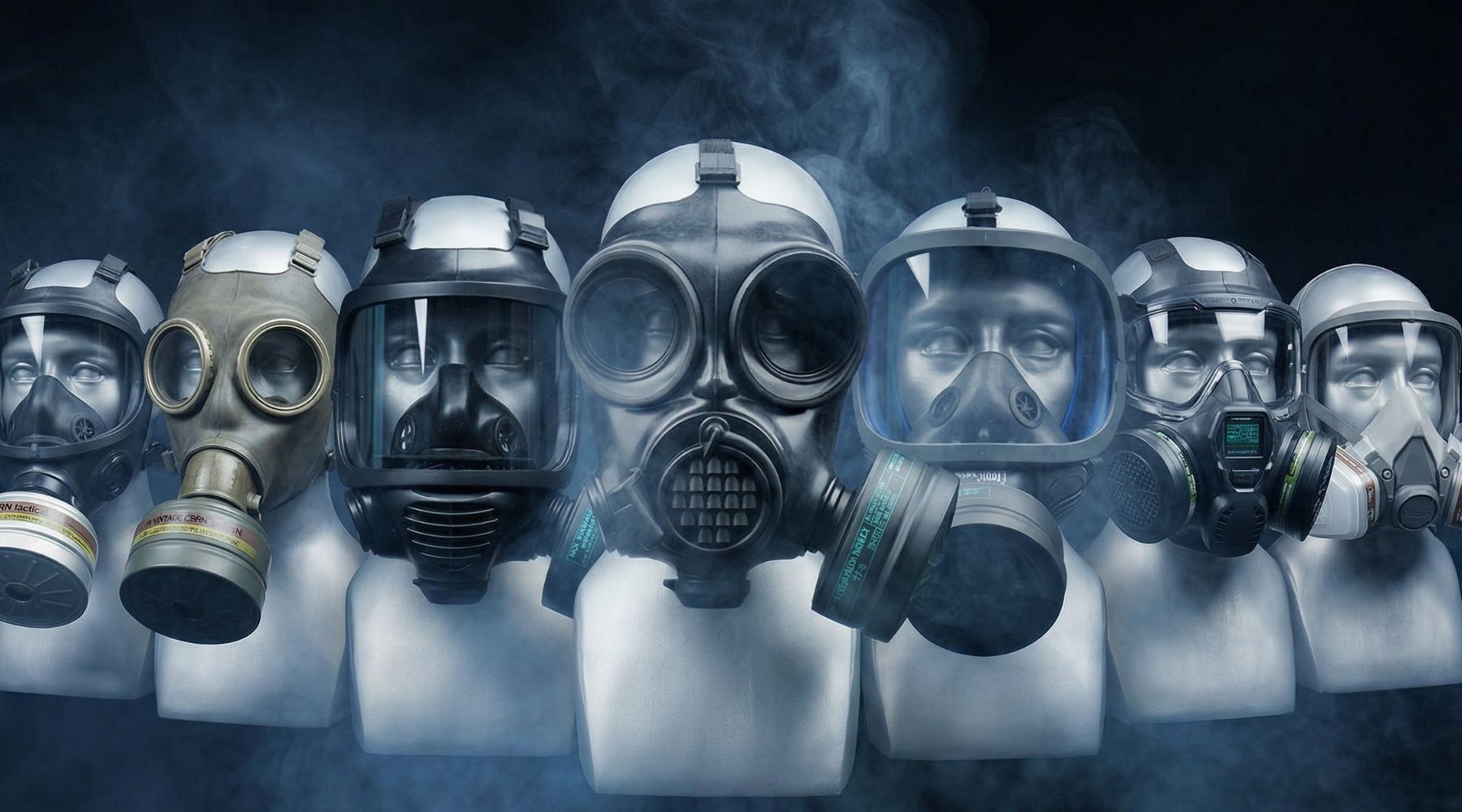
Like any piece of lifesaving equipment, it’s both natural and sensible to have questions about how effective a gas mask is. We don’t want our first indication that a particular mask or filter isn’t up to snuff to be when we’re surrounded by a sickly yellow cloud. Short of walking into a tear gas chamber like the military does, how can we, as civilians, be sure a mask will work as advertised? If you're still in the research phase, our gas mask buyer's guide is the best place to start, as it walks you through exactly what to look for before you spend a dollar.
What Is LD50 In Simple Terms? How Gas Masks And Filters Are Tested How Effective Is a Gas Mask?Table of Contents
When a P3 filter says it will block 99.99995% or more of viruses and particulate biohazards, how do we know the remaining 0.00005% isn’t harmful? Let’s investigate the deeper questions about gas mask effectiveness, both to make better preparedness decisions, and to build some much-needed confidence in our equipment.

Image source: MIRA Safety®
What Is LD50 In Simple Terms?
There’s a phrase in the medical world that says “The dose makes the poison.” First credited to 16th Century Swiss physician Paracelsus, the saying describes how anything in nature can be toxic if a person is exposed to enough of it. Oxygen, sunlight, and even water are all things we’d consider “healthy,” but can be downright deadly in extreme amounts. The saying works in the opposite direction too. Chemicals that we consider “toxic” can be harmless if we’re only exposed to a tiny amount at a time.

Cyanide is a great example since it’s one of the first compounds that comes to mind when someone mentions the word “poison,” yet cyanide shows up in some very surprising places when we look closer. The humble apple actually contains 3 mg of amygdalin, which releases cyanide when digested, in each of its seeds, yet we don’t have morgues full of people who actually swallowed an apple seed or two (aside from the choking hazard of course).
The human body isn’t completely defenseless against toxic compounds; it has the ability to neutralize poisons and repair their damage up to a certain point. Some compounds are more dangerous than others, and some people can tolerate more or less of it than the rest of us. We all know that one person who can drink heavily all night and still walk home afterwards, while another friend is a complete lightweight who starts stumbling after just a glass of wine.

That’s why there’s a concept in Toxicology called LD 50, which is shorthand for Lethal Dose 50%. Basically, a chemical’s LD50 is the dose at which we’d expect to see half of those exposed to that amount to die from the exposure. This is a statistical measure, not a prediction of actual fatalities; but it’s a useful metric for comparing how dangerous different chemicals are since it factors in the natural variation from person to person. That fact makes a chemical’s LD50 measurement especially useful for doctors and emergency responders who need to determine treatment and triage procedures after an incident. In the case of hydrogen cyanide, the type released by digested apple seeds, the LD50 comes out to 3.7 milligrams per kilogram of body weight.
That translates to 296 milligrams of cyanide to kill the average 80 kilogram (176 pounds) adult roughly half the time, or about 98 apple seeds' worth of amygdalin. So unless you’re actively chewing close to a hundred apple seeds a day, your body can easily process the tiny amount of amygdalin and cyanide that leaches into the rest of the apple we eat.

Applied toxicology
What that means for us in the gas mask world is that, even though no filter is 100% effective against all toxic compounds, the scattered molecules that might make it past a filter are so few that our body doesn’t suffer any ill effects. It’s a similar principle for germs and radioactive threats: our immune system and cellular DNA repair mechanisms are built to handle the odd germ or background alpha particle that we run into.

It’s when those defense mechanisms are overwhelmed by the number of germs or radioactive particles that we start having problems. This is oversimplifying a bit, different pathogens and radioactive sources damage different parts of the body in different ways and we haven’t covered the dangers of chronic exposure, but the deeper science of how the human body protects itself is as complicated as it is fascinating. We don’t need to know exactly how our body handles each and every type of dangerous molecule or infectious cell; it’s enough for our purposes as prepared civilians to know that we need not panic if a single atom or two makes it through a barrier like a filter canister. To understand exactly how those filters intercept threats in the first place, our guide on how gas masks work and what they protect against covers the full filtration science in plain English.
This doesn’t mean we don’t take CBRN threats seriously though. Some threats are so dangerous that they start to get lethal at alarmingly low dose rates. The LD50 for Sarin nerve gas is about 0.09 milligrams per cubic meter, making it 26 times more deadly than the cyanide we covered earlier, and newer varieties of nerve gases are even deadlier. A very recent example is the 2018 poisoning of Sergei and Yulia Skripal in the UK. The former Russian intelligence officer and his daughter were deliberately exposed to Russian-developed Novichok agents in Salisbury, England, allegedly as revenge by the Russian GRU and in an effort to silence them.
The Novichok family of chemical weapons are 5 to 8 times more deadly than the infamous VX agent featured in the movie The Rock, with an LD50 measured in micrograms. Even though the targets of the chemical attack were just Sergei and his daughter, the nerve agents are toxic at extremely low concentrations, such that 38 members of the public and emergency services were sickened through incidental exposure. Sergei and Yulia barely survived and had to be placed in a medically-induced coma to avoid organ damage while they spent weeks in the ICU, and the long-term health effects of Novichok exposure are still unknown. Given the risks of even low concentrations of agents like these or highly pathogenic diseases, gas masks and filters are built to capture as many molecules as the laws of physics allow. This is also why surplus and cheap gas masks can be genuinely dangerous: a mask that fails a filter integrity test in a Novichok environment isn't a minor inconvenience.
How gas masks and filters are tested

Image source: MIRA Safety®
Modern gas masks are a very mature technology. They’ve been protecting soldiers and industrial workers in some of the most challenging environments since the days of World War I. As a result, engineers have a pretty good idea of not just how to build gas masks, but also how to test new designs and formulations. Masks and filters are built to specific standards set by different governing bodies or industrial associations, depending on the region where a gas mask is built or who it’s issued to. In the case of MIRA Safety masks, we adhere to the European Standards (EN) set by the three European Standardization Organizations for our masks and filters.
Specifically, EN standards 143, 14387, and 149 are the main documents that regulate how respiratory protection gear is designed, built, classified, and tested. Different components or attributes of the mask and filter (breathing flow rate, breakthrough time, particle or gas filter efficiency, etc) are tested in different ways to measure their effectiveness and the whole system can be quite complex. For example, under the EN 13274 standard, the particulate filter efficiency against oil and non-oily aerosols is measured using separate mixtures of sodium chloride and paraffin oil at different flow rates. To meet the highest performance level of P3 under EN 143, a particulate filter must filter 99.95% of particles at a flow rate of 95 liters per minute. The particulate layer in our NBC-77 SOF filter canisters exceeds this with an efficiency greater than 99.999%.
Gas filtration performance is tested under EN 14387, which categorizes hazardous gases under lettered classes (A for organic vapors, B for inorganic vapors, E for acids, etc) and a filter’s performance level is graded from 1 to 3. Higher is better so to receive the B2 level of certification, a filter must resist breakthrough at 5,000 PPM of hydrogen sulfide for at least 40 minutes. Once again, our NBC-77 SOF filter exceeds this with a breakthrough time of over 80 minutes. 5000 parts per million is an extremely high concentration of gas, so the exact lifespan of a filter depends quite a bit on which threats are involved and how dense the CBRN environment is. For comparison, the usual level of carbon dioxide in everyday outdoor air is around 400 PPM.
The EN standards are actually stricter on results than the US-based NIOSH standards regarding total inward leakage and breathing resistance, so all of our masks and filters have to meet very high performance metrics to surpass these standards. That’s why our products are trusted by military and emergency response professionals all over the globe.
How Effective Is A Gas Mask?
Gas masks and filters protect soldiers and civilians in all kinds of emergency and workplace settings, using proven science, high-grade construction materials, and transparent testing standards. A very visible and increasingly commonplace example of their effectiveness comes from within our own cities — police officers are routinely exposed to tear gas and riot control agents, yet they operate effectively as a team in even the thickest clouds of CS gas. If that's your specific concern, our guide to the best riot gear gas masks for personal protection covers the exact filter types and mask fits built for that environment. Against even more dangerous aerosol or gaseous threats, the right mask and filter will protect you long enough to respond effectively and escape.
Frequently Asked Questions
About the author
