
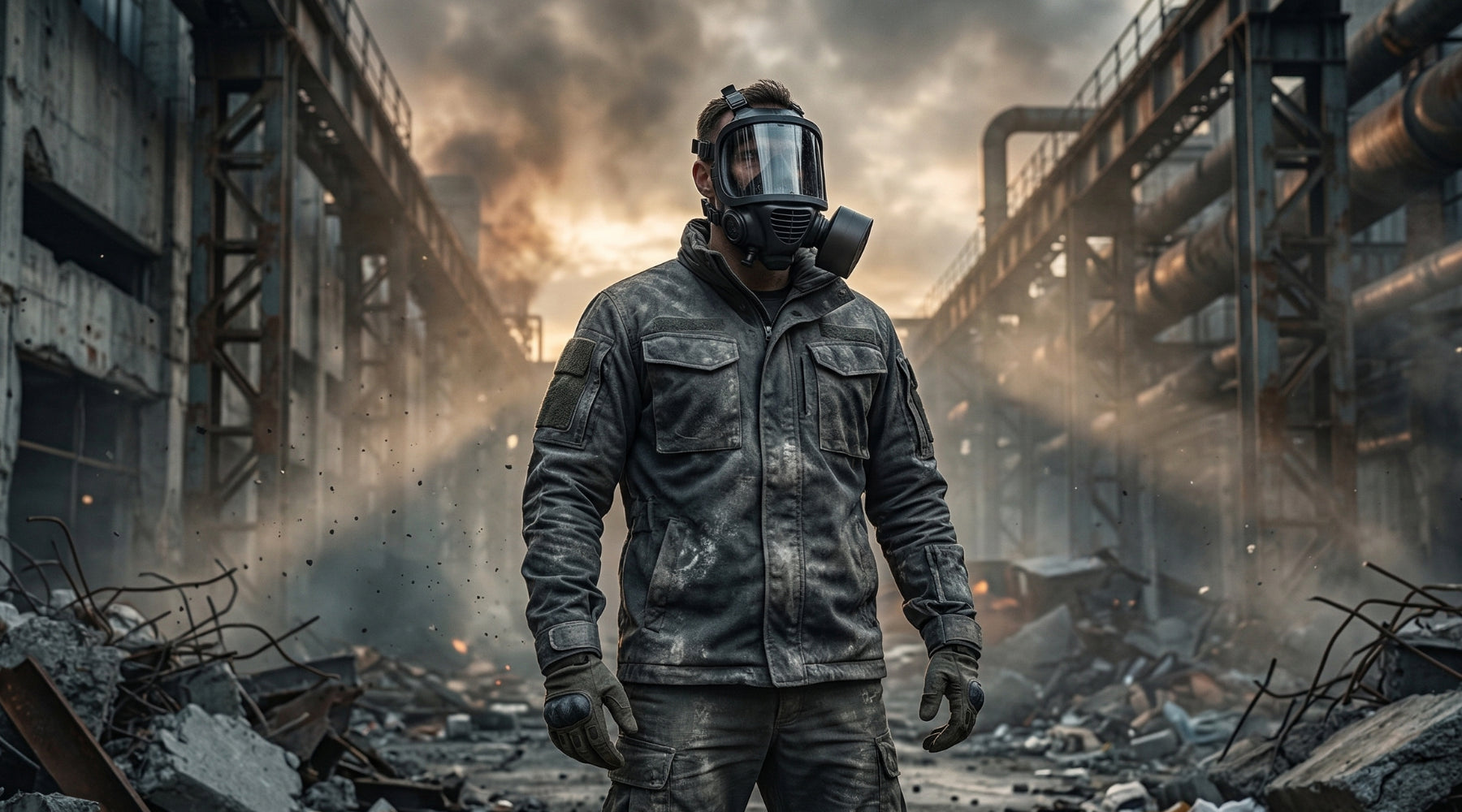
There’s no shortage of toxic chemicals, viruses, radioactive substances, and other hazardous materials out there that can do serious harm to living things. All of them work via different mechanisms and attack different parts of the body. Fortunately, gas masks defend against a huge variety of them, and you don’t need a chemistry degree to understand how they work.
Here is a quick rundown of how gas masks and filters protect people from all walks of life when the unexpected comes their way.
[Table-of-Contents]
The basics
The most fundamental principle of a gas mask’s function is to prevent any unfiltered air from reaching our airway. The facepiece physically blocks unfiltered air in such a way that the only way for new air to enter the mask is to go through the filter canister. It’s the job of the filter canister to scrub the air as it flows through, removing or neutralizing hazardous materials from the air so that, by the time the air reaches our mouths and nostrils, the air is as pure and clean as can be.

This depends on two main things: a good seal between the mask material and our faces, and a filter material that’s rated for the type of hazardous material that’s present in the environment. The mask material also needs to be tough enough to stand up to aggressive chemicals so that the seal stays airtight no matter what.
Why filters are so important
Since the mask is mostly just a physical barrier that isolates our precious airway and mucous membranes from the outside environment, it’s the filter canisters that do the real job of purifying the air we breathe.
The first way that canisters accomplish this is by trapping the bad stuff while letting the good air slide through. In more technical terms, the vast majority of chemical filters use a layer of activated carbon to adsorb hazardous molecules, sort of like how dust sticks to the surface of sticky tape if you leave it out too long. Activated carbon has a very porous texture with tons of microscopic holes that provide a lot of surface area. It’s these millions of tiny pores in the surface that makes it “activated” rather than just a lump of coal.

When highly reactive chemicals collide with the tightly-packed grains of activated carbon in a filter, molecular forces (called London dispersion forces) cause the atoms to electrostatically “stick” to the carbon structure. Most water filters you’ll find at home goods or camping stores work via the same principle, just with a different distribution of activated carbon. However, don’t try to use a water filter in place of an actual gas mask filter, as the size and distribution of the carbon grains are totally different to allow air to flow evenly through the canister.

Filter canisters also usually have a particulate filter layer as well to trap larger dust and aerosols before they reach the carbon layer. These work in the same way as HEPA air filters or medical N95 masks, just at even higher efficiency. Tiny fibers knit close together act as a microscopic strainer, catching anything larger than the mesh weave. Our filters at MIRA Safety® are built to the P3 standard, meaning they filter out more than 99.9999% of particles above 0.2 microns in size. This makes them ideal for capturing harmful dust and aerosolized pathogens, either on their own, like in our ParticleMax P3 filter canisters, or as part of our multi spectrum CBRN filters like the NBC-77 SOF® filter. Having a particulate filter in front of the activated carbon layer also helps the carbon last longer before it gets saturated and needs replacing.
Better living through chemistry

Activated carbon is usually treated with additional ingredients that chemically react with certain toxic agents, rendering them inert and harmless. Through a process called impregnation, these ingredients enhance the efficiency of the filter canister against specific threats, and changing the makeup of these additives helps “tune” the filter against particular agents. Phosphoric acid, sodium hydroxide, copper salts, and potassium carbonate are just some of the additives used to neutralize Volatile Organic Compounds (VOCs), sulfur-based agents, and many other CBRN threats. These additives help the canister purify the air before it goes into the mask better than activated carbon alone.
The mask itself
While the mask and facepiece might look like just a bunch of rubber, there’s a surprising amount of science at work here too. As mentioned above, the mask needs to be chemically resistant to some of the harshest compounds in the world. For just one example, the sulfur compounds in mustard gas can rapidly eat through natural rubber and even steel or brass. This means that the mask needs to be constructed from special materials like bromobutyl rubber, which is remarkably stable and can stand up to blister agents, acids, and strong bases. It’s also dense enough to prevent very lightweight chemical agents like hydrogen cyanide from seeping through. All of our CBRN-rated gas masks are made with bromobutyl rubber.

To keep the good air flowing in while keeping the bad air out, gas masks use one-way valves that use the air pressure of the user’s own inhalation and exhalation rhythm to control the flow of air into and out of the mask. Most mask designs have an inlet valve behind where the filter canister attaches, plus an outlet valve near the user’s mouth so that exhaled air clears out of the mask quickly even during strenuous activity. The gas mask design itself also needs to be comfortable enough for extended wear.
This means gas masks have to strike a delicate balance between being flexible enough to move with the user, while staying rigid enough to maintain their shape and seal. The interior of the mask also needs to move air across the visor to prevent fogging. During an emergency, it’s almost as important to see where you’re going and avoid danger as it is to keep breathing.
Putting it all together
A gas mask is only as good as its filter, and a filter is useless without a mask. The combination of these two components working in tandem is what keeps us safe in a CBRN environment. The exact design and materials of filters and masks available on the market varies wildly, but they all work according to the same basic principles mentioned above.

Image source: MIRA Safety®
To get your own gas mask and filter combination that’s ready to go right out of the box, have a look at our EvakPak™ Survival Kit. Complete with a carry bag, two types of filters, and radio protective Iodine tablets, this kit was built to offer the most versatility and protection available in a single, easy-to-use package.
[FAQ]
About the author


