
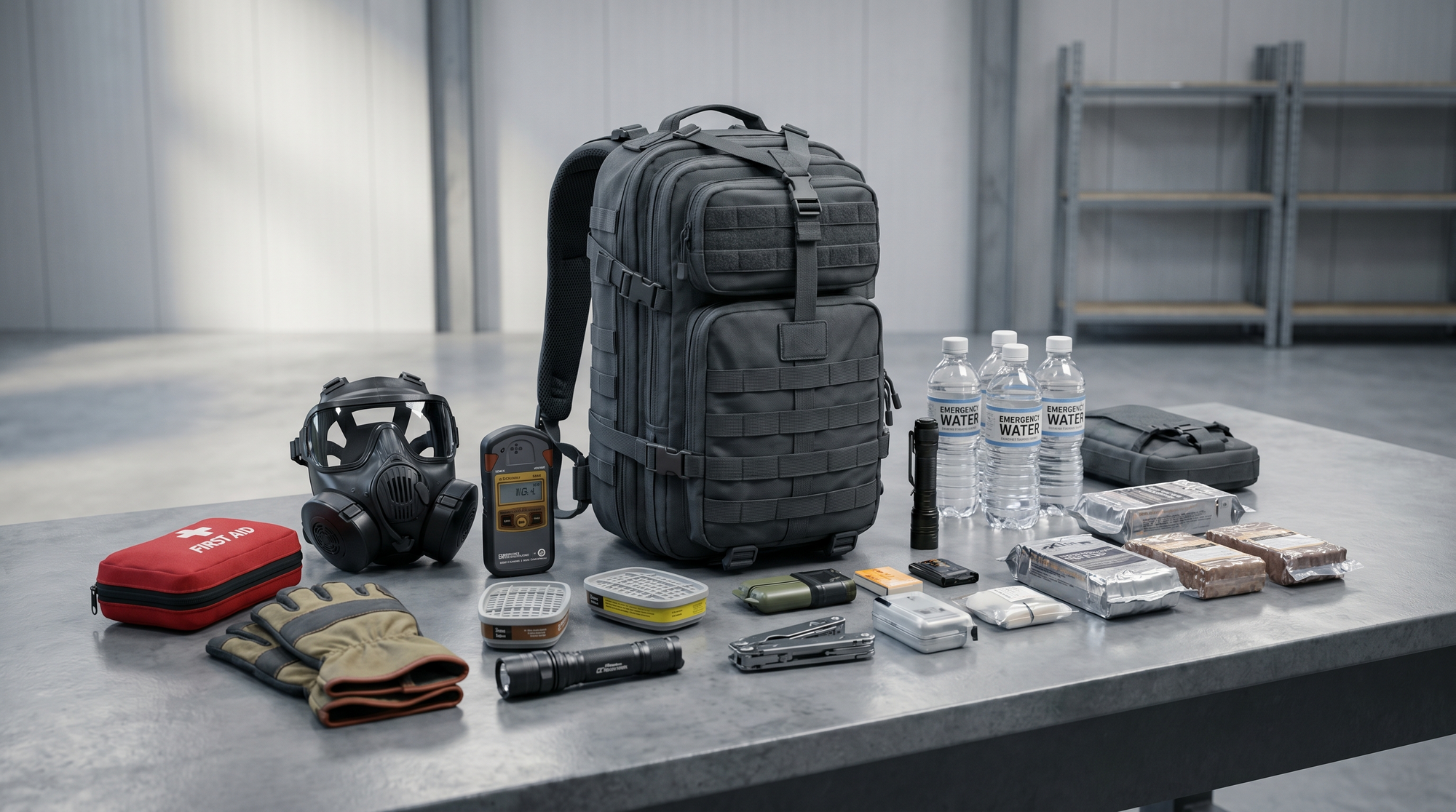
With global tensions, industrial sabotage, and civil unrest on the rise in 2026, your bug-out bag needs to go far beyond the basics. In addition to water, food, and a first-aid kit, pack reliable PPE—like a full-face gas mask with CBRN-rated filters, a semi-permeable MOPP suit, and a compact dosimeter— to shield yourself from chemical, radiological, and crowd-control threats.These next-gen essentials ensure you’ll be ready to survive—and even thrive—when “bugging out” becomes reality.
Addressing The Basic Survival Kit Mask On And Bugout The Ever Essential Bug Out Filter The Best Full Body Bug Out Protection Threat Detection Checklist Next-Gen Bug Out Bag Build Survival Gear The Bottom LineTable of Contents
Key Takeaways
• A bug-out bag is a portable 72-hour survival kit (the FEMA standard), covering water, food, shelter, first aid, and communications, plus modern PPE.
• Bug out bag essentials in 2026 include a CBRN-rated full-face gas mask, two filters per person per day, and a semi-permeable MOPP suit, the PPE tier that separates a serious kit from a camping trip.
• MIRA Safety core stack: CM-8M full-face respirator, NBC-77 SOF filter (or VK-530 for smoke and carbon monoxide), and the MOPP Suit.
• Threat detection is the most underrated essential. A Geiger-2 dosimeter and CWD-3 nerve agent strips let you make decisions before exposure, not after.
• 72-hour filter rule: stock at least two 40mm NATO filters per person per day of expected use.
What Should Be in a Bug Out Bag?

A complete bug-out bag covers water, food, shelter, first aid, and communications; but in 2026, personal protective equipment belongs on that list too. A bug-out bag is basically a survival kit that should contain all necessary tools and supplies that you may require to "bug out" of a serious situation. Some may call it a "go bag" and others may simply refer to it as an emergency kit, but at its core, it's designed to contain everything you may need to survive after you escape. The Federal Emergency Management Agency (FEMA) recommends, at minimum, a 72-hour emergency kit; a bug-out bag is the portable, self-sufficient version of that standard.
We're not going to focus on the average survival gear list that looks like the family camping trip to the lake in our bug-out bag guide. From a basic flashlight to a full list of survival tools, we'll cover all the bug-out bag list essentials to ensure that you're ready for any situation that may arise.
Despite this article focusing on the elevated threat levels we face in 2026, we'd be remiss if we didn't at least mention the basics. You're ahead of the curve if you bug out with a gas mask and level IV armor plates. However, if you live in Montana in the winter, and you forgot to bring your sleeping bag, it's going to be a long 72 hours before you make it back home.
The checklist below is fairly comprehensive and covers things like water, food, sleeping bags, first aid kit, and most items you need to cover your basic emergency situation. In many ways, it does resemble your average family camping list minus the S'mores and hot dogs.
As you can tell, a good bug-out bag should equip you to handle any survival situation that may arise. This goes without saying, but you should avoid putting your stuff in a flimsy trash bag if you're preparing for a bug-out situation. Instead, we recommend you invest in a reliable bag kit that has adequate space, since this will be your compact survival kit.
Here at MIRA Safety, we focus more on the PPE selection of emergency preparedness, and we highly recommend that your complete bug-out bag has PPE essentials. When building a bug-out bag, it's important to mention that many of the items would be similar to a CBRN go bag, though you'll have to prepare for any situation, such as wilderness survival or the extreme cold.
For instance, you won't put a fishing kit in your go bag, but you should absolutely consider keeping one. Remember, if you need a bug-out bag survival kit, you also need to be prepared to live in any situation. Serious survival skills will go a long way in keeping you safe.
Do You Need a Gas Mask in Your Bug Out Bag?
Chemical incidents, industrial accidents, and crowd-control deployments make a full-face respirator one of the highest-value additions to a modern bug out kit. The Norfolk Southern train derailment in East Palestine, Ohio (February 2023) is a great example of a chemical incident that can happen at any moment. Respirators and gas masks are a crucial component of any bug-out bag in 2026, and we have the ongoing conflict in Ukraine and OPCW-documented chemical incidents to thank for that. Across Europe and the United States, we are seeing industrial sabotage popping up at an alarming rate. Hybrid warfare seems to be the order of the day as chemical plants and munitions factories are catching on fire more frequently.

We're not asking you to throw a gas mask into your survival bag because we think that a foreign enemy is going to rain mustard gas down upon your family picnic. Rather, they just need to let a train full of toxic chemicals derail and the outcome will be the same. From basic bag items, like a survival knife, to dried snacks, every bug-out bag should have gas masks too.
If you're in the market for a reliable respirator that can keep you safe, the CM-8M is everything you need. It is important to point out that all Mira Safety masks and filters use the 40mm NATO threaded interface, the same standard adopted by NATO militaries worldwide.
The CM-8M essentially combines the best of both worlds, giving you an even wider range of vision than the CM-6M. combined with the optics/rifle compatibility of the tactical CM-7M mask. It’s the first completely original gas mask design we’ve ever deployed, and it’s already getting rave reviews from users in the field.
Recently, there were countless incidents recorded of civilians driving by when they stumbled upon an unruly mob facing off with law enforcement. Again, chemical crowd control has been used by both law enforcement and unruly agitators to control the conflict zone and there is every reason to believe that we are going to see more of that in 2026.
If your packed bag is full of survival gear and equipment, we do have an option that you can keep in your mobile bag for such scenarios. If you need something smaller for a basic bug-out kit, there’s the Tactical Air-Purifying Respirator (TAPR).
Since the TAPR is a half-mask, it won’t protect your eyes or the upper part of your face like a traditional gas mask. As such, it’s more ideal for purse/satchel carry. For duffle bags or other big bags, we recommend going with a full-sized gas mask as a part of your preparedness kit. A TAPR would also be great as a backup respirator if you have the room for it.
Which Gas Mask Filter Is Best for a Bug Out Bag?

Your gas mask is only as effective as the filter you pair with it, as filter choice determines which threats you can handle in the field. During Marine Corps recruit training at the Marine Corps Base Parris Island, recruits are taken into a chamber filled with CS gas while wearing gas masks. They are then asked to take off those masks and breathe the air, where a copious amount of vomiting and snot ensues. They are then asked to put back on the mask, clear the air inside, and begin to breathe normally again.
This is done to give the Marines the confidence in a fight that the masks work. When the dreaded "gas, gas, gas" warning is called out, those in a conflict zone do not have time to wonder if what they are about to try will work. It's eyes on the target, mind in the fight, and carry on with the mission.
Learning which gas mask filter is best for a bug out bag is the first step. The VK-530 gas mask filter has been one of MIRA Safety’s best-selling new products, and for good reason. In addition to protecting you from a wide range of toxic industrial chemicals, smoke, and particulates, the VK-530 can also filter out smoke and carbon monoxide, effectively allowing your gas mask to do double-duty as a smoke hood.
The NBC-17 SOF offers protection from common CBRN threats, all in a compact package that can be tucked into the side pouch of your bug-out bag. These filters use the same 40mm NATO standard interface as all the rest, so they’ll work with your MIRA Safety masks just fine.
We still recommend the NBC-77 SOF as the best filter when you’re dealing with unknown threats and are packing your emergency essentials. It’s rated for high concentrations and comes with a completely unrivaled twenty-year shelf life, so it’s an outstanding investment in personal protection. You can also check out our guide on how long gas mask filters last in storage and in use.
Should a Bug Out Bag Include a CBRN Suit?

Full-body protection is no longer reserved for military units. Compact semi-permeable suits can fold into a standard pack without displacing food or water. We realize that disaster and crisis preparation exists on a continuum. All should prepare, which is why, when you build your own bag, you'll notice that the list of items is tailored to specific needs. Some want a basic 72-hour kit, while others need a kit that covers different survival items to last for much longer in unknown environments.
Survival experts will always argue over the right level of preparation, but what is beyond dispute is that a full body protective suit should absolutely be on your bug out bag checklist. If you have the new MIRA Safety MOPP Suit in your backpack, you'll be as ready to face even the worst of scenarios.
In reality, you'll be ahead of the Marines, as the suits worn by them were engineered using impermeable fabric. Wearing a traditional impermeable hazmat suit for longer periods of time can be difficult depending on the environment. If it’s an especially hot day, one might experience a small greenhouse effect within the suit, leading to rapid fatigue and dehydration.
That is why the MIRA Safety MOPP Suit was constructed using what’s called “semi-permeable” fabric, which allows some small amount of air through the suit while keeping CBRN threats out. Designed for the perfect bug-out bag, it can easily be folded to make it an integral part of your urban survival package.
If that seems a bit much for your bug-out bag, our M4 CBRN Poncho is another recommended addition for full-body protection. The M4 looks like any standard poncho, but it’s constructed using a unique tear-resistant fabric that can provide protection from even the most toxic CBRN threats.
How Do You Detect Chemical and Radiological Threats in the Field?

Dosimeters and nerve-agent detection strips let you make informed decisions before committing to an area, rather than reacting after exposure. One of the best additions that you can make to your survival system kit is a threat detection tool like a dosimeter. Radioactivity is silent, but extremely deadly, and one of the best survival tips that we can give you is to ensure that your kit includes threat detection systems such as these.
First, let's take a look at the Geiger-2 dosimeter.
The Geiger-2 starts with the proven SBM-20-1 Geiger-Mueller tube used by military Geiger counters for decades. Then it adds a microprocessor with a color LCD screen, giving you “iPhone”-style functionality and access to a wide range of tracking features, alarms, and data on exposure.
The Geiger-2 is sensitive enough to detect even background radiation, and it’s powered by a rechargeable integrated battery (with supplementary solar power).
Meanwhile, the new DETEHIT CWD-3 Nerve Agent Detection Strips can be used to detect nerve agents in the atmosphere in a matter of seconds. Simply expose the strip and wait for a reaction to gauge the presence and concentration of deadly nerve agents.

The same CWD-3 strips can also be used to ensure you’ve been successfully decontaminated before removing your PPE.
Finally, there’s the CWD-1 CBRN Detection Paper.
As the name implies, CWD-1 is similar to CWD-3. But CWD-1 testing paper can distinguish the difference between three different families of nerve agents including G agents (sarin, soman, tabun), V agents (VX Gas), and H agents (blister agents like mustard gas) in liquid form.
What Is the Complete Next-Gen Bug Out Bag Build?

Here is the full Mira Safety PPE stack in a bug-out context: mask, filter, suit, and detection tools. As you can see, the purpose of this article was to help you consider moving beyond your standard thermal sleeping bag and first aid kit. We just do not believe that such a kit would suffice given the threats we face in 2026. It is a new generation of threats that will require a new generation of emergency supplies.
With a VK-530 gas mask filter, you get instant protection from smoke inhalation, adding a whole new dimension to your PPE. With a PAPR, you can enhance your range on foot or make it possible for someone to wear a mask when they otherwise couldn’t.
A MOPP Suit will also take you further than you’d get otherwise, and the right detection gear can make all the difference when you’re navigating the aftermath of a disaster or a terrorist attack.
Most of these upgrades would only replace existing gear or take up minimal extra space. So you would still have plenty of room for food, a bag for water, first aid, and other essentials. There is zero downside
Armor plating, on the other hand, is an upgrade where you’ll have to weigh (pun intended) the costs vs. the benefit. An extra 6 lbs. isn’t too much, but if it makes you want to leave your bug-out bag at home, then you should probably skip it.
The Bottom Line
At the end of the day, there are many bug out bags, but this one will be yours. You must master the contents of the bag as you must master your life. In an emergency situation, your bag without you is useless. In that same situation, you without your bug-out bag are useless. It is your family on the line and you are the hero in their story. MIRA safety is merely the guide that helps show you the way to preparedness.
Frequently Asked Questions
About the author
