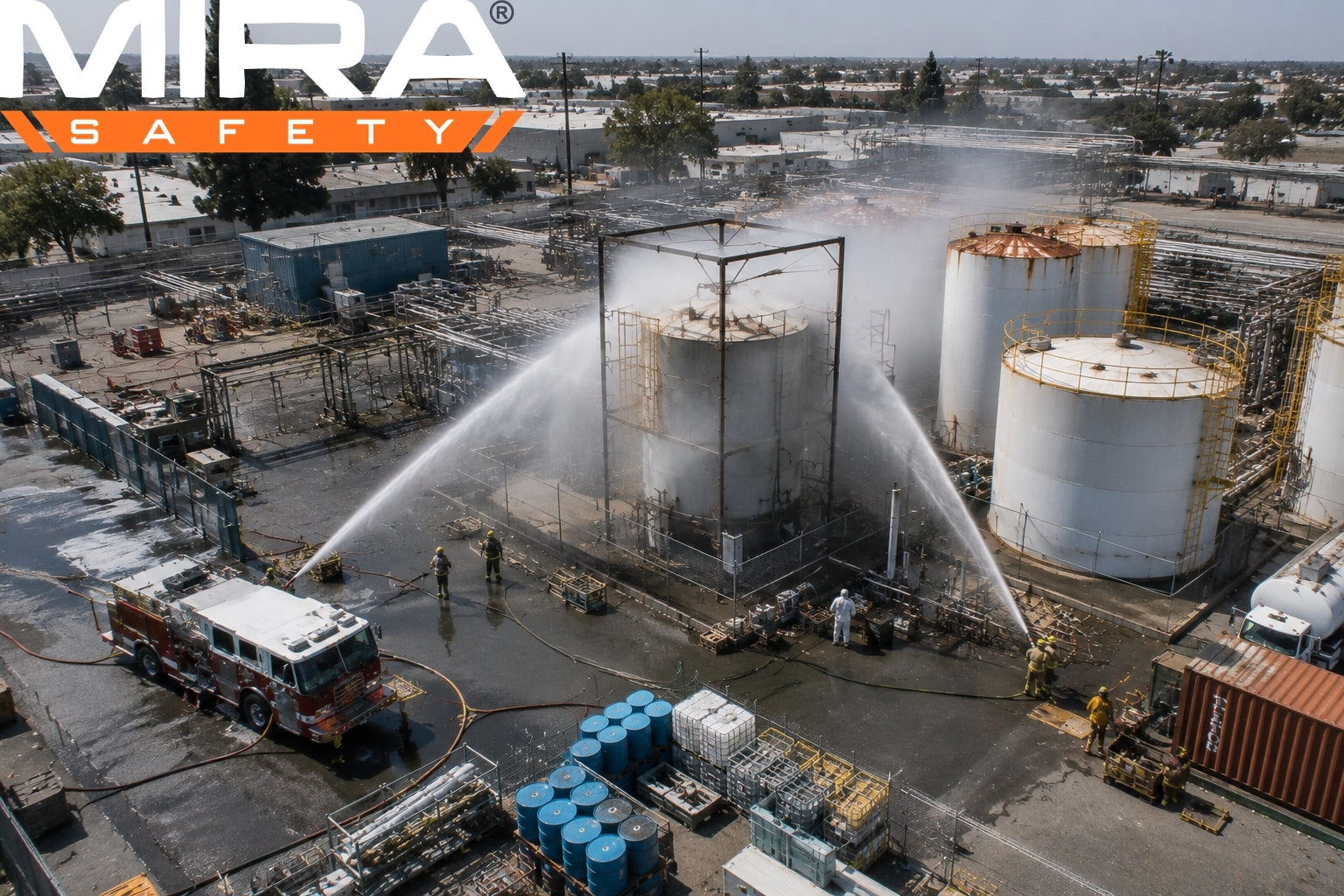
Primary image photo credit: Ev Buchanan
Editor's note: This article is based on publicly available reporting from official sources, news outlets, and the Orange County Fire Authority as of Sunday, May 24, 2026. The situation is active and evolving. We will update this piece as new information becomes available. The intent is to provide clear guidance and useful context to anyone who needs it.
As of this weekend, 50,000 people in Orange County are out of their homes. They don't know when they're going back.
A 34,000-gallon chemical tank at the GKN Aerospace facility on Western Avenue in Garden Grove started overheating on Thursday afternoon. The chemical inside is methyl methacrylate, a flammable liquid used to make the clear acrylic windshields and canopies on military and commercial aircraft. The valves on the tank are broken. Crews can't relieve the pressure. The internal temperature has climbed from 77 degrees to 90 degrees and is rising about one degree per hour.
Orange County Fire Authority Division Chief Craig Covey put the two outcomes plainly in a Friday briefing: the tank cracks and spills 6,000 to 7,000 gallons of "very bad chemicals" into the parking lot, or it goes into thermal runaway and explodes.
Governor Gavin Newsom declared a state of emergency Saturday. The evacuation zone covers nine square miles across parts of six cities: Garden Grove, Stanton, Westminster, Cypress, Buena Park, and Anaheim. About 15% of residents in the zone have refused to leave. No injuries reported so far. Air monitoring stations around the zone are reading clean.

Photo credit: Mira Safety
What's happening, in order
-
Thursday, May 21, around 3:30 PM. Orange County Fire Authority responds to reports of vapor venting from the tank. Initial evacuations were issued, then lifted that night when conditions improved.
-
Friday. Crews discover the tank's valves are damaged. They can't remove the chemical or relieve pressure. Evacuations reinstated and expanded.
-
Friday night. Firefighters and a chemist team go in to attempt stabilization. They get a direct reading on the internal temperature: 90 degrees, higher than drone readings had suggested.
-
Saturday. Newsom declares a state of emergency. The evacuation zone expands to roughly 50,000 residents. Tank temperature continues to climb.
-
Sunday morning. Crews continue dousing the tank with water in hopes of slowing the chemical reaction. Authorities are now considering a third outcome: that the chemical solidifies from the outside inward, like an ice cube freezing, which would buy them time.
What is methyl methacrylate?
Methyl methacrylate (MMA) is a clear, colorless liquid with a fruity odor. Industrial users make it into acrylic plastics, dental resins, and the high-clarity transparencies used in aircraft windshields and canopies.
MMA is CAS 80-62-6, with a boiling point of 100.5°C and a vapor density of 3.45, meaning the gas is heavier than air and settles low. OSHA's permissible exposure limit is 100 ppm over an 8-hour shift; NIOSH sets the IDLH (immediately dangerous to life or health) threshold at 1,000 ppm. The EPA's Acute Exposure Guideline Level AEGL-2 for MMA is 38 ppm over 60 minutes, the value authorities use to draw evacuation distances.
The failure mode in a tank like this one is typically depletion of the polymerization inhibitor MEHQ (4-methoxyphenol), which normally prevents the monomer from bonding with itself. Once inhibitor protection drops, heat accelerates polymerization, and polymerization accelerates heat. That feedback loop is the thermal runaway authorities are racing.
|
Threshold |
Value |
What it means |
|
Odor threshold |
0.21 ppm |
Most people can smell MMA well below harmful levels |
|
EPA AEGL-2 (60 min) |
38 ppm |
Threshold authorities use to draw evacuation distances |
|
OSHA PEL (8-hr TWA) |
100 ppm |
Maximum legal workplace exposure averaged over a shift |
|
NIOSH REL (8-hr TWA) |
100 ppm |
NIOSH recommended exposure limit |
|
NIOSH IDLH |
1,000 ppm |
Immediately Dangerous to Life or Health |
The chemistry making this dangerous is the same chemistry that makes MMA useful: it polymerizes. Under heat, pressure, or contamination, the liquid bonds with itself and turns into solid acrylic. The reaction releases heat. The heat triggers more reactions. In a controlled industrial process, that's how you make plexiglass. In a 34,000-gallon tank with broken valves, that's how you get a thermal runaway.
Acute health effects of MMA exposure, per the EPA and the Orange County Health Care Agency: respiratory irritation (throat, nasal passages, lungs at higher exposures), headache, dizziness, lightheadedness, skin and eye irritation. At high concentrations: severe respiratory distress, unconsciousness, and the potential for lasting injury. The odor threshold is very low, so people can smell it long before it reaches harmful concentrations. As Orange County Health Officer Dr. Regina Chinsio-Kwong put it on Saturday: "We're going into unique times, and we have limited information."
What officials are telling residents right now
The current guidance is direct.
If you live inside the evacuation zone (north of Trask Avenue, south of Ball Road, east of Valley View Street, west of Dale Street), evacuate. Shelters are open at Golden West College, Freedom Hall, Savanna High School, John F. Kennedy High School, Oceanview High School, and the Garden Grove Sports and Recreation Center. All Planet Fitness locations in Orange County are open to evacuees and first responders without a membership.
If you are not in the evacuation zone, Dr. Chinsio-Kwong's guidance is direct: you do not need a mask. Air quality outside the zone is being monitored continuously and reading clean. The evacuation boundary was drawn around the worst-case scenario including a potential explosion.
That's the truth of the moment. What we want to address next is what comes after, because the conditions that led to Garden Grove are not unique to Garden Grove.
What to do if you're in or near the Garden Grove evacuation zone right now
If you live inside the evacuation boundary, leave. The 15% refusal rate reported by Garden Grove Police is exactly the population that would be hardest to help if the situation goes the wrong way. Shelters have capacity. The Red Cross is on site. Bring pets.
If you live just outside the boundary, monitor official channels. The Garden Grove 24-hour emergency hotline is 714-741-5444. The Orange County Public Information Hotline is 714-628-7085. The Orange County Fire Authority is posting updates on X at @OCFireAuthority and has been the most timely source.
If you live elsewhere in Southern California, you are not at risk from this specific event. The bigger question is whether the gear you have at home would be enough if a similar event happened in your zip code next month.
This isn't the first one, and it won't be the last
Industrial chemical incidents in residential areas have been climbing for years. The 2023 East Palestine, Ohio train derailment dumped 115,000 gallons of vinyl chloride across a small town. The Houston petrochemical fires. The Texas plant explosions.
Further back, the reference cases for residential chemical exposure include Bhopal (December 1984, methyl isocyanate release from a Union Carbide plant, thousands killed), West Fertilizer Co. (West, Texas, April 2013, ammonium nitrate detonation, 15 dead), and the Phillips 66 Pasadena explosion (October 1989), the closest historical analog to a thermal-runaway industrial event in a populated corridor. The US Chemical Safety Board (CSB) is the federal body that investigates incidents in this class, alongside OSHA and the EPA.
|
Incident |
Date |
Chemical |
Casualties |
Lesson |
|
Bhopal, India |
Dec 1984 |
Methyl isocyanate (Union Carbide) |
3,000+ killed acutely |
Worst industrial chemical disaster; residential proximity made it lethal |
|
Phillips 66, Pasadena TX |
Oct 1989 |
Ethylene/isobutane vapor cloud |
23 killed, 314 injured |
Closest analog to thermal-runaway industrial explosion in a populated corridor |
|
West Fertilizer Co., TX |
Apr 2013 |
Ammonium nitrate detonation |
15 killed, 200+ injured |
Industrial facility next to homes and a school; zoning gap |
|
East Palestine, OH |
Feb 2023 |
Vinyl chloride (Norfolk Southern derailment) |
0 immediate deaths |
Rail-borne chemicals in residential towns; reactive public guidance |
|
Garden Grove, CA |
May 2026 |
Methyl methacrylate (GKN Aerospace) |
0 reported, 50,000 evacuated |
Aerospace supplier in suburban corridor; thermal runaway risk |
Garden Grove is a Southern California suburb next to Disneyland, not a chemical industrial district. The GKN Aerospace facility has been there for more than 30 years, and most residents under evacuation orders had no idea what was inside the tanks until this week. The next event won't be in Garden Grove. It'll be in another town nobody expected.
Where this guidance comes from
MIRA Safety® has manufactured CBRN-grade protective equipment for over a decade. Our gear is used by military and government end users, professional first responders, and civilian preparedness customers across the country. We've covered the East Palestine train derailment, wildfire smoke events, civil unrest deployments, and other chemical incidents in our blog over the years. What follows is the gear category breakdown for the type of threat Garden Grove falls into.
What real preparedness looks like for a chemical event
Preparedness for chemical emergencies is not complicated. Four pieces: a sealed-airway protection system for everyone in the household, the right filter for the threats you're realistically likely to see, the ability to move quickly if you need to evacuate, and the information to know when to use any of it.
A full-face respirator for every family member
Chemical vapors that irritate the eyes (and MMA is one of them) make half-face masks a non-starter for serious chemical exposure. You need a full-face mask that creates a continuous seal from the hairline to under the chin.
The CM-8M® Full-Face Respirator is MIRA Safety®'s entry-level full-face mask. It uses the 40mm NATO threaded filter port standardized across most modern civilian gas masks, which means filters cross over between masks within a household kit. The CM-6M® Tactical Gas Mask adds a panoramic visor, dual filter mounts, and an integrated drinking system. The C21® Full-Face Respirator uses bromobutyl rubber for extended service life. The CM-I01® Full-Face Respirator is MIRA's industrial and general-purpose full-face mask, built for workplace and household chemical applications, with a 10-year shelf life and a five-point adjustable harness for extended wear.
Adult masks don't fit children. Standard adult sizes don't seal on small faces, and breathing resistance is too high for small lungs. The children's gas masks collection and baby gas masks collection cover that gap. If you have kids and an adult mask, you don't have a complete kit.
Protection for pets, because they're part of the household
Pets get left out of most chemical preparedness conversations, which is strange given that they're closer to the ground (where heavier-than-air chemicals like methyl methacrylate settle), they breathe faster than adults, and they can't tell you when something is wrong until they're symptomatic. The Animal ARK® Dog Gas Mask is MIRA Safety®'s protection system built for dogs: a sealed enclosure with filtered air, sized to actually fit a real dog's head. The broader gas masks for pets collection covers other species. Animals are family. The kit should reflect that.
The right filter for the threats you'll actually face
The mask is the platform. The filter is the protection. A great mask with the wrong filter leaves the same gap as no mask at all. MIRA Safety® makes three filters worth knowing about for chemical and industrial threats.
The NBC-77 SOF® Filter is the workhorse. 40mm NATO threaded, designed for broad CBRN coverage, with a 20-year shelf life when stored sealed in vacuum packaging. The starting point for most household kits and the filter that handles the widest range of realistic threats: chemical industrial events, biological hazards, radiological particulates, nuclear fallout byproducts.
For MMA specifically: methyl methacrylate is an organic vapor with a boiling point of 100.5°C, which places it in EN 14387 Class A filter territory (the brown color code reserved for organic vapors with BP above 65°C). The NBC-77 SOF® cartridge combines A-class organic vapor adsorption with B (inorganic), E (acid gas), K (ammonia), P3 (particulate), and reactor/special bands. That is why a single CBRN cartridge covers MMA alongside named chemical warfare agents (sarin, VX, sulfur mustard, chlorine) and radiological particulates (cesium-137, iodine-131 fallout dust).
|
Color |
Class |
Protects against |
Present in MIRA Safety® filters |
|
Brown |
A |
Organic vapors (BP >65°C): MMA, solvents, fuels |
NBC-77 SOF®, NBC-17 SOF®, DOTPro 330®, VK-530® |
|
Gray |
B |
Inorganic gases: chlorine, hydrogen cyanide |
NBC-77 SOF®, NBC-17 SOF®, DOTPro 330® |
|
Yellow |
E |
Acid gases: sulfur dioxide, hydrogen chloride |
NBC-77 SOF®, NBC-17 SOF®, DOTPro 330® |
|
Green |
K |
Ammonia and amine derivatives |
NBC-77 SOF®, NBC-17 SOF®, DOTPro 330® |
|
White |
P3 |
Particulates: radiological dust, aerosols, biological |
All MIRA Safety® CBRN filters |
|
Red |
Reactor |
Radioactive iodine (I-131) and methyl iodide |
NBC-77 SOF®, NBC-17 SOF® |
|
Special |
CBRN |
Low-boiling organics and named CWAs (sarin, VX, mustard) |
NBC-77 SOF® (CBRN-rated) |
The NBC-17 SOF® Filter is the compact version of the NBC-77 SOF. Same broad coverage profile, smaller form factor, lighter carry weight. The right choice for go-bags, travel kits, and situations where you'll be wearing the mask for hours rather than minutes.
The DOTPro 330® rounds out the lineup as the heavier-duty industrial option, built for higher-intensity chemical scenarios. Worth considering for households closer to industrial corridors, petrochemical facilities, or transportation routes where the threat profile skews toward concentrated industrial chemicals.
Most household kits start with the NBC-77 SOF, two filters per person, stored sealed. From there, you build out based on what's actually near your zip code. Our gas mask filter buyer's guide covers the full breakdown.
Grab-and-go kits for households that haven't built a full setup
For households that want a sealed, ready-to-deploy option without piecing a kit together component by component, MIRA Safety® makes two pre-built evacuation kits, making it easier and safer to evacuate your home for these emergencies.
The EvakPak® is built around the CM-6M® Tactical Gas Mask. The kit includes an NBC-77 SOF filter for broad CBRN coverage, a VK-530® filter built for smoke and carbon monoxide (the threat profile in fire-related scenarios), MIRA potassium iodide tablets for nuclear contamination scenarios, and a camo drop-leg pouch that mounts to the thigh for fast deployment.
The EvakPak Plus® uses the CM-8M® Full-Face Respirator instead of the CM-6M, includes the same NBC-77 SOF® and VK-530® filter combination, the same KI tablets, and ships in a military-style gas mask bag with adjustable straps and multiple compartments instead of the drop-leg pouch. Both share the 40mm NATO filter thread, so filter inventories carry over between kits.
The point of either kit is that it's ready before you need it. The Garden Grove timeline from initial vapor release to mandatory evacuation of 50,000 people was under 48 hours. That's not enough time to research, order, and learn a new piece of equipment.
The information piece, which most people skip
All the gear in the world doesn't help if you don't know when to use it. Worth knowing in advance:
-
Your local emergency notification system. Most counties run reverse-911 alerts and SMS notifications, but you usually have to opt in.
-
The closest industrial facilities to your home. The EPA's Toxics Release Inventory and your state's hazardous materials transportation routes are publicly searchable.
-
Which way the prevailing wind goes. In a release scenario, downwind is the bad direction.
-
Two evacuation routes out of your neighborhood, not one. The main route jams in every real event.
What to do after a chemical exposure event
If you've been near a chemical release, even briefly, the period right after matters. Residue settles on clothing, skin, and exposed surfaces. Carrying it indoors carries the exposure with you.
The basic decontamination sequence:
-
Strip outer layers before going inside. Don't bring contaminated clothing into your home.
-
Bag the clothing in sealed plastic for separate washing or disposal.
-
Rinse with cool water before warm. Hot water increases skin absorption of chemical residues. A cool rinse first removes surface contamination before you transition to a regular shower.
-
Wash hair separately. The scalp holds residue.
-
Air out belongings (bags, shoes, electronics) outside for several hours before bringing them in.
-
Watch for delayed symptoms over the next 24 to 48 hours. Headache, throat irritation, dizziness, or respiratory issues that develop later are worth a medical visit.
Building a decon kit alongside your gas mask setup
Most household preparedness kits focus on protection during an event (mask, filter) and skip the decontamination piece for after. MIRA Safety® makes purpose-built decon gear that handles each step of the cleanup sequence.
The CWD Detection Paper® verifies whether you or your gear actually got contaminated. Useful for telling the difference between "I think I was exposed" and "I was actually exposed," which matters when you're deciding whether to do a full decon or just rinse off.
The MDG-1® Personal CBRN Decontamination Glove is built for the immediate "I need to get this off my hands and arms" moment. Pre-treated, sealed, ready to use in the field without water or setup.
The DeconDust® Dry Decontamination Powder absorbs liquid chemical agents off skin and gear without needing water. Useful in the first minutes after exposure, before you have access to a shower or sink.
The CBRN Decontamination Wipes handle wiping down skin, equipment, and gear after primary decon. Self-contained, no water required, designed for use in the field.
The DS-1® Portable Decontamination Shower is for full-body rinse when you don't have access to indoor plumbing or you don't want to bring contamination into the house. Sets up outdoors and lets you do a proper decon shower before going inside.
None of these are required for a basic preparedness kit. They become relevant when your threat model includes actually being exposed, not just protecting against exposure. Households in industrial corridors, transportation routes, or anywhere within a few miles of a chemical facility are the ones who should think about adding decon gear alongside the mask and filter.
Where to follow the situation
The reporting on this incident has been strong across multiple outlets. Recommended sources for ongoing coverage:
-
Orange County Fire Authority (@OCFireAuthority on X). Official and timely.
-
ABC7 Los Angeles live blog. Frequent updates and local context.
-
KTLA. Strong on the blast zone map and evacuation logistics.
-
Orange County Register. Best for regulatory history and GKN Aerospace background.
-
Los Angeles Times. Strong on long-term policy implications.
Frequently asked questions
What is methyl methacrylate?
Methyl methacrylate (MMA) is a clear, flammable liquid chemical used to manufacture acrylic plastics, dental resins, and the high-clarity transparencies used in aircraft windshields and canopies. It has a fruity odor and is heavier than air. Exposure can cause respiratory irritation, dizziness, nausea, and at high levels severe respiratory distress.
Do I need a gas mask if I live in Orange County but outside the evacuation zone?
According to Orange County Health Officer Dr. Regina Chinsio-Kwong, if you are not inside the evacuation boundary, you do not need a mask for this specific event. Air monitors across the affected area are reading clean. The evacuation zone was drawn around the worst-case scenario including a potential explosion.
What is the evacuation zone for the Garden Grove chemical tank?
The evacuation zone covers approximately nine square miles, bounded by Trask Avenue (south), Ball Road (north), Valley View Street (west), and Dale Street (east). It includes portions of Garden Grove, Stanton, Westminster, Cypress, Buena Park, and Anaheim. Around 50,000 residents are under evacuation orders.
How can I prepare for a chemical incident in my own area?
Four pieces: a full-face mask for every family member (including children's-specific gear for kids and pet protection for animals), a filter rated for the threats you'd realistically encounter, the ability to evacuate quickly, and information on your local industrial facilities and emergency alert systems. Our gas mask buyer's guide covers the gear side.
The bottom line
Garden Grove ends one of three ways. The chemistry solidifies and the tank holds. The tank cracks and 7,000 gallons spill into a contained parking lot. Or the tank explodes.
Whichever ending plays out, the lesson is the same. The 50,000 people in shelters this weekend didn't choose to learn about methyl methacrylate. They learned because a tank failed three miles from Disneyland. The households that come through events like this best are the ones who built basic protective capability before the news started running.
If you want to look at the gear, the MIRA Safety® gas mask lineup and filter inventory are the starting points. If you're new to the category, the types of gas masks guide walks through what each kind of mask is built for.


